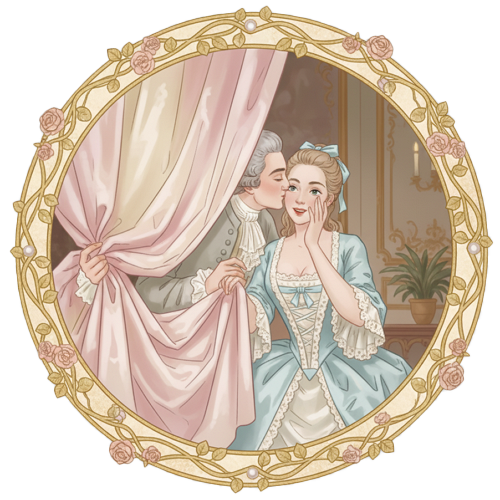
The morning after the kiss was a study in silence. The canyon, usually alive with the chittering of wrens and the hum of insects, seemed to be holding its breath.
Or perhaps it was only Beatrice who was. She worked with a frantic, focused energy, using the cool dawn air to sketch the Ghost Lily in her journal.
Every stamen, every delicate vein on its translucent petals, was a refuge from the memory of Wes Callahan’s lips on hers—a memory that was as wild and unsettling as the landscape itself.
She meticulously recorded her observations, her quill scratching a sharp counterpoint to the quiet. Lilium phantasma. Petals exhibit a unique cellular structure, allowing for bioluminescence in low light. Pollination mechanism currently unknown.
The familiar Latin terms were a balm, a return to the orderly world of Boston academia. In that world, feelings were categorized, dissected, and filed away.
They were not a raw, thrumming presence that left one’s skin feeling both scorched and chilled.
Wes was a shadow at the edge of her camp, sharpening a knife with long, deliberate strokes of a whetstone. The rhythmic shhhk-shhhk of steel on stone was the only sound he made.
He hadn’t spoken a word about the kiss, and neither had she. He had retreated behind a wall of stoicism so absolute it made his earlier contempt seem warm by comparison.
When their eyes met, he looked away, his jaw tight. He was a man wrestling with a complication he neither wanted nor understood, and Beatrice felt a pang of something uncomfortably close to empathy. She, too, was wrestling.
To escape the suffocating tension, she took her notebook and headed toward the small, clear creek that was the canyon’s lifeblood. “I am going to measure the water’s salinity and take samples of the riparian flora,” she announced to his broad back, her voice overly formal.
He grunted in acknowledgment without turning.
Beatrice knelt by the water’s edge, her boots sinking slightly into the damp, loamy soil. It was here, amongst the ferns and mosses that thrived in the creek’s spray, that the delicate equilibrium of the canyon was most apparent.
She dipped a finger in the water. It was cool, but not as cold as it had been two days ago.
And the current, she noted, seemed… sluggish. Less vibrant.
She frowned, turning her attention to a cluster of maidenhair ferns. Their fronds, usually a lush, vibrant green, were tinged with brown at the tips, their delicate leaves slightly curled, as if in thirst.
It was subtle, something a casual observer would never notice, but to her trained eye, it was an alarm bell.
“Wes,” she called out, her voice tight with a sudden, inexplicable worry.
He was beside her in an instant, his silence replaced by an alert stillness. He didn’t ask what was wrong; he simply followed her gaze, his eyes scanning the creek, the rocks, the plants, with an intensity that missed nothing.
“The water level,” she said, pointing to a dark, wet line on a boulder a good two inches above the current surface. “It’s dropped.”
Wes crouched, his hand hovering over the water as if taking its pulse. He scooped some of the silty mud from the bank, rubbing it between his thumb and forefinger.
His expression, already grim, darkened into a thunderhead. “It’s slowing. Dying.”
“But how? There’s been no drought,” Beatrice protested, her mind racing through potential natural causes.
A rockslide? A shift in an underground spring? Nothing made sense.
“This ain’t nature,” Wes said, his voice a low growl.
He stood and looked upstream, toward the narrow passage where the creek entered their hidden sanctuary. “This is a man.”
The word hung in the air between them, heavy and ugly. Croft.
The awkwardness of the morning vanished, consumed by a new and terrible urgency. There was no more hesitation, no more stolen glances.
They were a team again, united by a common threat.
“We have to go upstream,” she said, already gathering her satchel.
“Stay here,” he commanded. “It could be his men.”
“No,” Beatrice replied, her tone leaving no room for argument.
“This is about the entire ecosystem. I need to see the extent of the damage. I will not be left behind like some damsel.”
A flicker of something—annoyance, or perhaps grudging respect—crossed his face. He gave a curt nod. “Keep close.”
They moved up the canyon, following the diminishing creek. The further they went, the more pronounced the signs of distress became.
The vibrant green turned to a sickly yellow-brown. The banks, once soft and muddy, were cracked and dry.
The water trickled where it once flowed, pooling in stagnant, lukewarm puddles that buzzed with desperate insects. The canyon felt ill, feverish.
Beatrice’s scientific mind cataloged the devastation with a cold horror, but her heart ached. In a few short days, this hidden paradise had become a part of her.
It was the place where she had felt the thrill of discovery, the humbling awe of nature, and the terrifying, exhilarating pull of attraction to the man now walking grimly ahead of her. To see it being strangled was a physical pain.
After nearly an hour of climbing over rocks and pushing through wilting brush, they heard it: the dull, rhythmic thud of axes against wood and the guttural shouts of men. Wes held up a hand, and they slowed their approach, using a thicket of junipers for cover.
Peering through the branches, Beatrice felt a wave of cold fury wash over her. There, wedged into the narrowest point of the canyon, was a crude, brutal structure of felled logs, packed earth, and rocks.
A dam. It was an ugly gash on the landscape, a muddy scar holding back the water that was the canyon’s very soul. On the other side, a stagnant lake was already forming, drowning the upstream vegetation.
On their side, the creek bed was little more than a damp stain on the rocks.
Three of Croft’s men were working on it, reinforcing a section with fresh mud. They were the same men who had confronted them on the trail, their faces smug with the casual cruelty of hired muscle.
“He’s choking it,” Wes whispered, his voice dangerously low.
“He’s choking the canyon to kill it off. Make it seem worthless so no one will question him when he fences it.”
Beatrice’s mind spun, connecting the terrible dots. Croft wasn’t just trying to drive them away. He was engaging in scorched-earth tactics.
If he couldn’t have the land, he would ruin it. He would destroy the water source, turning the lush canyon into a barren gulch, and the Ghost Lily—a species that relied on the unique, constant humidity of this microclimate—would be the first casualty.
Her father’s cure. Her scientific legacy.
The sacred flower of Wes’s ancestors. All of it would turn to dust.
“How long do we have?” she asked, her voice trembling with a rage that surprised her. This was no longer a matter of academic curiosity.
It was a declaration of war.
Wes surveyed the dam, his Ranger’s eye assessing its structure, its weaknesses, its purpose.
“The lilies? A week, maybe less in this heat. The whole canyon… a month before it’s irreversible.”
The finality in his tone was like a physical blow. All her life, Beatrice had fought her battles in sterile lecture halls and dusty libraries, her weapons being logic, evidence, and peer-reviewed papers.
She had never faced a problem that could be solved only with action, with risk, with a fight.
She looked at the dam, at the ignorant men defiling this sacred place. She thought of Silas Croft, a man who would poison a miracle just for a few more acres of dust for his cattle.
And she thought of the delicate, glowing flower downstream, a testament to millions of years of evolution, being casually snuffed out by greed.
The shy, uncertain woman who had arrived in Redemption felt like a distant memory. In her place was someone harder, clearer.
They retreated back into the cover of the rocks, the sounds of destruction fading behind them. The silence that fell between them now was different.
It wasn’t the awkward silence of unspoken feelings, but the heavy, charged silence of a shared and terrible understanding. The side plot of their lives had just crashed into the main one.
Silas Croft was no longer a peripheral threat; he was the primary obstacle to everything they both held dear.
Wes stopped and turned to face her, his eyes the color of a stormy sky. The guarded walls were gone, replaced by a raw, cold fury that mirrored her own.
“He wants to erase this place,” Wes said. “He wants to pretend it never existed.”
“We cannot let him,” Beatrice stated. It wasn’t a question. It was a vow.
Her quest for a rare flower, a mission to save her father and prove her worth, had become something infinitely larger.
It was now a fight to save this land. Her scientific journey and Wes’s role as its guardian were now inseparable.
“To save the flower,” she said, meeting his intense gaze without flinching, “we have to fight the man.”
A grim smile touched Wes’s lips, devoid of any humor but filled with a lethal purpose. “That’s the first thing you’ve said all day that makes perfect sense, Boston.”
The emotional chasm of the morning was gone, bridged by the ugly reality of Croft’s dam. They stood together, no longer just a botanist and her guide, but allies facing a common enemy.
The true thorny bargain had just begun.