The first light of dawn was a shy, watercolor wash of lavender and rose against the canyon’s high stone walls. It crept into their camp softly, touching the embers of last night’s fire and illuminating the fine, silvery hairs on the leaves of a nearby sagebrush.
For Beatrice, it felt like an intrusion, a quiet accusation. The world was waking up to a day she did not know how to face.
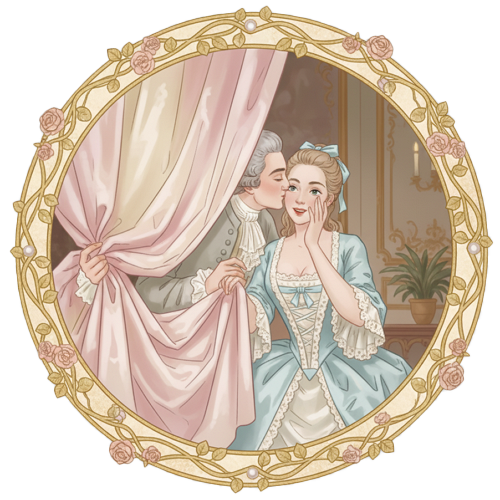
She had slept in fits and starts, the phantom press of Wes’s lips a constant, disorienting presence. The memory was not a gentle one. It was raw, demanding, and tasted of campfire smoke, desperation, and a wildness she had only ever read about in forbidden novels.
The kiss had been an earthquake, cracking the foundations of the carefully constructed world she inhabited.
When she finally emerged from her bedroll, her movements stiff and deliberate, she found Wes already awake. He was hunkered by the fire, a tin cup of coffee cradled in his hands, his gaze fixed on the canyon entrance.
He didn’t look at her. The easy, if often contentious, rhythm they had fallen into was gone, replaced by a silence as profound and unbreachable as the rock surrounding them.
“Good morning,” she said, her voice sounding unnaturally formal in the quiet air.
He gave a curt nod, his eyes never leaving the rim of the canyon. “Coffee’s made.”
That was it. No gruff commentary on her sleeping late, no sardonic remark about Boston ladies and their need for beauty rest.
Just a flat statement of fact. He was a stranger again.
Worse than a stranger—he was a man with whom she had shared a moment of shocking intimacy, and who now acted as if she were a piece of the landscape.
Beatrice poured herself a cup, the bitter, smoky aroma a familiar comfort. She tried to organize her thoughts as a scientist would, to classify the event and file it away.
Anomalous reaction due to heightened emotional state. Cause: discovery of Lilium phantasma. Contributing factors: isolation, shared danger, physiological stress. Conclusion: a momentary, regrettable lapse in professional decorum.
But the tidy explanation fell apart the moment she risked a glance at him. The set of his jaw was harder than usual, the lines around his eyes etched deeper.
He wasn’t merely being professional; he was fortified, a fortress of muscle and silence. He was angry.
Not at her, she suspected, but at himself. He had breached his own defenses, and the retreat was swift and absolute.
She wrestled with a storm of her own emotions. The Beatrice Kincaid of Boston, the one who presented papers to sneering male academics and debated the finer points of plant morphology over Earl Grey tea, would be appalled.
Utterly, incandescently scandalized. A kiss, with an uneducated, uncivilized guide in the middle of the wilderness?
It was a ruinous breach of propriety. It was a confirmation of every fear her colleagues held about women in the field—that they were susceptible to hysterics and emotion, incapable of detached, scientific pursuit.
But the woman who stood in this hidden canyon, her hands calloused and her face smudged with dirt, was not entirely that Beatrice Kincaid. This woman felt something else.
A dizzying, terrifying thrill. A sense of being truly seen, not as a collection of theories and ambitions, but as a woman.
The memory of his hands, calloused and strong, cupping her face, sent a shiver through her that had nothing to do with the morning chill.
She had to regain control.
For her father. For her career. For her own sanity.
“Mr. Callahan,” she began, her tone crisp and business-like.
“I would like to begin documenting the lily’s immediate habitat this morning. I’ll need to take soil samples, measure the ambient humidity, and sketch the surrounding flora to understand the symbiotic relationships at play.”
He finally turned to look at her, his eyes dark and unreadable.
For a fleeting second, she saw a flicker of something—regret? confusion?—before it was extinguished.
“Fine,” he said, his voice flat. He rose to his feet, tossing the dregs of his coffee into the fire.
“I’ll scout the upper ledge. Yell if you see anything that isn’t a lizard.”
He picked up his rifle, the motion economical and practiced, and strode away without another word. The space he left behind felt cavernously empty.
He was putting a chasm between them, deliberately re-establishing the roles of employer and employee. She knew she should be grateful. It was what she needed, what was proper.
But it felt like a punishment.
Beatrice set to work, forcing her mind into the familiar channels of scientific observation. She knelt beside the patch of Ghost Lilies, their spectral white petals seeming to absorb the morning light.
With her instruments, she became the botanist once more. She measured, she recorded, she sketched.
Her journal filled with precise notations: Soil composition: high in loam and decomposing organic matter. pH level: slightly acidic. Exposure: north-facing slope, receiving approximately four hours of indirect sunlight daily.
The meticulous work was a balm, a shield against the turmoil inside her. Here, in the ordered world of data and evidence, she was safe.
Here, there were rules. A leads to B. Cause and effect.
Nothing like the chaotic, unpredictable wilderness of human emotion.
An hour passed, then two. The canyon warmed under the strengthening sun.
Beatrice was so engrossed in cataloging the minute hairs on a lily’s stamen that she didn’t hear Wes return. One moment she was alone, the next his shadow fell over her journal.
She gasped, startled, and looked up. He stood over her, his expression impassive.
“Nothing on the ridge,” he reported, his voice low. “No sign of Croft’s men. No new tracks.”
“Thank you,” she said, her heart thumping against her ribs. She was acutely aware of his proximity, of the scent of leather and dust that clung to him.
The air between them felt thick, charged with unspoken words.
She tried to focus back on her work, but her concentration was shattered. Her hand trembled slightly as she tried to continue her sketch.
He remained where he was, a silent, brooding statue. It was unnerving.
“Is there something you require, Mr. Callahan?” she asked, not looking up.
“You’re going to need a live specimen,” he said. It wasn’t a question. “One to take back.”
“Yes. A rhizome, carefully packed. I will have to simulate its native soil conditions as closely as possible for the journey.”
“There’s a smaller one, over there.” He gestured with his chin toward a rockier patch.
“Growing separate from the main cluster. Taking that one will do less damage to the colony.”
She looked where he indicated. It was a perfect choice—a young, healthy plant, but isolated enough that its removal wouldn’t disrupt the delicate balance of the main group.
He had been watching her, observing her work, understanding her needs even through the wall of silence he had erected. The thought was both comforting and deeply unsettling.
“An excellent suggestion,” she said quietly. “Thank you.”
She gathered her trowel and a collection tin, and moved toward the plant. The ground was uneven, slick with moss near a trickle of water seeping from the rock face.
As she reached for the lily, her boot slipped. She cried out, flailing for balance, but her ankle twisted beneath her.
Before she could fall, a hand shot out and clamped around her upper arm, steadying her. Wes’s grip was like iron.
He hauled her upright, his body flush against hers for a dizzying second. She could feel the solid wall of his chest, the heat of him through her thin blouse.
The world narrowed to that single point of contact, to the strength in his fingers, to the sudden, ragged intake of his breath.
He released her as if her skin had burned him. They sprang apart, leaving a yard of crackling, empty space between them.
“Watch your step,” he rasped, his voice rougher than before. He turned away abruptly, presenting her with his rigid back.
Beatrice stood frozen, her hand pressed to her chest, trying to calm the frantic beat of her heart. The professional arrangement was a farce.
The scientific detachment was a lie. They were a man and a woman, trapped in a canyon thick with unspoken desire, and every attempt to ignore it only made it more potent.
The rest of the day passed in a similar state of excruciating tension. They worked, they ate, they drank, all with a minimal exchange of words.
But the silence was no longer empty; it was filled with the memory of the kiss, with the jolt of his touch, with the things they desperately wanted to say and couldn’t. Her secondary conflict, the battle between her Boston society and his wilderness ways, had evaporated.
The new war was entirely within herself—a battle between the person she was supposed to be and the woman this harsh, beautiful land and this impossible, infuriating man were forcing her to become.
That evening, as they sat on opposite sides of the fire, the flames painting dancing shadows on the canyon walls, Beatrice looked at him. He was sharpening his knife on a whetstone, the rhythmic shhhk, shhhk, shhhk the only sound besides the crackling wood.
His focus was absolute, his face a mask of concentration.
Their bargain had indeed been thorny, she thought. She had agreed to his rules, to his guidance.
But she had never bargained for this. She had never bargained for her own heart to become the most treacherous and unknown territory of all.