The silence in the comms room was a thick, heavy blanket, suffocating the low hum of the servers.
It had been two hours since Alistair had left, two hours since Vivi had laid the ghost of her former self bare on the table between them, her confession a fragile offering next to his.
The story of his mentor, the weight of the station’s legacy—it had settled into the architecture of his face, carving new lines of purpose and pain around his eyes.
She had seen him then, truly seen him, not as a warden or a skeptic, but as a man clinging to the last spar of a ship he refused to let sink.
And she, in turn, had given him her own shipwreck.
The loss of her ‘nose’ was a simple, clinical phrase for the hollowing out of her soul.
She hadn’t just lost a career; she had lost the language she used to speak to the world, the filing system for her own heart.
A memory of her mother was no longer the scent of vanilla and lavender; it was a faded photograph, two-dimensional and silent.
Now, sleep was an impossible proposition.
The recycled air of the station felt too close, too contained.
Her mind, buzzing with caffeine and emotional exhaustion, craved the vast, clean emptiness of the outside.
Pulling on her parka, the one Alistair had once sneered at, she stepped out into the brutal, beautiful night.
The cold was a physical blow, a shock that jolted her senses awake.
It scoured her lungs and tightened the skin on her face, a raw and honest sensation in a world that had become muted.
And then she looked up.
The sky was on fire.
Great, silent ribbons of light rippled across the canvas of the cosmos.
Emerald green bled into shimmering violet, twisting and folding in on themselves like celestial silk.
The aurora borealis.
It was not a static painting but a living, breathing entity, a spectacle of such profound and silent majesty that it stole the air from her lungs.
She stood, head tilted back, a small, insignificant figure beneath an impossible sky, feeling the vibrations of its beauty not in her nose, but in the marrow of her bones.
Here, in this place of absolute zero, where scent went to die, was a visual symphony so overwhelming it felt like a scent.
It was the color of frozen mint, the shimmer of ozone, the deep, resonant hum of a world far beyond her own.
She imagined assigning it notes: a top note of crisp, electric air, a heart of ethereal, glowing florals, and a base of ancient, cold stone.
The exercise was a familiar comfort, a ghost of a habit, but tonight it felt less like a loss and more like a translation.
The crunch of boots on snow broke the spell. She didn’t need to turn. She knew the deliberate, heavy tread.
Alistair came to a stop beside her, a respectful distance between them.
He didn’t speak, just followed her gaze upward, his own face illuminated by the phantom green glow.
The light softened the hard angles of his jaw, pooling in the hollows of his cheeks.
The exhaustion was still there, but it was overlaid with something else—a raw, unguarded wonder.
For a long time, they just stood, two solitary figures sharing an immense, silent spectacle.
The universe danced for them, and the petty anxieties of funding proposals and failed experiments seemed to shrink into irrelevance.
The pressure, the sleepless nights, the weight of their confessions—it all hung in the frozen air between them, a tangible, invisible cloud.
“It’s the solar wind,” he said, his voice low, a rough murmur against the profound silence. “Charged particles from the sun, guided by the Earth’s magnetic field, colliding with atoms in the upper atmosphere.”
It was so perfectly, predictably him.
To take this miracle of light and color and reduce it to its component parts, to explain it away with physics.
A month ago, she would have found it infuriatingly clinical, a dismissal of its magic. Tonight, she heard the reverence in it.
It was his way of touching the sublime, of understanding it not by feeling, but by knowing. For him, the equation was the poetry.
“Oxygen gives off the green,” he added quietly, his breath a plume of white. “Nitrogen, the purples and blues.”
“It’s beautiful,” she whispered, the words feeling small and inadequate.
“Yes,” he agreed, and she could feel his gaze shift from the sky to her. “It is.”
The air crackled. Or perhaps it was just the static electricity of their proximity, a charge that had been building since the whiteout, arcing now in the super-chilled atmosphere.
She turned her head to meet his eyes. They were dark, intense, and in their depths, she saw a reflection of the celestial chaos above them.
He wasn’t looking at her with scientific curiosity or begrudging respect.
He was looking at her as if she were a new element, one whose properties he was only just beginning to discover, and whose effect on his own tightly controlled ecosystem was both terrifying and undeniable.
His world was one of quantifiable data, of measurable phenomena and predictable outcomes. He tracked glacial melt in millimeters, atmospheric carbon in parts per million.
Everything could be charted, graphed, and understood through the cold, clean lens of logic.
She was an anomaly. An unplottable point on his graph.
Her grief, her phantom scents, her surprising competence, her intuitive ordering of his life’s work—none of it fit into his equations.
Their conversation hours ago hadn’t clarified anything for him; it had simply added a dozen new, terrifying variables.
She saw the conflict in his face. The rigid set of his jaw fought against the softening of his mouth.
His mind, the powerful, analytical tool he relied on for everything, was failing him.
It was trying to process the input—the emerald light, the shared vulnerability, the bone-deep exhaustion, the woman standing beside him whose scent he couldn’t imagine but whose presence had become as essential as oxygen—and it was coming up with no logical course of action.
So he abandoned logic.
He took a step, closing the small gap between them. The crunch of his boot was the only sound in the world.
He lifted a hand, his glove rough and cold as he cupped her jaw, his thumb stroking the frozen skin of her cheek. The gesture was hesitant, questioning.
His eyes searched hers for a sign, a stoplight, a warning. She gave him none.
She was so tired of warnings, so tired of holding herself back from the precipice. She leaned into his touch, a silent surrender.
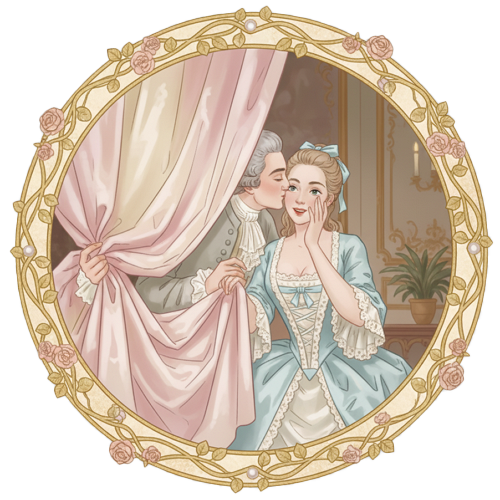
That was all the permission he needed. Driven by an impulse he could no longer quantify or suppress, Alistair lowered his head and kissed her.
The first contact was the freezing cold of his lips against hers, a shock that quickly melted into a surprising warmth. It was a slow kiss, unhurried and profound, a stark contrast to the frantic energy that had defined their lives for the past two weeks.
It wasn’t a kiss of passion, not yet, but of desperation. It was the kiss of two people who had spent their lives in isolation—his by choice, hers by circumstance—and had suddenly, impossibly, found a shoreline in the other.
For Vivi, it was an anchor in a sensory storm. Without the distraction of scent, every other sensation was amplified into startling clarity.
She felt the slight roughness of his five-o’clock shadow against her skin, the solid, unyielding strength of his body as he drew her closer, the gentle but firm pressure of his hand at the back of her neck, his fingers tangling in the hair that had escaped her hat.
It was real. It was tangible.
It was a powerful, physical truth that grounded her in the here and now, silencing the ghosts of the senses she had lost.
This, she could feel. This, she could trust.
For Alistair, it was a cataclysm. His entire world, a carefully constructed edifice of theories, data points, and controlled variables, shuddered on its foundations.
This single, illogical act sent a seismic shock through his system. There was no hypothesis, no experiment, only a conclusion he had arrived at by pure, unadulterated instinct.
He wasn’t measuring, he was feeling. The softness of her lips, the quiet sigh that escaped her as she responded to him, the way her gloved hands came up to rest on his chest—these were data points his logic had no way to process.
His mind, which could trace the history of the world in a cylinder of ice, went blissfully, terrifyingly blank. He was in free fall, and the only thing he was aware of was her.
The kiss was deeply cathartic, a release of every unspoken word, every charged glance in the lab, every moment of tension in the cramped snow vehicle. It was a confession more potent than any they had shared over cold coffee.
It said: You are not alone in your struggle. I see you. I am here.
When he finally, slowly, pulled away, they remained where they were, foreheads resting against each other, their breath mingling in a shared cloud of white. The aurora still danced above them, indifferent to the monumental shift that had just occurred below.
Alistair’s logical world was in a tailspin. He had just acted on an impulse as wild and unpredictable as the solar winds above them, and the result was a stillness inside him he hadn’t felt in years.
He looked at Vivi, truly looked at her, her eyes luminous in the green light, and realized with a jolt of panic and wonder that he had just discovered a force of nature more powerful and far more dangerous than any glacier.
And he had absolutely no idea how to measure it.