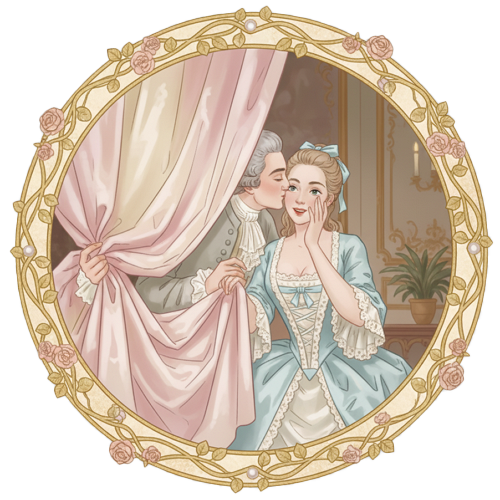
The air in the small room above the music shop was different now. It had always been a space defined by its sensory details—the scent of old paper and beeswax, the motes of dust dancing in the weak afternoon light, the distant cacophony of London bleeding through the floorboards.
But today, a new element had been added, something as thick and tangible as the silence that stretched between them: the memory of a kiss.
Beatrice arrived first, deliberately so. She needed a moment to compose herself, to re-erect the walls that had been so spectacularly demolished in the deserted rehearsal hall.
She ran a gloved finger over the worn keys of the pianoforte, the ivory cool against the leather. The instrument was their altar, the place where Lady Beatrice Marlowe and Mr. Finnian Shaw ceased to exist, replaced by two halves of a single, creative soul.
But now, it felt like the scene of a crime, or perhaps, a confession.
When Finnian entered, the floorboards groaning a soft announcement of his arrival, her heart gave a painful lurch.
He closed the door behind him, and for a long moment, they simply stood there, separated by five feet of dusty air that felt as wide and impassable as the Thames.
“Lady Beatrice,” he said, his voice a low rumble that seemed to vibrate in her very bones.
The formality was a shield, and a clumsy one at that. He had never sounded less like a man from the rookeries and more like a courtier attempting a bow.
“Mr. Shaw,” she returned, her own voice betraying a slight tremor. She focused on a smudge on the sheet music before her, unable to meet his gaze.
She could feel his eyes on her, and she remembered their intensity, the way they had searched her face in the moonlight, just before his mouth had claimed hers. The memory sent a flush of heat creeping up her neck.
They had unleashed something in that stolen moment—a wild, untamed melody that had no place in their carefully structured composition. Now, they were left to face the discordant aftermath.
“I have reviewed the revisions for the second act’s opening,” she said, her tone clipped and business-like.
“The transition from the market scene to Helena’s soliloquy feels… abrupt. The orchestration needs a bridge.”
Finnian moved closer, not to her, but to the table where he’d left his libretto. He set his satchel down with a soft thud.
“A bridge,” he repeated, as if the word itself were foreign. “Yes. I thought as much. I was considering a shift in the lyrics, perhaps a refrain from the earlier scene to echo her thoughts.”
This was how it would be, then. They would speak only in the language of their opera, using the emotions of their characters as stand-ins for their own.
It was a coward’s truce, but it was the only one they had.
He joined her at the pianoforte, carefully maintaining a respectable distance. He smelled of ink and the crisp autumn air.
She forced her attention back to the score, her fingers hovering over the keys.
“Show me,” he said.
Her hands began to move, sketching out a delicate, melancholic passage. It was a tentative exploration, full of unresolved chords and questioning phrases.
It was the sound of uncertainty, of a heart caught between two worlds. It was, she realised with a start, the sound of her own soul.
Finnian listened, his expression unreadable. His proximity was a constant, unnerving pressure.
She could feel the warmth of his body, sense the rhythm of his breathing. Every nerve ending was alight, screaming with an awareness of him that had not existed before.
When her hand faltered on a difficult arpeggio, his was there, hovering just over hers.
“Like this,” he murmured, his voice close to her ear. His fingers gently guided hers, pressing down on the keys in the correct sequence.
It was not a lover’s touch, but it was not a composer’s, either. It was something in between—a gesture of shared creation that was now impossibly intimate.
A jolt, sharp and sweet, shot up her arm. She snatched her hand away as if burned.
“I see,” she said, her voice breathless.
The silence returned, heavier this time. The professional facade was a fragile sheet of glass, and they could both see the cracks spreading across its surface.
“Beatrice,” he began, his voice losing its formal edge, becoming rough with an emotion she couldn’t name.
“We should focus on the music, Mr. Shaw,” she interrupted, her gaze fixed resolutely on the score. “The opera is what matters.”
A muscle worked in his jaw. “Is it?” he asked softly. The question hung between them, unanswered, unanswerable.
***
In the dimly lit, gin-soaked confines of The Grapes, Lord Ashworth swirled the brandy in his glass, the amber liquid catching the light of the sputtering oil lamp. He was far from the perfumed salons of Mayfair, but this was a necessary excursion.
Jealousy, he had discovered, was a far more potent motivator than inspiration. The whispers of the “Ghost of Covent Garden” were a constant irritant, a phantom success that mocked his own theatrical failures.
But it was Finnian Shaw’s name, always attached to this spectral genius, that truly stoked his ire.
He had chosen his target carefully: a violinist named Cromwell, a man whose talent was matched only by his bitterness. Ashworth had heard him complaining in the orchestra pit about Shaw’s secretive nature and paltry pay.
“Mr. Cromwell,” Ashworth said, his voice a silken contrast to the tavern’s rough din.
“Allow me to offer my condolences on the lamentable state of London theatre. To have one’s talents squandered on the scribblings of an upstart playwright… it is a tragedy.”
Cromwell, already three drinks in at Ashworth’s expense, grunted in agreement. “Shaw,” he slurred, spitting the name like a sour grape.
“Thinks he’s a bloody Shakespeare. Struts about, guards his new music like it’s the Crown Jewels. Won’t even let the orchestra see the full score.”
“Indeed?” Ashworth leaned in, feigning casual curiosity.
“And this mysterious composer of his. This ‘Ghost.’ No one has laid eyes on him?”
“Him?” Cromwell laughed, a short, sharp bark. “No one’s laid eyes on anyone. But I can tell you this for nothing, m’lord.”
He lowered his voice, his eyes gleaming with a conspirator’s pride.
“A few nights ago, I was passing the old rehearsal hall, the one with the drafty windows. Heard music coming from inside. Not Shaw’s clumsy pecking on the keys, no. This was… different.”
Ashworth’s posture straightened imperceptibly. “Different how?”
“It was the quality of it, see?” Cromwell’s hands, calloused from his instrument, began to move in the air as if holding a phantom violin.
“The touch. The phrasing. It was clean. Precise. The sort of playing you only hear in… well, in your world, m’lord. In the drawing rooms of Belgravia. Learned from a master, on a proper Broadwood grand, not some tavern clunker.”
A slow, cold smile began to form on Ashworth’s lips. This was more than he had hoped for.
The Ghost was not some rival playwright or a hidden prodigy from the slums. The quality Cromwell described pointed to breeding.
To education. To a world Ashworth knew intimately.
“And you are certain of this?” he pressed, sliding another coin across the sticky table.
Cromwell pocketed it greedily.
“As certain as I am that this brandy is better than the swill they usually serve. There was a passage, a little flourish with the left hand… a trill followed by a descending chromatic scale. It’s a devilishly difficult little thing. You don’t learn that playing for pennies in a pit. That’s a Mayfair touch, m’lord. Through and through.”
And then, Cromwell delivered the final, damning piece of the puzzle.
“And I heard a voice,” he added, squinting as he tried to recall the detail.
“Just for a second. The music stopped, and I heard a woman’s voice. Soft. Refined. Telling him the tempo was too slow.”
A woman.
The word landed in Ashworth’s mind with the force of a thunderclap. It all clicked into place.
The secrecy. The refined, emotional quality of the music that so mismatched Shaw’s brutish persona.
The collaboration was not just professional; it was a sordid affair. A common playwright had somehow ensnared a lady of quality, convincing her to share not only her talent, but likely her bed as well.
The audacity of it was breathtaking. The scandal… catastrophic.
Ashworth tossed a few more shillings onto the table, his mind already racing. He stood, the predatory gleam in his eyes now sharp and focused.
The field of his investigation had narrowed dramatically. He was no longer searching all of London for a ghost.
He was now hunting in his own garden. And he had a very good idea of which delicate, talented flower was hiding the sharpest thorns.
Lady Beatrice Marlowe, with her quiet defiance and her virtuoso’s hands, had just moved to the very top of his list.