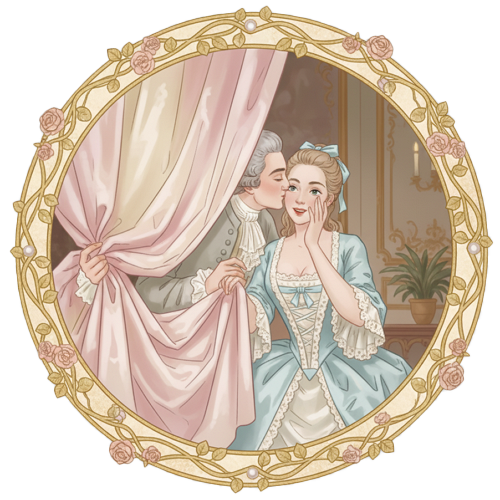
The bell above the door of Faden’s Bookshop chimed a discordant note, a sound swallowed whole by the oppressive silence within. Beatrice Marlowe clutched the collar of her dark wool cloak, drawing the heavy fabric closer as if it were a suit of armour.
The scent of aging paper and cracked leather, a fragrance she usually adored, now felt suffocating, thick with the weight of her transgression. Every creak of the floorboards under her half-boots was a cannon shot announcing her presence.
She had read the advertisement a dozen times, the concise, cryptic words seared into her memory: To the Ghost of Covent Garden. I wish to discuss your composition. Faden’s Bookshop, near Seven Dials. Tuesday, three o’clock. In the philosophy section.
Philosophy. How fitting. She was, at this very moment, questioning the sanity of her entire existence.
Her lady’s maid, Agnes, had nearly fainted when Beatrice announced her intention. To venture into Seven Dials, a place spoken of in Mayfair with the same hushed horror reserved for tales of plague, was unthinkable.
But the pull of Mr. Shaw’s plea, the undeniable connection she felt to his art, was stronger than a lifetime of decorum. It was a hunger she had only just discovered she possessed, and it would not be denied.
Navigating the labyrinth of towering shelves, she felt like a ghost already, a spectre from another world drifting through this dusty tomb of forgotten words. Motes of dust danced in the single shaft of late afternoon sun piercing the grimy window, illuminating a world of quiet decay.
She found the philosophy section in a shadowed rear alcove, a forgotten corner where Aristotle leaned wearily against Plato.
And a man leaned against Aristotle.
He was not what she had expected. The author of such searing, intelligent prose—she had pictured someone older, perhaps a scholar with ink-stained fingers and spectacles perched on a noble nose.
The man before her was young, not much older than herself, with a dishevelled crop of dark hair that looked as though he’d been running his hands through it in frustration. His coat was more practical than fashionable, his jawline sharp and stubborn, and his eyes… his eyes were the most arresting thing about him.
They were a deep, stormy grey, and they held the flinty, impatient spark of a man who had fought for every scrap of his existence. He was, she realised with a jolt, the playwright from the theatre.
He pushed off the bookshelf as she approached, his posture radiating a restless energy.
“You’re late,” he said, his voice a low baritone with the rough, unpolished edges of the London streets. It was the same voice she’d overheard in the theatre alley, laced with passion and fury.
Beatrice’s heart hammered against her ribs, a frantic drumbeat against the quiet hum of the bookshop. Her hand, hidden in the folds of her cloak, trembled.
This was the moment. The precipice.
With a deep breath that did little to calm her, she reached up and pushed back her hood, lowering the heavy veil that had shielded her from the world.
Finnian Shaw’s reaction was a study in stillness. The impatience vanished from his face, replaced by a wave of utter, profound disbelief.
His grey eyes widened, sweeping over her—the simple but impeccably cut travelling dress, the string of modest pearls at her throat, the carefully arranged coils of her hair. His gaze was an inventory, a calculation that ended in a conclusion he clearly found abhorrent.
The spark in his eyes cooled to ice.
“No,” he breathed, the word a soft, sharp rejection. “Absolutely not.” He took a step back, as if she were carrying one of the diseases of which her class was so terrified.
“This is a joke. A cruel sort of parlor game.”
The shock was mutual. She had known he was not a gentleman, but seeing him up close, seeing the raw charisma and the palpable disdain radiating from him, was another matter entirely.
He was dangerous, not in the way a highwayman was dangerous, but in the way a fire is—unpredictable, consuming, and utterly mesmerizing.
His scorn pricked her pride, overriding her fear. “I assure you, Mr. Shaw, my life is not nearly so amusing as to require such games.”
A harsh laugh escaped him.
“Your life?” he scoffed, gesturing vaguely in the direction of Mayfair.
“Your life of balls and baubles and choosing which colour ribbon to wear? Forgive me if I fail to see the tragedy that would inspire the music you sent.” He folded his arms, a barrier between them.
“Who put you up to this? Was it Ashworth? That preening peacock has been trying to sabotage me since my first play bested his dreadful farce.”
Beatrice stiffened at the mention of Lord Ashworth’s name.
“This has nothing to do with him. It has to do with the music. My music. The music you summoned.”
“I summoned a composer,” he bit back, his voice low and intense.
“A musician with soul, with grit. I did not summon a… a lady of the ton to pass a tedious afternoon.”
The condescension in his tone was a slap. He saw her title, her clothes, her station, and nothing else.
He saw the cage, but not the woman rattling the bars. It was the same invisibility she suffered in her brother’s drawing room, and hearing it from him, the one person she thought might understand, was a betrayal that tasted like ash.
“You think because I wear silk, I cannot feel?” she challenged, her own voice dropping, gaining an edge he had not expected.
“You think because I can play a pianoforte in a drawing room, I cannot understand rage? Or sorrow? Or the desperate, clawing need to create something real in a world of artifice?” She took a step closer, closing the distance he had put between them.
“You are a hypocrite, Mr. Shaw. Your plays rail against the judgment of a class-obsessed society, yet you stand here and dismiss me out of hand for the very same reason.”
He was momentarily stunned into silence, his stormy eyes searching her face as if seeing it for the first time. He saw not just the delicate features of an aristocrat, but the flush of anger on her cheeks and the fierce, unwavering light in her eyes.
Still, the pragmatist in him fought back. “Even if I were to believe you,” he said slowly, the words grinding out, “the entire notion is impossible. Preposterous.”
“Why?”
“Why?” He let out another incredulous laugh. “Lady… I don’t even know your name.”
“And you shall not,” she retorted. “It is irrelevant.”
“Is it? What do you suppose would happen if you were seen with me? A common playwright from the rookeries. Your reputation would be in tatters before sunset. And what of me? Do you think the theatre patrons would celebrate an opera written by one of their own pampered darlings? They want authenticity, not a society pet project. And your brother, your father… they would see me ruined. Hanged, perhaps, for daring to corrupt a lady of quality.”
Every word was a cold, hard truth, and the weight of it pressed down on her. He was right.
The chasm between their worlds was not a gap; it was a canyon, vast and impassable.
The hope that had carried her here began to wither.
She looked away, her gaze falling on a worn copy of Milton.
Paradise Lost. How appropriate.
“So, that is it, then,” she murmured, the fight draining from her. “You will dismiss the music—the one thing that is true in all this—because of the hand that wrote it.”
Silence stretched between them, thick with the scent of old paper and shattered dreams. He watched her, his expression a conflict of raw prejudice and something else, something he fought to suppress.
He was a man who lived by his instincts, and his instincts were screaming that this was madness. But his artistic soul, the very core of his being, whispered a different truth.
He thought of the sheet music that had arrived like a bolt of lightning. The overture she had composed.
It wasn’t just technically brilliant; it was emotionally perfect. It understood his characters’ silent grief, their defiant hope.
It was the other half of his own soul, rendered in melody. To turn it away would be an act of artistic suicide.
“Damn it all,” he finally swore, running a hand through his hair in exasperation. The gesture was so full of raw frustration it was almost painful to watch.
“Damn you. The music… the music was right.”
The admission hung in the air, a fragile truce.
Beatrice’s head snapped up, her eyes meeting his. A spark of hope rekindled, fierce and bright.
“It is the only thing that matters,” she said, her voice soft but firm.
He paced the small alcove, a caged tiger wrestling with an impossible choice. He stopped and pinned her with a look of grim resolve.
“If we do this,” he said, the words sharp and precise, like stones being laid for a gallows, “it will be on my terms. With rules. Iron-clad and absolute.”
Beatrice straightened her spine, her own resolve hardening to match his. “I would expect nothing less.”
“First,” he began, ticking the points off on his ink-stained fingers, “no one can ever know. Not your maid, not my manager, not God himself. To the world, this music is mine, sprung fully formed from my own head. You will be a ghost. Nothing more.”
“Agreed,” she said without hesitation. The title suited her.
“Second, we never meet in your world. Never in Mayfair. And we do not meet here again. It will be on neutral ground, a place of my choosing. A place where a lady would never be seen, so you had best be prepared to abandon your sensibilities.”
“I have already ventured to Seven Dials, Mr. Shaw. I believe my sensibilities are hardier than you imagine.”
A flicker of grudging respect entered his eyes.
“Third, this is a professional arrangement. Strictly. We are collaborators in art, and nothing more. There will be no personal questions, no discussion of our lives outside of the work. You are the composer. I am the librettist. That is all we are to each other.”
She felt a strange, sharp pang at the finality of that rule, a feeling she promptly and ruthlessly suppressed.
“That seems a prudent and necessary boundary.”
“It is the only thing that will keep us from ruin,” he corrected her grimly.
He stopped, his gaze intense. “If you break these rules—any of them—it is over. Do you understand?”
“I understand perfectly,” she said, her voice as steady as a rock, though her insides were a churning sea of terror and elation.
He stared at her for a long moment, the playwright in him assessing the character before him, weighing her courage and her conviction. Finally, he gave a short, sharp nod.
“There is a music shop on Denmark Street. Above it is a small room for rent by the hour. Dusty, with a tolerable pianoforte. Be there Friday. Four o’clock. Use the side entrance.”
He turned to leave, their business concluded.
“Mr. Shaw,” she called after him.
He paused in the mouth of the alcove, his silhouette framed against the dim light of the shop, but did not turn back.
“Thank you,” she said softly.
He gave no reply. He simply walked away, the sound of his footsteps echoing on the old floorboards before the discordant chime of the bell announced his departure.
Beatrice was left alone in the shadows, her heart beating a wild, triumphant rhythm against the silence. She had walked into the bookshop a lady of the ton, trapped in a gilded cage.
She was walking out a ghost, a secret, a composer. And for the first time in her life, she felt breathtakingly, terrifyingly free.