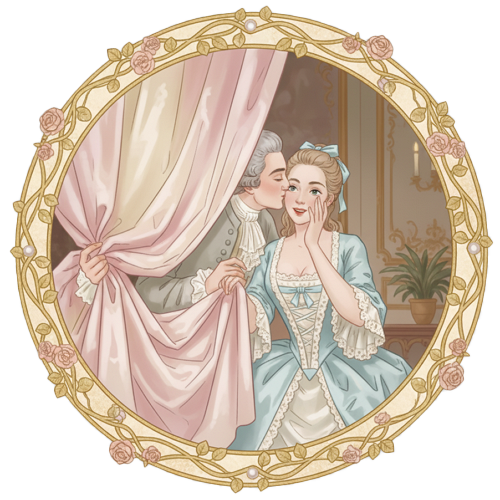
The music lay scattered across the polished rosewood of the pianoforte like fallen leaves after a storm. Beatrice traced the frantic, ink-blotted notes of the composition she had poured her soul into the night before.
It was a raw and turbulent piece, full of crashing chords and a desperate, yearning melody. It was the sound of her own heart, a heart that beat against the gilded bars of its cage.
But here, in the silent morning light of her Mayfair drawing-room, the music felt inert, its power contained and silenced. It was a scream locked in a soundproof box.
The memory of the gentlemen at the ball, their dismissive praise for trifles and their grudging admiration for the playwright, Mr. Finnian Shaw, returned to her. They had spoken of his work with a mixture of fascination and distaste, as one might speak of a magnificent, untamed animal.
Raw. Brilliant. Uncouth. His play, they’d said, was the talk of Covent Garden.
It was a world away from the manicured lawns and whispered scandals of the ton, a world where passion was not a weakness to be concealed but a force to be unleashed upon a stage.
A resolution, as sharp and clear as a struck crystal glass, formed within her. She would not simply dream of that world. She would see it.
She found her lady’s maid, Anne, in the linen closet, her small, capable hands folding sheets with practiced efficiency. Anne had been with her since childhood, a steady, cautious presence in Beatrice’s tumultuous inner life.
“Anne,” Beatrice began, her voice lower than usual, betraying a hint of the conspiracy she was about to propose. “I have a… a rather unusual request.”
Anne paused, a length of white linen held mid-air. She knew that tone.
It was the same one Beatrice used as a girl before climbing the forbidden oak tree or sneaking an extra helping of trifle from the kitchens. “My lady?”
“I wish to go to the theatre. To Covent Garden.”
Anne’s eyes widened, the linen dropping to the pile at her feet.
“To Covent Garden, my lady? Alone? Your brother would never permit it. A public playhouse… it is not a suitable place.”
“Which is precisely why he must not know,” Beatrice said, her gaze steady. “And I would not be alone. I would have you with me.”
The poor woman looked as though Beatrice had suggested they take up street juggling.
“Me? But… the crowds, the people… It is a world of pickpockets and playwrights, not ladies of quality. If you were seen—”
“We will not be seen,” Beatrice insisted, stepping closer, her voice a persuasive whisper.
“We will take a plain carriage. We will wear simple, dark cloaks and keep our faces veiled. We will sit in the back of a public box, in the shadows. No one will ever know. Please, Anne. I must see this play.”
She saw the battle in her maid’s face: loyalty warring with deep-seated propriety and genuine fear. Anne’s world was one of rigid rules, and Beatrice was asking her to break nearly all of them.
“Why, my lady?” Anne asked, her voice soft with confusion. “Why this play?”
Beatrice thought of the music upstairs, the silent, raging notes. “Because I have a feeling,” she said, the words truer than any she had spoken in years, “that it is something I am meant to hear.”
***
Hours later, huddled in the corner of a hired, musty-smelling carriage, Beatrice felt her heart thrumming a frantic rhythm against her ribs. The familiar, stately façades of Mayfair gave way to the narrow, jostling streets of the city proper.
The air grew thick with the smells of coal smoke, roasted nuts, and the damp press of humanity. The refined clip-clop of society carriages was replaced by the rumble of drays, the cries of street vendors, and the clamour of a thousand lives lived in close, unapologetic proximity.
It was terrifying. It was intoxicating.
Anne sat rigidly beside her, clutching her reticule as if it were a shield, her face pale behind her veil. But Beatrice leaned forward, peering through the small window, her senses alight.
This was London, the real, beating heart of it, a place of vibrant, chaotic life far removed from the choreographed stillness of her own.
The carriage shuddered to a halt near the grand portico of the Theatre Royal. Beatrice pressed a few coins into the driver’s hand and, with a final, steadying glance at Anne, pulled the hood of her dark wool cloak further over her face and stepped out into the electric evening air.
Inside, the theatre was a magnificent cavern of noise and light. The scent of orange peels, melting wax, and damp wool filled her nostrils.
Gilded balconies soared into the painted heavens of the ceiling, while below, in the pit, a boisterous crowd shifted and laughed, their energy a palpable force. They were merchants, clerks, and shop girls—a cross-section of the city she had only ever observed from the pristine distance of a carriage window.
She and Anne found their box, a modest one set back from the main stage, and settled into the shadows as the gaslights began to dim.
The play was called The Chimney Sweep’s Requiem. There was no artifice to it, no gentle satire or mannered romance.
It was a story forged in soot and sorrow, a brutal and beautiful tale of a young boy fighting for a sliver of dignity in a world determined to grind him into dust. The language was not the polished wit of the drawing-room; it was poetry spun from the argot of the streets, full of fury and grace.
Beatrice was mesmerized. She forgot the scratchy wool of her cloak, the nervous presence of Anne beside her, the fear of being discovered. She was utterly consumed.
In the protagonist’s silent defiance, she recognized her own quiet rebellion. In his yearning for a sky he could only see through a film of grime, she felt the echo of her own longing for a world beyond her gilded cage.
This Mr. Finnian Shaw, this man she had never met, seemed to have reached into her very soul and pulled its secret melodies out into the light. He understood what it was to be trapped, to possess a voice no one was willing to hear.
When the final curtain fell, the theatre exploded. The applause was not a polite patter but a roar, a thunderous, heartfelt ovation that shook the very foundations of the building.
Beatrice remained seated, her hands clasped in her lap, her own applause silent and internal. Tears she hadn’t realized she’d been holding back traced cool paths down her cheeks.
“My lady, we should go,” Anne whispered, tugging gently at her sleeve as the audience began to file out.
“In a moment,” Beatrice murmured, her gaze fixed on the now-empty stage.
She felt a strange reluctance to leave, to return to a world where such powerful truths were never spoken aloud. “I… I feel a little faint. Let the crowd disperse first.”
It was a flimsy excuse, but Anne accepted it, busying herself with refastening Beatrice’s veil. They waited in the deepening shadows of the box as the great hall emptied, the roar of the crowd fading to the scuff of feet and the murmur of ushers.
It was in that ensuing quiet that she heard the voices from the corridor just below their box. One was placating and weary; the other was a low, impassioned baritone that vibrated with frustration.
“The words are not enough, Davies!” the second voice bit out. “Can’t you see? It needs more. It needs music to give it flight!”
Beatrice froze, her hand gripping the velvet railing. She gestured for Anne to remain silent, tilting her head to better hear the clandestine conversation.
“Finnian, we’ve been over this,” said the weary voice, which she surmised belonged to the theatre manager.
“An opera? The cost alone is prohibitive. And who would write the score? All the respectable composers are busy writing saccharine Italian nonsense for the King’s Theatre. What you’re proposing… it’s a fool’s errand.”
“It is not a fool’s errand! It is the future!” The voice—Finnian’s voice—was laced with a desperate energy that resonated with the stormy music she had composed just last night.
“An English opera, with English themes, for an English audience! Think of it! The libretto is the best thing I’ve ever written. It’s the story of a selkie, a creature of the sea trapped on land, her true voice stolen from her. But it needs a score that understands her soul. Not technical brilliance, Davies, but… heart. Raw, untamed heart. And I cannot find a composer in this entire city with enough soul to write a single, honest note.”
Beatrice’s breath caught in her throat. A creature trapped on land, her true voice stolen. The theme was so close to her own silent anguish it felt as though he had plucked it from her mind.
“Find me one of your drawing-room maestros, then,” Davies scoffed. “I hear the ladies of Mayfair tinkle away on their pianofortes quite prettily.”
Finnian let out a short, harsh laugh.
“Prettily, yes. They play what they are told to play. Their music has no blood in it. It’s as constrained and passionless as their lives. I need a ghost, Davies. A musician who feels the cage as I do, who understands what it is to have a fire in your belly and be told to smile and curtsy. Someone whose music can rage and weep.”
There was a pause, a heavy silence that seemed to stretch for an eternity. Beatrice leaned forward, her body tense, straining to hear more.
“There is no such person, my boy,” the manager said, his tone softening with a weary pity.
“You ask for the impossible. Now, go home. The play was a triumph. Be content with that.”
Footsteps receded down the hall. Beatrice peered over the railing and saw him then.
A tall man, standing alone in the centre of the stage, his back to her. He was dressed in the simple, dark clothes of a working man, his shoulders slumped in defeat.
He stared out at the cavernous, empty theatre, a solitary figure dwarfed by the space around him. He was the man whose words had just laid her soul bare, and he was as lost as she was.
He needed a composer with soul. A ghost who understood the cage.
And in that moment, watching the playwright in his solitary despair, a thought took root in Beatrice’s mind. It was a terrifying, impossible, and utterly exhilarating idea.
It was a spark landing in the driest tinder, and as she watched the man on the stage run a hand through his dark hair in a gesture of pure frustration, she knew, with a certainty that stole her breath, that she was going to let it burn.