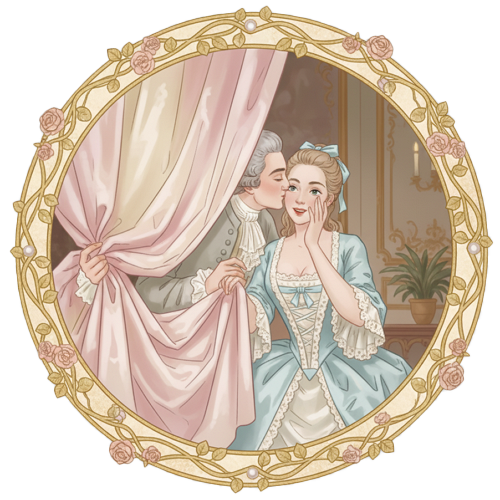

The heat was the first assault. It rose in waves from the press of a hundred bodies, thick with the scent of beeswax, cloying perfume, and the faint, funereal sweetness of wilting hothouse flowers.
Lady Beatrice Marlowe felt it clinging to her skin beneath layers of silk and whalebone, a physical manifestation of the gilded cage that was her life.
“You see, Lady Beatrice,” Lord Ashworth droned on, his voice a reedy instrument playing a dreadfully dull tune, “the true artistry of a cravat is not in the complexity of the knot, but in the nonchalance of its execution. It must appear as if it simply… happened.”
He gestured to the starched monstrosity at his own throat, a confection of white linen so stiff it seemed to hold his chin at a perpetual angle of disdain. Beatrice forced her lips into the shape of a smile, a carefully practiced sculpture of polite interest.
In her mind, she was snapping the strings of his cravat like a hangman’s noose.
“Fascinating, my lord,” she murmured, the words tasting of ash. Her gaze drifted over his shoulder, across the shimmering, suffocating sea of the Duchess of Abernathy’s ballroom.
Diamonds glittered like captive stars, laughter pealed with the brittle sound of breaking glass, and everywhere, the ton performed its tedious, intricate dance of courtship and commerce.
“Indeed.” Ashworth preened, utterly oblivious to the storm brewing behind her placid grey eyes.
“My man, Higgins, has the touch of a poet, truly. A poet of the necktie.”
From the corner of her eye, Beatrice saw her brother, Alistair, the Earl of Danbury, observing them. He gave a slight, almost imperceptible nod of approval, the gesture of a merchant pleased with the quality of his goods on display.
At twenty-six, Alistair wore his title like a suit of armor, his expression perpetually set in a mask of grim responsibility. And tonight, her successful match to Ashworth—a man with a respectable title and an intellect as shallow as a puddle—was his most pressing duty.
She was not his sister; she was a strategic alliance, a closing of accounts. She felt utterly, terrifyingly invisible.
“If you will excuse me, Lord Ashworth,” she said, her voice a model of decorum. “The heat is a trifle… overwhelming.”
Before he could launch into a lecture on the proper ventilation of a ballroom, she executed a neat turn and slipped into the crowd, the rustle of her gown the only sound of her escape. She moved with practiced grace, a ghost in powder-blue silk, navigating the currents of society until she found a small alcove partially concealed by a monstrous fern.
Leaning against the cool marble wall, she closed her eyes for a blessed moment, letting the cacophony wash over her.
It was then that she heard it. Not the music from the orchestra, a bland and forgettable waltz, but the low, rumbling tones of a conversation between two older gentlemen hiding from their wives.
“—utterly savage, I tell you,” one of them, Sir Winston Croft, was saying.
His voice was laced with a mixture of shock and grudging admiration. “No sentiment, no powdered-wig poetry. Just… blood and thunder. The man writes with a cudgel, not a quill.”
“You mean the new play at Covent Garden?” the other, Lord Hemlock, replied, his tone dismissive.
“The Beggar’s Throne? Heard it was penned by some guttersnipe from the rookeries. Shaw, is it?”
“Finnian Shaw,” Sir Winston corrected.
“And yes, they say he clawed his way out of the Seven Dials. But my God, Hemlock, the power of it. The audience was silent. Not bored silent, but held silent. He put the raw, brutal truth of this city on that stage, and for two hours, he made us all look at it.”
Beatrice’s eyes snapped open. Finnian Shaw.