The world outside the glasshouse had long since surrendered to the deep, velvet dark of a moonless night. Inside, however, under the golden halo of a single oil lamp, time seemed to have stopped.
The air was a humid, fragrant cocktail of damp earth, night-blooming jasmine, and the uniquely spicy scent of the orchid that had become the center of their universe.
Papers covered every available surface, filled with Beatrice’s elegant script and Alistair’s sharper, more angular notes.
Glass slides, beakers, and a brass microscope gleamed in the lamplight, instruments in a silent symphony only they could hear.
Beatrice leaned over the microscope, her brow furrowed in concentration, a stray curl escaping the careful knot at her nape to brush against her cheek.
For hours, they had worked in a rhythm that had become surprisingly familiar.
A question from her would be met with a hypothesis from him; a calculation he struggled with would be clarified by her swift, logical assessment.
The intellectual sparring of their first days had evolved into a seamless collaboration, their minds moving in tandem toward a single, elusive goal.
“It’s the cellular structure,” she murmured, more to herself than to him. “There’s a crystalline inclusion within the vacuoles that I’ve never seen. Not in any other Cymbidium.”
Alistair moved to stand behind her, his proximity sending a familiar, unsettling jolt through her.
He was close enough that she could feel the warmth radiating from him, could smell the faint, clean scent of starch and Earl Grey tea that clung to his waistcoat.
He leaned forward to peer into the eyepiece she had just vacated, his arm brushing hers.
“Peculiar,” he breathed, his voice a low rumble. “Almost geometric. Like tiny shards of glass.” He straightened, his gaze distant as his mind raced.
“We’ve been focused on its pigmentation, its reproductive strategy… but what if this is the key? What if its uniqueness isn’t merely aesthetic?”
This was the thread they had begun pulling at dusk.
An old herbalist’s text Alistair owned had mentioned a similar, though less vibrant, orchid from the same region of the Himalayas, noted for its use in local folk remedies.
It had been a long shot, a wild tangent born of late-night exhaustion, but it had ignited a new fire in them both.
“The text mentioned its use in poultices for reducing swelling,” Beatrice recalled, her fingers tracing a diagram she had sketched. “If these crystalline structures contain a unique alkaloid…”
“…it could have a potent anti-inflammatory effect,” Alistair finished, his eyes alight with the thrill of the chase. “We need to isolate it. Prepare a distillation.”
The next hour was a blur of focused activity.
They moved around the narrow potting bench with an unconscious grace, a practiced dance of passing beakers, adjusting the flame on the spirit lamp, and measuring reagents.
The air grew thick with the herbaceous scent of the crushed orchid petals and steam. All pretence, all rivalry, had been burned away by the pure, refining heat of discovery.
There was no Earl of Blackwood, no Miss Holloway. There were only two scientists on the precipice of something extraordinary.
Beatrice carefully measured the final distillate into a petri dish containing a blood sample they had acquired from the estate’s butcher. It was a crude experiment, but it was all they had.
They both held their breath, leaning over the dish, their heads nearly touching in the pool of lamplight.
For a long moment, nothing happened. A heavy weight of disappointment began to settle in Beatrice’s stomach.
It had been a foolish hope, a romantic notion born from an old book and too many hours awake.
Then, Alistair pointed, his finger hovering just over the dish. “Look.”
Beatrice followed his gaze.
At the edge of the drop of clear liquid, the red blood cells, which should have been breaking down in a process of hemolysis, were instead clumping together.
The coagulation was happening at a rate that defied logic.
It was not just an anti-inflammatory; it was a powerful, fast-acting styptic. A hemostatic agent of incredible potential.
A soft gasp escaped Beatrice’s lips. “My God.”
Alistair’s breath hitched. “It’s… revolutionary.”
He looked up from the dish, his gaze finding hers. And in that instant, the world shifted on its axis.
The clinical thrill of the scientific breakthrough was suddenly overwhelmed by a different, far more potent energy.
The exhilaration was still there, a thrumming, vital current between them, but it was no longer about the orchid.
In his eyes, Beatrice saw not the arrogant Earl or the wounded recluse, but a man stripped bare by the raw, incandescent joy of discovery.
His face, usually a mask of guarded control, was open and brilliant with triumph. A slow, genuine smile spread across his lips, transforming his features, making him look younger, freer.
And he was looking at her as if he’d never truly seen her before.
The air crackled. The humid warmth of the glasshouse seemed to intensify, wrapping around them like a blanket.
Beatrice’s heart hammered against her ribs, a frantic counterpoint to the gentle hiss of the lamp. She could see the reflection of the flame dancing in his dark pupils.
Alistair’s mind, usually a fortress of logic and methodical thought, was in chaos.
He saw Beatrice, her face flushed with success, her intelligent grey eyes wide with wonder, and felt something inside him—a dam he had spent years constructing—finally, irrevocably break.
This woman, this infuriating, brilliant, tenacious woman, had not only breached the walls of his estate but had laid siege to the very core of his solitude.
She was not a rival to be defeated. She was an equal, a partner in the truest sense of the word.
The thought was not frightening; it was liberating.
The professional admiration that had been growing for weeks gave way to a wave of pure, unadulterated desire that stole his breath.
He saw her not just as a mind to be respected, but as a woman to be… known.
He didn’t think. He simply acted.
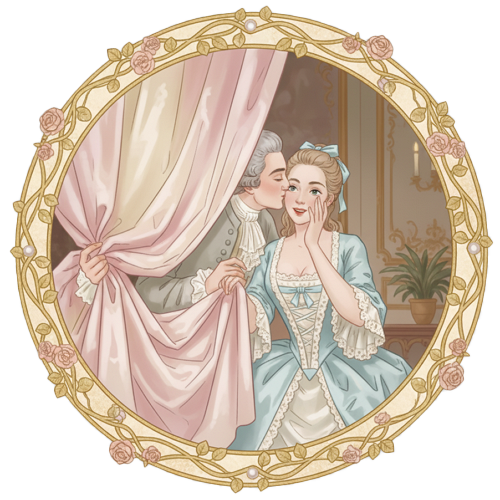
He raised a hand, his fingers gently brushing the errant curl from her cheek. Her skin was soft, warm.
She flinched, a barely perceptible movement, but she did not pull away. Her gaze remained locked on his, her lips slightly parted in surprise.
“Beatrice,” he murmured, the sound of her name on his tongue both an apology and a prayer.
And then he leaned in.
Time seemed to draw out, to become thick and syrupy like the nectar of the flowers surrounding them.
He closed the small distance between them, his world narrowing to the scent of her skin, the sight of her eyes fluttering closed, the soft hitch of her breath.
His lips met hers.
It was not a gentle, tentative kiss.
It was searing, a collision of heat and tension and the explosive release of weeks of unspoken friction. It was fueled by the exhilaration of their discovery and the forbidden thrill of the moment.
His hand moved from her cheek to the back of her neck, his fingers tangling in the soft hair at her nape, pulling her closer.
A small, shocked sound escaped Beatrice’s throat, a sound he swallowed with his own. She tasted of weak tea and a fierce, unexpected sweetness.
For a dizzying moment, she was stiff with surprise, but then, her hands, which had been resting on the workbench, came up to grip his arms, her body melting against his.
She kissed him back with a startling passion that met his own, a raw honesty that sent a shockwave straight through him.
It was a stolen moment, a secret forged in the humid heart of his sanctuary, witnessed only by the silent, watching orchids.
It was everything he had denied himself for years—connection, collaboration, passion.
As quickly as it began, it ended.
He pulled back, his chest heaving as if he had run a mile. Beatrice swayed slightly, her hands still clutching his arms for balance.
They stared at each other, both breathless, both utterly shocked by what had just transpired. The silence that rushed in to fill the void was deafening, broken only by the frantic beat of their own hearts.
Her lips were red and swollen, her eyes wide and dark with a confusion that mirrored his own.
The brilliant scientist, the formidable rival, looked completely undone. And in that moment, Alistair knew he was lost.
He had crossed a line, and he had no desire—no ability—to ever go back.