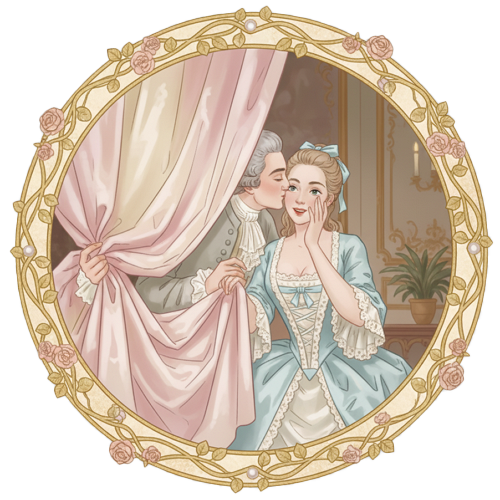
The ballroom at Atherton Hall was a hothouse of a different sort.
Instead of the damp, earthy scent of humus and blooming orchids, the air was thick with a cloying blend of French perfume, beeswax, and overheated humanity.
Beatrice Holloway felt her collar wilt, a sensation she usually associated with a failing hygrometer.
She clutched a glass of lukewarm lemonade, her sketchbook-roughened fingers feeling entirely out of place against the delicate crystal, and wished for the hundredth time that she were in a muddy pair of boots, trespassing in a glade.
Her mother had been insistent. “You cannot simply let society forget you exist, Beatrice. An eligible young woman does not spend all her hours with dirt under her nails.”
The irony, of course, was that the dirt under her nails was their only hope of remaining eligible for anything other than a debtor’s cottage.
And so, she was here, a specimen pinned to a board, observed and classified by matrons with lorgnettes and bachelors with vacant smiles.
She was scanning the crowd for a polite avenue of escape when she saw him.
Alistair Beaumont, the Earl of Blackwood, stood near a marble pillar, looking as though he’d been transplanted from his native soil into a sterile bell jar.
He wore the requisite formal attire, but his shoulders were tensed beneath the fine wool, and his gaze, usually so sharp and focused when bent over a microscope, was distant and guarded.
He looked utterly, profoundly miserable.
A pang of something that felt dangerously like sympathy resonated in her chest.
For a moment, their eyes met across the glittering expanse of the dance floor, and in that shared glance was a silent, mutual acknowledgment: We do not belong here.
The moment was shattered by the arrival of a man who moved with the unctuous glide of oil on water.
Lord Davies was handsome in a polished, predatory way, his smile a little too wide, his eyes a little too assessing.
He was known in the county for his political ambitions and his knack for turning any conversation to his own advantage.
He clapped a familiar hand on Alistair’s shoulder. “Blackwood! A rare sighting indeed. I had begun to think you’d taken root amongst your precious flowers.”
Alistair’s posture stiffened. “Davies. I trust you are enjoying the evening.” His tone was glacially polite.
“Immensely,” Davies purred, his eyes sweeping the room before landing back on Alistair with pointed interest.
“Though many here are remarking on your… prolonged absences. Both from London and from your duties here. One begins to wonder if the estate is managing itself. A pity, for a man of your standing to be so consumed by a simple hobby.”
The word ‘hobby’ landed like a slap. Beatrice saw a muscle jump in Alistair’s jaw.
Davies was not just making small talk; he was publicly questioning Alistair’s competence, painting his life’s work as a frivolous pastime and him as a derelict peer.
Beatrice’s first instinct was to shrink back into the potted ferns, to remain an unobserved specimen.
This was their conflict, not hers. Alistair was her rival, the arrogant Earl who had tried to steal her discovery.
Why should she care if his political opponent flayed him with a silver tongue?
But Davies continued, his voice rising just enough to be overheard by those nearby.
“Science is a fine thing, of course, for academics and clergymen. But the running of a great estate, the welfare of its tenants… these are a lord’s true responsibilities. One hopes they are not being neglected for the sake of a few exotic weeds.”
A hot spike of indignation shot through Beatrice.
Weeds.
He had dismissed a world of intricate, breathtaking complexity as weeds.
He had belittled the relentless pursuit of knowledge, the very thing that drove her, that gave her purpose. And in doing so, he belittled her as much as he did Alistair.
Before she could fully comprehend her own actions, she found herself stepping forward. “Lord Davies,” she said, her voice clearer and steadier than she felt.
Both men turned, their expressions a study in contrasts. Davies’ was one of mild, condescending curiosity. Alistair’s was one of pure, unguarded shock.
“Forgive my interruption,” Beatrice continued, meeting Davies’s gaze directly.
“But I believe you misunderstand the nature of the Earl’s work. It is hardly a ‘hobby.’ Botanical research has led to advancements in medicine, in agriculture, in our very understanding of the world God has created. The work being done at Blackwood is not a dereliction of duty, but rather an investment in the future, one that could bring more benefit to this country than a thousand parliamentary debates.”
Her own words surprised her. They were a passionate, full-throated defense not just of Alistair, but of their shared world.
Davies’s smile tightened. “Miss Holloway, is it not? I was unaware you had an interest in… weeds.”
“My interest is in science, my lord,” she replied coolly.
“A field where progress is measured not by the volume of one’s talk, but by the depth of one’s dedication. A quality the Earl of Blackwood possesses in abundance.”
A tense silence descended. Davies, clearly unaccustomed to being intellectually cornered by a woman, gave a stiff, dismissive bow.
“A most spirited defense, Miss Holloway. You are a loyal… associate, it would seem. Blackwood.” He gave Alistair a final, pointed look before melting back into the crowd.
Beatrice’s heart was hammering against her ribs. She had just publicly aligned herself with her adversary.
She risked a glance at Alistair.
The shock had faded from his eyes, replaced by an expression she could not decipher—a complex mixture of gratitude and stunned appraisal, as if he were seeing a rare, unclassifiable specimen for the very first time.
Before he could speak, they were joined by Sir Reginald Thorne, a pompous and senior fellow of the Royal Society, a man whose approval could make a career.
He was flanked by a younger, sycophantic colleague.
“Beaumont,” Sir Reginald boomed, his gaze flicking over Beatrice as if she were a piece of furniture.
“Good to see you out of that glorified conservatory of yours. Heard you’re dabbling with some new orchid.” He then leaned in conspiratorially.
“Is this the little illustrator you’ve hired? It is wise to have a woman for such delicate, mindless work. Their hands are so steady for the fine details.”
The condescension was so profound, so utterly dismissive, it stole the air from Beatrice’s lungs.
All her years of study, her meticulous research, her father’s tutoring—all reduced to the mindless dexterity of her hands.
But this time, it was Alistair who stepped forward, positioning himself slightly in front of her, a subtle but unmistakable shield.
“Sir Reginald,” Alistair’s voice was low and resonant, laced with a steel Beatrice had only ever heard directed at herself.
“Allow me to correct you. This is Miss Beatrice Holloway. Not my illustrator. Not my assistant. She is my colleague.”
The word hung in the air, weighted and significant.
“Her knowledge of botanical taxonomy is formidable,” Alistair continued, his eyes fixed on the older man.
“Her observational skills are unparalleled, and her scientific mind is sharper than any I have encountered in recent memory. Our work on this new species is a partnership. An equal partnership. You would do well to remember her name.”
Sir Reginald blinked, his florid face darkening with affront. He mumbled a hasty pleasantry and steered his companion away, leaving a wake of stunned silence.
Beatrice stood frozen, the echo of Alistair’s words resounding within her.
My colleague. An equal partnership.
He had not just defended her; he had championed her. He had lent her his name, his status, his credibility, in a public forum where she had none of her own.
The warmth that flooded her cheeks had nothing to do with the heat of the ballroom.
“Thank you,” she managed, her voice barely a whisper.
“It was nothing less than the truth,” he said, his gaze finally meeting hers. The guarded distance was gone, replaced by an intensity that made her feel as though they were the only two people in the room.
“Shall we?” He gestured toward a set of French doors leading to a stone balcony.
She nodded, unable to find her voice, and followed him out into the cool night air.
The manicured gardens stretched out below, silvered by the moonlight. The noise of the ball faded to a muted hum, leaving them in a pocket of profound quiet.
They stood side-by-side at the balustrade, not speaking for a long moment. It was a comfortable silence, no longer the tense quiet of rivals, but the easy stillness of allies.
“I confess,” Alistair began, his voice softer now. “I did not expect you to come to my defense. Especially not against Davies.”
“And I did not expect you to call me your colleague in front of Sir Reginald Thorne,” she countered, a small smile touching her lips. “I believe he nearly swallowed his cravat.”
A low chuckle rumbled in Alistair’s chest, a sound so unexpected and genuine it startled her. “He deserved it. What he said… it was unforgivable.”
His gaze lingered on her face. “What you said, to Davies… why?”
Beatrice looked out at the moon-drenched landscape, considering her answer. “Because he was wrong,” she said simply.
“He attacked the work. Our work. He dismissed it as meaningless. And it is not meaningless. It is everything.”
When she looked back at him, he was closer than before. The careful distance they always maintained in the glasshouse had vanished.
She could see the flecks of gold in his dark eyes, smell the faint, clean scent of soap and starch.
The pretense of a united front they had presented inside had evaporated, leaving behind something raw and surprisingly real. A current, potent and unfamiliar, crackled in the space between them.
“It is everything,” he repeated, his voice a low murmur. It was not an agreement; it was a confession.
In that moment, he was not the arrogant Earl of Blackwood and she was not the desperate Miss Holloway. They were two people who understood the singular, obsessive passion that drove the other.
They had spent weeks at war over a flower, only to find themselves, for one night, standing as a bulwark for one another against the rest of the world.
And that shared defense had ignited something far more volatile than academic rivalry.
It felt thrilling. It felt essential.
And as he held her gaze in the quiet moonlight, Beatrice knew, with a certainty that shook her to her very core, that it was also incredibly dangerous.