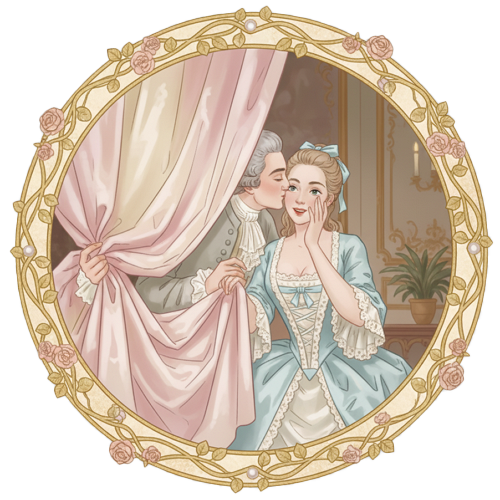
The air in Alistair’s study was thick with the scent of old paper, leather, and the ghost of yesterday’s rain. A single lamp cast a warm, golden circle on his mahogany desk, leaving the corners of the room in deep shadow.
He had been pacing the perimeter of that light for what felt like an eternity since receiving her clandestine message—a small, folded note delivered by a stable boy with wide, unquestioning eyes.
It contained only five words: I believe you. I will help.
Each word was a lifeline thrown into the wreckage of his life. He had read them a dozen times, the crisp edges of the paper softening under the anxious press of his thumb.
Trust.
It was a concept he had long since relegated to the realm of theoretical science—a variable too unpredictable to be relied upon. Yet here it was, offered freely when he least deserved it, from the very woman he had so callously shut out.
When a soft rap sounded at the French door leading to the garden, his heart hammered against his ribs. He strode to the door and pulled it open.
Beatrice Holloway stood on the stone terrace, a dark shawl wrapped tightly around her shoulders, her face pale in the moonlight.
Her bonnet was gone, and the damp night air had teased loose tendrils of hair around her temples.
She looked less like a trespasser and more like a co-conspirator, her eyes holding a fierce, steady resolve that mirrored the one solidifying in his own chest.
“You came,” he said, his voice rough with an emotion he couldn’t name.
“You thought I wouldn’t?” She stepped inside without waiting for an invitation, her gaze sweeping the room before settling back on him. The chill of the night followed her in.
“My name is as entangled in this mess as yours, my lord. More importantly, I do not suffer fools, and I will not be made one by Lord Davies.”
Alistair closed the door, the latch clicking shut with a sound of finality. The world was narrowed to this room, to the two of them against the coming storm.
“Beatrice,” he began, the use of her given name feeling both utterly natural and dangerously intimate. “Thank you. That note… it was more than I had any right to expect.”
“Expectations have little to do with it,” she countered, her tone crisp and scientific, a familiar defense he was beginning to understand. She moved closer to the desk, into the island of light.
“You are under house arrest. I am under a cloud of suspicion. Cowering will solve neither. You said in your reply that you had answers. I am here to hear them.”
He gestured to a worn leather chair opposite his own, but she remained standing, a clear signal that this was not a social call but a council of war. He respected her for it.
“It began and ends with Finch,” Alistair said, leaning against the edge of his desk.
He proceeded to lay out the whole sordid tale—the confession he had wrung from his head gardener just hours before Lord Davies’s theatrical arrival.
He spoke of Finch’s son, whose gambling debts had left the family vulnerable, and the brutish men who had come to collect.
He described the threats against Finch’s young daughter, a quiet, sweet-faced girl who sometimes left wildflowers on the greenhouse steps.
“They offered him a way out,” Alistair explained, his voice low and tight with anger—at the smugglers, at Davies, at himself for his blindness.
“They knew of my botanical shipments from the continent. Rare plants require delicate, discreet handling and arrive at odd hours. The perfect cover. Finch was to ensure certain crates were unloaded without inspection and stored temporarily in one of the cooler potting sheds.”
Beatrice listened intently, her brow furrowed in concentration. Her analytical mind was clearly processing every detail, cataloging it, searching for patterns.
“He swore he didn’t know what was in them at first,” Alistair continued. “Only that they were valuable. But he is a good man trapped in an impossible situation. The guilt was destroying him.”
“A good man who allowed his desperation to endanger you,” she stated, not unkindly. It was a simple statement of fact.
“Which brings us to the discovery. Did he plant the French silks and brandy among our orchids?”
Alistair shook his head.
“No. That, he was adamant about. He hid the contraband exactly where he was told, in an old shed near the eastern wall. He said the men were meant to collect it the following night. He never touched the glasshouse. He wouldn’t dare. He… he reveres that place as much as I do.”
A profound silence filled the room.
Beatrice’s gaze was distant, her eyes unfocused as she stared at the flame of the lamp, the cogs of her brilliant mind visibly turning. It was the same look she wore when identifying the subtle vein structure on a new leaf.
“It was too perfect,” she murmured, almost to herself. “The way Davies’s man walked directly to that specific bench. He didn’t search; he proceeded. As if following a map.”
“My thoughts exactly,” Alistair affirmed, a surge of vindication running through him. “Davies received an ‘anonymous tip,’ or so he claims. He used Finch’s predicament as an opportunity.”
“No,” Beatrice said, her voice suddenly sharp and clear. Her eyes snapped back to his, burning with a new, startling intensity.
“An opportunist takes advantage of a situation. This is something else entirely. This is architecture.”
She moved to the desk and, without asking, pulled a clean sheet of foolscap towards her and dipped a quill in the inkpot.
“You have provided the motive and the means. I believe I have the methodology.”
Alistair watched, fascinated, as she began to sketch a rough timeline. With deft, precise strokes, she laid out the facts as she had observed them.
“Weeks ago,” she began, her quill scratching against the paper, “I saw Mr. Finch near a late-night delivery of ferns. He was… agitated. I later found this near the cart track.”
She reached into the small reticule at her waist and produced a small, tarnished object, placing it on the desk between them. It was a foreign coin, dull and heavy.
“Spanish, I believe. Not the currency of a French silk trader.”
Next, she spoke of the hushed argument she’d witnessed at the village pub between Finch and a man who reeked of salt and tar.
“He was not a local. Finch gave him a small pouch. Appeasement, I thought at the time. Or payment.”
Finally, she mentioned the ledger she had found in the potting shed. “It was coded,” she explained, her voice quickening with intellectual fervor.
“He used botanical nomenclature. ‘Rosa gallica’ for French brandy. ‘Nicotiana’ for tobacco from the Americas. But there were other entries, for items far more valuable. Spanish lace. Portuguese spices. He wasn’t just working with one crew; he was a port in a storm for a network.”
She pushed the paper towards him. All her disparate observations, once mere curiosities, were now laid out as a damning chain of evidence.
Alistair stared at the page, then at her. The anger at Finch’s betrayal had been a simple, straightforward thing.
This was a complex, tangled web, and the sight of it laid bare by her logic was both terrifying and exhilarating.
“Davies didn’t just stumble upon this,” he said, the final piece clicking into place with grim certainty. “He couldn’t have. Finch’s involvement was a closely guarded secret, born of shame. No one knew.”
“Unless,” Beatrice supplied, her voice dropping to a near-whisper, “Lord Davies was never an outsider to the operation. He wasn’t an opportunist who heard a rumor. He is the operation.”
The theory settled in the air between them, monstrous and undeniable. Lord Davies, his political rival, the man who smiled in Parliament and spoke of national integrity, was the mastermind.
He hadn’t used Finch’s plight; he had orchestrated it. He had targeted Alistair, aiming not just to inconvenience him, but to utterly destroy him, seize his lands, and absorb his political influence.
The ‘anonymous tip’ was simply him activating his own trap.
Alistair felt a cold fury rise within him, sharper and purer than any emotion he had felt before. But it was tempered by the woman standing before him, whose belief was a shield and whose intellect was a sword.
He was no longer isolated. He was one half of an alliance.
“He will expect me to crumble,” Alistair said, his voice hard as iron. “To protest my innocence while he dismantles my life from afar. He will not expect us to fight back.”
“A theory requires proof,” Beatrice said, her gaze unwavering. “To prove it, one must design an experiment.”
A dangerous, audacious plan began to form in his mind, taking shape from their shared conclusions. “Davies believes he has an asset inside my estate. A frightened, pliable gardener.”
“An asset we now control,” she finished, understanding immediately. “We can use Finch to pass new information.”
“False information,” he confirmed, a grim smile touching his lips for the first time that night.
“About another shipment. Something far too valuable for Davies to delegate. Something he would have to oversee himself.”
“It would have to be tonight, or tomorrow at the latest,” she reasoned, her mind racing.
“Before he thinks you’ve had time to uncover the truth. The trap must be sprung while the hunter still feels secure.”
“And the location must be of our choosing. A place with nowhere to run.” He looked at her, and he knew they were thinking the same thing. “The glasshouse.”
The very place where they had fought, where they had found a fragile truce, where they had made their discovery—and where they had shared a kiss that now felt like a premonition.
It would be the stage for the final act.
He reached across the desk and his fingers brushed hers, a jolt of warmth that had nothing to do with conspiracy and everything to do with the woman who had walked back into the fire for him.
“Beatrice, this is incredibly dangerous,” he said, his voice low and serious. “Once this is set in motion, I cannot guarantee your safety.”
She did not pull her hand away. Instead, her fingers curled slightly, a silent affirmation.
“You are mistaken, my lord. The most dangerous thing I could do is nothing. This is our discovery, our paper, our name. We will see it through. Together.”
He held her gaze, seeing in her eyes not a hint of fear, but a reflection of his own determination. The theory of an earl, he thought, had always been one of solitude and self-reliance.
But Beatrice Holloway, with her sketchbook, her courage, and her brilliant, unyielding mind, had just proven it false.
Their own theory—a theory of a conspiracy—was about to be tested, and for the first time in years, Alistair Beaumont did not feel he was facing the world alone.