The world had been leached of its colour.
For two days, Beatrice had existed in a monochrome landscape of grief and humiliation. Her study, once a sanctuary of vibrant potential, had become a tomb.
The meticulous drawings of Cymbidium Beaumontia-Holloway—a name that now tasted like ash in her mouth—lay scattered across her desk, their graceful lines mocking her.
Each petal, each stamen she had rendered with such hope, was now evidence of her own foolishness.
She had believed in the science. She had believed in the discovery. And, most ruinously, she had begun to believe in him.
The memory of Alistair’s face when the Bow Street Runners uncovered the crate was seared into her mind. Not guilt, she had thought at first, but a cold, shuttered fury.
He had looked at her, his expression unreadable, before being escorted back to the main house. He hadn’t offered a word of explanation, no denial, no whispered plea for her to believe him.
The silence was the most damning evidence of all.
It confirmed every fear she harboured: that she was merely a means to an end, her research rights a convenient cover for his illicit activities.
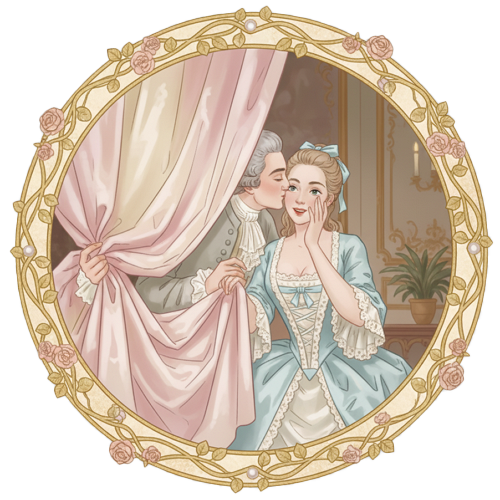
The kiss they had shared, a moment she had replayed in her mind with a breathless, blossoming joy, now felt like a calculated deception.
A tear, hot and unwelcome, escaped her eye and splashed onto a detailed sketch of the orchid’s pollinarium.
The ink blurred, distorting the delicate form into a meaningless smudge.
Just like her future. Ruined.
Her family’s debts loomed, heavier than ever, and her own name was now irrevocably tied to a scandal that would see her barred from the Royal Society for life. She was not just a failure; she was a pariah.
She pushed away from the desk, her chair scraping against the floorboards with a desolate sound.
Pacing the small room, she wrapped her arms around herself, a futile attempt to hold the fractured pieces of her life together. Betrayal was a physical ache, a leaden weight in her chest.
But as she paced, another, more persistent part of her mind began to stir.
It was the part that catalogued, that observed, that sought patterns in the chaos of nature. It was the scientist, and the scientist was not satisfied.
It was too neat, a small voice whispered, cutting through the fog of her despair.
She stopped, her gaze fixed on the rain-streaked windowpane.
Too neat. The phrase snagged in her thoughts.
Scientists knew that nature was rarely neat. It was messy, unpredictable, filled with confounding variables.
And the scene in the glasshouse… it had been anything but messy. It had been a perfectly constructed syllogism of guilt.
Beatrice returned to her desk, pushing aside the botanical drawings.
She took a fresh sheet of paper and a stick of charcoal. This was not a problem of botany, but of logic.
She would approach it as such.
At the top of the page, she wrote: The Incident at Blackwood.
First, the discovery of the contraband.
Where was it found? In a packing crate, tucked behind a row of potted ferns, directly beside the bench where she and Alistair had spent countless hours studying their orchid.
It was the most conspicuous of hiding places. Why would a seasoned smuggler—or a clever Earl—be so careless?
It was like hiding a jewel in a beggar’s empty bowl. Anyone looking would find it instantly.
Second, the timing.
Lord Davies had arrived with the Bow Street Runners. Not local constables, but London’s finest, suggesting he had anticipated a significant crime.
He claimed to have received an anonymous tip.
How convenient that this tip arrived precisely when the crate was there, and that it led them directly to the most damning location on the entire estate: the site of Alistair’s groundbreaking joint research with the very woman whose family charter gave her access.
It was a narrative written for maximum damage, implicating them both in a single stroke.
Her charcoal scratched across the paper as she sketched a diagram, connecting the players with lines of influence.
Alistair. Herself. Mr. Finch. Lord Davies.
What did each person stand to gain or lose?
Mr. Finch: She recalled his perpetual anxiety, his hushed conversations, the foreign coin. He was clearly involved, but he was a pawn, not a king.
He stood to lose his position, his home, possibly his freedom. He gained nothing but the continued safety of his family, which suggested coercion, not ambition.
Alistair: He lost everything. His reputation, the legacy of his family’s glasshouses, the validation of his life’s work, and his freedom.
The risk was catastrophic, the potential reward—a few crates of brandy and silk—laughably small in comparison. It made no sense.
The Alistair she knew, the man who guarded his work with a ferocity born of past betrayal, would never jeopardise it for something so trivial.
Beatrice Holloway: She paused, her hand hovering over the paper. She lost everything, too.
Her one chance to save her family, her scientific credibility, her future. She was collateral damage, the female botanist whose presence added a delicious layer of scandal to the Earl’s downfall.
And then, Lord Davies.
What did Lord Davies lose? Nothing.
What did he gain? Everything he’d ever wanted. The humiliation of his political and social rival.
The discrediting of a brilliant mind that overshadowed his own meager ambitions.
The potential to acquire the Blackwood lands and its political influence should the estate be broken up to pay the Crown’s fines.
The board was cleared of his most formidable opponent.
The charcoal stick snapped between her fingers.
It was a hypothesis, elegant in its cruel simplicity.
Lord Davies hadn’t stumbled upon a smuggling operation; he had orchestrated it.
He had used Finch’s desperation, planted the evidence, and sprung the trap.
The entire event was not a discovery; it was a performance.
But a hypothesis required more than logic. It required faith in the variables one could not see. Could she trust her assessment of Alistair’s character over the evidence laid before her eyes?
She closed her eyes, shutting out the dreary study.
She was back in the greenhouse, the air thick with the scent of damp earth and blooming orchids. The downpour drumming against the glass.
Alistair’s voice, low and rough, speaking of a colleague who had stolen his research years ago.
“Trust is a currency I no longer trade in,” he had said, the bitterness in his tone as sharp as a thorn. A man so wounded by one betrayal would not so carelessly commit another.
She remembered the ball. Lord Davies, his words dripping with insinuation.
And Alistair, standing beside her, a quiet, solid presence, deflecting the condescension of others. A united front, she’d thought at the time.
A pretense that had felt surprisingly real.
And the kiss.
Her breath hitched. That had not been a pretense.
The raw, desperate hunger in that kiss had been real. It was the collision of two lonely, brilliant minds who had finally found their equal.
It was a moment of pure, unguarded truth in a world of academic rivalry and social artifice.
A man who could kiss a woman like that—as if she were a discovery more profound than any orchid—was not a common criminal.
Her eyes snapped open. The choice was clear..
She could drown in her misery, a victim of circumstance, or she could fight. Her father had taught her to observe, to question, and to trust the evidence above all else.
But the evidence here was not the crate of silk; it was the character of the man she had come to know. The man she had, against all reason, fallen for.
She would trust the man.
Energy, sharp and purposeful, surged through her veins, chasing away the lethargy of despair.
She had a new specimen to dissect: a conspiracy. And she would apply the full force of her scientific mind to pinning it down.
But she couldn’t do it alone.
She had to reach Alistair.
Dusk was settling, blurring the edges of the day into a soft, grey gloom. It was the perfect cover.
She changed from her house dress into a practical dark wool skirt and a plain blouse, pulling a hooded cloak over her shoulders.
She left a note for her housekeeper, a vague mention of an evening walk to clear her head, before slipping out the back door.
The journey to Blackwood was a torment of shadows and imagined sounds. Every rustle of leaves was a Bow Street Runner, every snap of a twig a guard.
The estate, once a place of illicit scientific adventure, was now a fortress. But she knew its secret ways, the game trails and the weak points in the old stone walls she had used in her first incursions.
She circled the main house, staying deep within the line of ancient oaks.
Lights glowed in a few windows, but the wing where Alistair kept his private study was dark. He was a prisoner in his own home.
Getting a message to him directly would be impossible.
Then she remembered Mrs. Gable, the head housekeeper.
A woman whose loyalty to the Beaumont family was legendary, and whose nephew was a gardener who worked under Mr. Finch. A gardener who had always treated Beatrice with a quiet kindness.
It was a risk, but it was the only one she had.
She found the young man, Tom, securing the cold frames for the night. He started when she emerged from the gloaming, his eyes wide with alarm.
“Miss Holloway! You shouldn’t be here. The whole estate is crawling with… well, with trouble.”
“I know, Tom,” she said, her voice a low, urgent whisper. “That is why I am here. I must get a message to the Earl. It is of the utmost importance. Can you help me? Can you trust me?”
He looked from her desperate face towards the looming silhouette of the great house. His loyalty to his employer warred with his fear. “They say he…”
“They are wrong,” Beatrice said, her conviction unwavering. “He has been framed. I can help him prove it, but only if he knows he is not alone.”
Something in her certainty must have convinced him. He gave a short, sharp nod.
Beatrice quickly retrieved a small, folded piece of paper from her pocket, on which she had written a message before she left. She pressed it into his hand.
“Give this to your aunt. Tell her it is for the Earl’s eyes only. She will know what to do. Please, Tom. Everything depends on it.”
He curled his fingers around the note, his expression grim. “I will.”
She melted back into the shadows, her heart hammering against her ribs.
She did not know if the message would reach him, or if he would even believe her after her own cold silence these past two days. But she had made her choice.
She had abandoned the safety of her grief and stepped onto the battlefield.
Their partnership was no longer a reluctant contract written in ink on a legal document.
It was an alliance forged in the dark, based on a single, unprovable, and utterly terrifying theory: faith.