The air in the glasshouse, usually thick with the scent of damp earth and exotic blooms, was now sharp with the alien tang of smuggled French brandy.
The smell of corruption. It clung to the humid air, a foul miasma that seemed to choke the very life from the orchids hanging in their delicate rows.
Beatrice stood frozen, her sketchbook clutched to her chest like a shield.
A few feet away, a Bow Street Runner in a drab coat held up a bolt of shimmering French silk, its illicit luxury a garish wound against the verdant green of the ferns.
The crate, nestled so damningly amongst the specimens they had so carefully nurtured, was a gaping maw of evidence.
But it wasn’t the silk or the brandy that held Beatrice’s gaze. It was Alistair.
He stood perfectly still as the chief Runner read the warrant, his face a mask of stone.
His eyes, which she had seen blaze with scientific passion and soften with a startling vulnerability, were now cold, distant voids.
He didn’t look at her. Not once.
As the Runner finished speaking, placing him formally under house arrest pending a magistrate’s inquiry, Alistair gave a single, sharp nod.
That was all. No protest. No denial.
Just a cold, hard acceptance that sliced through Beatrice more cleanly than any shouted accusation could have.
He had known. He must have known.
The thought was a shard of ice in her heart. Their partnership, their late-night discoveries, their kiss… had it all been a cover?
Had she been nothing more than a convenient, scientifically-minded shield for his criminal enterprise?
A wave of nausea and shame washed over her. She was a fool. A naive, desperate fool who had mistaken intellectual fire for integrity, and a moment of shared triumph for something true.
“Miss Holloway,” the chief Runner said, his voice startlingly loud in the suddenly silent glasshouse.
“Your name is on the preliminary research abstract submitted to the Society alongside the Earl’s. You will be questioned in due course. For now, I suggest you return home.”
It was a dismissal.
She was implicated, her name now irrevocably tied to this scandal, yet she was being sent away like a child who had stumbled upon something she ought not to have seen.
Her cheeks burned. She risked a final glance at Alistair.
He was being escorted back toward the manor, his shoulders rigid, his profile as unyielding as a marble bust.
He never looked back.
Beatrice turned and fled.
She ran from the glasshouse, from the suffocating scent of brandy and betrayal, past a pale and trembling Mr. Finch who wouldn’t meet her eye, and out into the bleak, grey afternoon.
***
The journey home was a blur of muted colours and numbing cold. The familiar path seemed alien, every tree a silent witness to her humiliation.
When she finally reached her small, debt-ridden house, it offered no comfort. It was merely a cage of her own failure, the peeling paint on the door a testament to the salvation she had so spectacularly failed to secure.
Inside, she went straight to her father’s old study. The room was her sanctuary, a place of intellect and order.
But today, the neat rows of books seemed to mock her.
On her drawing table lay the finished plate of the orchid, rendered in exquisite, painstaking detail.
The curve of its petals, the unique mottling of its throat, the delicate structure of its stamen—she knew every line of it by heart. It was supposed to be her legacy, her family’s lifeline.
Cymbidium Beaumontia-Holloway.
A name that bound them together.
Now, it was just a beautiful drawing of a lie.
Her fingers trembled as she traced the outline of a petal.
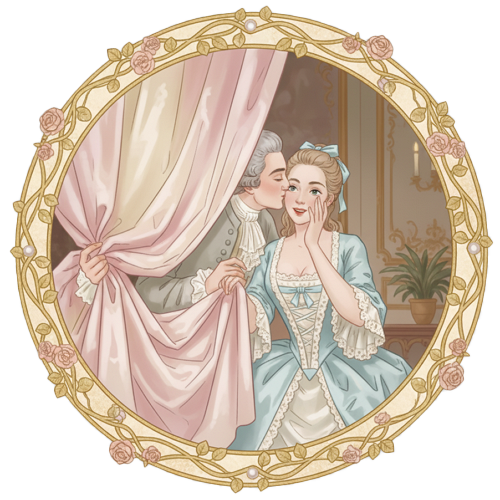
The memory of the kiss surged, unbidden and scorching. The humid air, his hand tangled in her hair, the shocking, breathtaking press of his lips.
She had allowed herself, for one intoxicating moment, to believe it was real. To believe that the brilliant, difficult man who saw her as an equal might also see her as something more.
With a choked sob, she snatched the drawing from the table. Her first instinct was to tear it to shreds, to destroy the evidence of her own gullibility.
But her hands froze.
Destroying it would accomplish nothing. The damage was done.
With a gesture of utter defeat, she let the heavy paper drift back to the table, a pristine, painful reminder of everything she had just lost.
***
Alistair stood at the long window of his library, a prisoner in his own home. He had been a recluse by choice for years; now, that choice had been stripped from him, and the gilded cage of Blackwood Manor had never felt so small, so suffocating.
Outside, a persistent drizzle began to fall, streaking the glass like tears.
He was not allowed in the glasshouse—the scene of the crime, they’d called it. His sanctuary, his laboratory, his life’s work, was now cordoned off as if it were a common back-alley den.
A cold, familiar rage simmered in his gut.
Davies. This had his rival’s stench all over it.
The perfectly timed tip-off, the dramatic arrival of the Runners—it was a performance, and Alistair had been cast as the villain.
But the fury was a shallow thing, a thin layer of ice over a deep, black ocean of despair.
Because this time, the betrayal wasn’t just professional. It was personal.
He closed his eyes, but all he could see was Beatrice’s face in the glasshouse. The dawning horror in her eyes, the swift, brutal shattering of her trust.
He had seen the exact moment she convicted him.
And why wouldn’t she?
He had been secretive. He had discovered Finch’s involvement and kept it from her.
He had grown cold and distant after their kiss, pushing her away in a misguided attempt to shield her from the very scandal that had now engulfed them both.
He had handed Davies the tools to destroy them.
He had wanted to protect her, and instead, he had made her a victim of his own ruin. The irony was a bitter acid in his throat.
A footman entered, his footsteps unnaturally quiet on the thick carpet. He carried a silver salver, a single, crisp envelope resting upon it.
“From the Royal Society, my lord. A messenger just delivered it.”
Alistair took it, his hand steady despite the tremor in his soul. The seal was broken with a flick of his thumb. The language was cold, brutally formal.
In light of the grievous allegations of smuggling and illegal trade levied against the Earl of Blackwood… and the implication of his collaborator, Miss Beatrice Holloway… the Board has voted unanimously to suspend indefinitely all consideration of your submitted paper… pending the outcome of a full legal investigation…
He crushed the letter in his fist.
Indefinitely.
A death sentence in the world of science. To be the first to discover, to classify, to name—that was everything.
Now, their work would languish, their orchid would be a footnote in a scandal, and someone else would inevitably claim the discovery.
He had not only failed to protect his family’s legacy, but he had also single-handedly destroyed Beatrice’s future. The weight of it was crushing, heavier than any legal sanction.
***
Beatrice received her own copy of the Society’s letter that evening. It was delivered by a boy who looked at her with wide, curious eyes, his gaze a mixture of pity and morbid fascination.
The news had clearly already swept through the village. The disgraced Miss Holloway, the botanist who had gotten entangled with a criminal Earl.
She read the letter in the dim light of her study, her mother hovering worriedly in the doorway. The formal words swam before her eyes, each one a hammer blow against the fragile structure of her dreams.
Suspend indefinitely. Implication of his collaborator.
Her family’s debts. Her father’s name. Her own burning ambition to be recognized not as a woman who dabbled, but as a scientist who discovered.
All of it, gone. Turned to ash by a man’s greed and her own weakness.
“Oh, my dear,” her mother whispered, her voice trembling.
“Please,” Beatrice said, her own voice raw and unrecognizable. “Just… leave me be.”
She waited until her mother’s soft footsteps receded before she allowed herself to break.
She didn’t scream or weep. A single, dry sob escaped her lips, a sound of utter desolation.
She slumped into her father’s chair, the weight of her failure a physical force pressing down on her, stealing the very air from her lungs.
She had trespassed on his land to find a flower, hoping to save her family. Instead, she had trespassed into his life, and in doing so, had ruined her own.
The partnership, the discovery, the hope—it was all an illusion.
Alistair Beaumont, the Earl of Blackwood, was not a brilliant, misunderstood scientist.
He was a smuggler. A liar.
A man who had used her, her knowledge, and her desperation as a respectable cover for his crimes.
And she, Beatrice Holloway, had let him.
She had trusted him. She had kissed him.
Staring at the drawing of the orchid, its beauty now seeming grotesque, she felt the last flicker of hope die within her. All that was left was the cold, hard certainty of ruin, and the profound, aching emptiness of a heart betrayed.