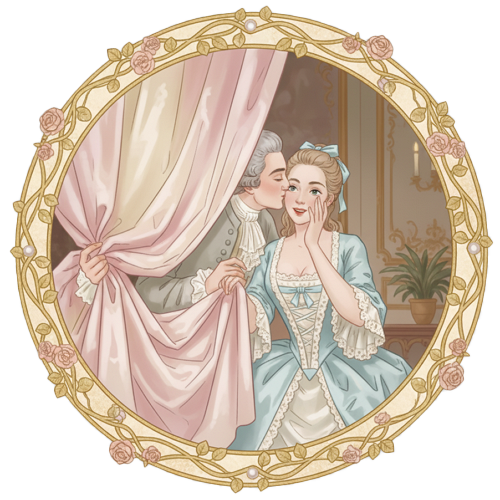
The kiss had been a catalyst, an uncontrolled reaction that had changed the very composition of the air between them.
For two days, Beatrice had breathed it in, a heady mixture of astonishment, hope, and a thrilling, terrifying sense of possibility.
Now, that same air was thick with the suffocating fumes of misunderstanding.
Alistair’s retreat had been as swift and absolute as a winter frost.
The warmth she had seen in his eyes—the unguarded admiration that had made her feel more seen than any scientific citation ever could—was gone.
In its place was a cool, shuttered distance that chilled her to the bone. He had spoken of protection, of shielding her from an impending scandal, but his words felt like carefully constructed walls.
To Beatrice, they sounded less like chivalry and more like regret.
He regretted the kiss. He regretted their partnership. He saw her now not as an equal, but as a liability.
The hurt was a sharp, physical ache in her chest. She sat at her drafting table, the delicate, veined petals of the Cymbidium orchid sketched before her, but her hand was unsteady.
The precise, confident lines she usually produced were wavering and uncertain. Her mind, usually a sanctuary of logic and order, was a maelstrom of conflicting emotions.
She had allowed herself to believe, for one exhilarating moment, that they had discovered something far rarer than a new species of flower.
Now, she felt like a fool, a specimen of feminine gullibility pinned to a board for inspection.
But beneath the hurt, something else stirred: indignation.
And deeper still, the ingrained instinct of a scientist. An anomaly had been presented, and her nature demanded it be examined.
Alistair’s reaction was disproportionate to the cause.
A mere society scandal? The man had faced down the scorn of the Royal Society for years. He was proud, reclusive, but not a coward.
Lord Davies’s public inquiry was a nuisance, to be sure, but it was not a death sentence. It did not explain the complete severing of a connection that had felt so real, so fundamental.
No, she thought, setting her charcoal down with a decisive click.
This is not an emotional problem to be endured. It is a scientific problem to be solved.
Her hypothesis was simple: Alistair’s withdrawal was not about her. It was about the accusation itself.
He was not retreating from their kiss; he was reacting to a genuine threat. And if that were true, she was not a liability to be protected, but a partner who had been unjustly benched.
The first variable to examine was Mr. Finch.
She remembered his perpetual state of anxiety, his nervous glances and hasty actions. She recalled the night of the storm, the hurried concealment of a crate.
More vividly, she remembered the strange coin she’d found near the delivery path and the hushed, angry conversation she’d witnessed between the head gardener and a rough-looking sailor at The Gilded Anchor.
Finch was the inconsistency in the otherwise immaculate equation of the Blackwood estate.
Armed with a renewed sense of purpose that felt infinitely better than passive misery, Beatrice put on her sturdiest walking boots.
She told her mother she was going to the glade to gather new samples, a plausible excuse that was only half a lie. Her true destination, however, was the potting shed.
The walk to Blackwood was different this time.
The familiar path no longer felt like a trespass but a line of inquiry.
When she arrived, she saw Mr. Finch near the glasshouses, his shoulders hunched as he directed two young garden hands in the moving of several large terracotta pots.
He looked thinner than she remembered, the skin around his eyes stretched taut with worry. He didn’t see her as she slipped around the yew hedge, keeping to the shadows.
Her plan was simple, perhaps foolishly so. She needed to get inside his potting shed, the small stone building that served as his private domain.
She circled around to the back, her heart thumping a nervous rhythm against her ribs. The rear window was caked with dirt but blessedly unlatched.
It opened with a low groan that sounded as loud as a gunshot in the quiet afternoon. Hoisting her skirts, Beatrice scrambled through the opening, landing with a soft thud on the packed-earth floor.
The shed smelled of damp soil, manure, and sweet, decaying leaves. It was meticulously organized, a testament to Finch’s professional pride.
Tools hung in their designated places, bags of soil were neatly stacked, and clay pots were arranged by size. But Beatrice wasn’t looking for gardening implements.
She was looking for something that didn’t belong.
Her eyes scanned the cluttered workbench. Tucked beneath a stack of seed catalogues was a thick, leather-bound ledger.
It looked like any other gardener’s logbook, and for the first several pages, it was. Meticulous notes on rainfall, soil pH, and pruning schedules filled the paper in a tidy, looping script.
But then, the entries changed.
She flipped to a section dated three months prior. The handwriting was the same, but the content was… odd.
14 April. Shipment received. Ten Crates, ‘Ficus elastica.’ Moon high.
28 April. Shipment received. Six Crates, ‘Rosa gallica.’ Tide low.
12 May. Shipment received. Twelve Crates, ‘Vitis vinifera.’ Fog thick.
Beatrice frowned. She knew Alistair’s collection well.
He had no particular interest in rubber plants, and while he had roses, an entire shipment of French roses was unlikely.
And Vitis vinifera—common grapevines? It made no sense.
These were not the rare, exotic specimens Alistair prized.
Her scientific mind began to work, searching for the pattern. The shipments coincided with new moon cycles or adverse weather conditions—the perfect cover for clandestine activities.
The sailor at the pub. The hushed arguments.
The foreign coin. It all began to coalesce into a single, alarming theory.
The plant names were a code.
Her fingers trembled slightly as she began to cross-reference.
Ficus elastica.
A hardy, dark plant. Could it represent something dark and strong? Brandy, perhaps?
Rosa gallica.
The Apothecary’s Rose, known for its use in perfumes and textiles. Silks?
Lord Davies had accused Alistair of smuggling French silks and brandy.
She felt a cold dread mix with the thrill of discovery. She continued reading, her eyes flying across the page.
The entries went back nearly a year. This was no small, desperate act.
It was a systematic, organized operation. Beside some entries were initials—’D.S.’—and figures that were far too large for the cost of simple plants.
She turned the page and froze. Near the back of the ledger, a new entry, written in a shakier hand than the others.
21 June. Special order. One crate, placed amongst ‘C. Beaumontia-Holloway.’ For L.D.
Her breath caught in her throat. C. Beaumontia-Holloway. That was their orchid.
The one they had laboured over, the one that had been the catalyst for their rivalry, their partnership… their kiss.
And L.D. It could only stand for one person: Lord Davies.
The pieces slammed into place with brutal clarity. Finch was using the legitimate botanical shipments from the continent as cover.
The smugglers, whoever they were, were threatening him or his family, forcing his cooperation.
And Lord Davies… he wasn’t just a political rival making a lucky accusation. He was involved.
He had ordered a shipment to be hidden amongst their research specimens. He hadn’t just stumbled upon the contraband; he had orchestrated its discovery.
This was a trap, exquisitely designed and sprung with cruel precision.
Alistair wasn’t regretting their kiss. He wasn’t rejecting her.
He was caught in the centre of a dangerous conspiracy, and his coldness, his desperate attempt to push her away, was not an act of dismissal but one of profound, misguided protection.
He was trying to keep her name from being entangled with his, unaware that Lord Davies had already woven her into the plot.
The weight of her realization was immense. The operation was far more dangerous than she had imagined.
These were not simple smugglers; they were criminals capable of blackmail and elaborate schemes to ruin an Earl.
And Finch, the gentle, worried gardener, was their pawn.
Clutching her notes—she had furiously copied the key entries onto a scrap of paper from her satchel—Beatrice felt a surge of cold fury directed squarely at Lord Davies.
He had used their discovery, the purest thing in her life, as a weapon to destroy Alistair.
She had to tell him. She had to show him what she’d found.
Just as she was about to slip back out the window, she heard voices approaching the shed.
Panic seized her.
It was Finch, and with him, the deep, resonant tones of Alistair.
“…cannot continue like this, my lord. The risk is too great,” Finch was saying, his voice strained with desperation.
“The risk is mine to manage, Finch,” Alistair’s voice was low and hard, stripped of all warmth. “You will tell me everything. Now.”
Beatrice pressed herself into the darkest corner of the shed, behind a stack of empty burlap sacks.
She held her breath, her heart hammering against her ribs. She was no longer just an investigator; she was a witness.
And what she was about to overhear would either confirm her theory entirely or shatter it to pieces.