The air in the glasshouse the next morning was just as warm, just as humid, but it felt entirely different. Yesterday, it had been a sanctuary, a laboratory, a battlefield.
Today, it felt sacred.
Beatrice stood before their orchid, sketchbook held loosely in her hands, though she had yet to make a single mark.
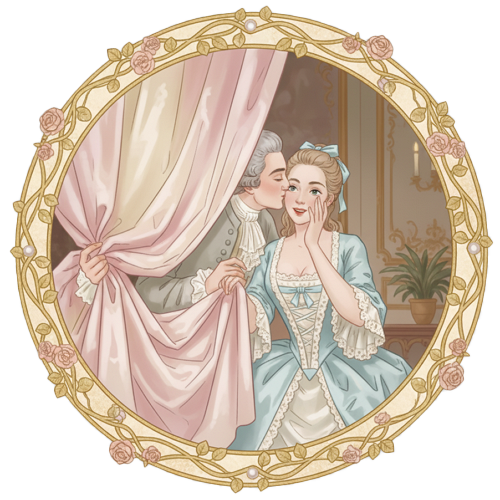
Her gaze was fixed on the velvet petals of the Cymbidium, but her thoughts were a maelstrom, circling back again and again to the moment Alistair’s lips had met hers.
It had been a collision of intellect and impulse, a searing moment of clarity that had rendered every sharp word, every academic barb between them utterly meaningless.
They had pulled away, breathless and wide-eyed, the unspoken question hanging in the air thick as the scent of damp earth and blooming jasmine.
No words had followed.
He had simply given her a look—a raw, unguarded expression that held more meaning than a thousand apologies—before they had parted for the night.
Now, in the bright morning light, doubt pricked at the edges of her euphoria.
Had it been a mistake?
A fleeting madness brought on by the thrill of discovery?
She traced the outline of a leaf with her fingertip, her stomach a knot of delicious, terrifying anxiety.
The glass door creaked open, and Alistair entered.
He stopped a few feet away, his presence filling the space.
He wasn’t looking at her, but at the orchid, his profile sharp and serious. The silence stretched, populated by the ghosts of last night’s passion.
Beatrice’s heart hammered against her ribs.
She was a woman of science, of observable facts and logical conclusions. But the equation of Alistair Beaumont defied all her known principles.
“I trust you slept well, Miss Holloway,” he said, his voice a low rumble that seemed to vibrate through the very floor.
It was so formal, so jarringly polite, that a fresh wave of panic washed over her. He regretted it. Of course, he did. He was an Earl, and she was… well, she was a trespasser he was legally bound to tolerate.
“As well as could be expected, my lord,” she replied, her own tone more starched than she intended. She cleared her throat.
“I was just considering the unique cellular structure of the labellum. It refracts light in a most peculiar way.”
He finally turned to look at her, and the guarded expression in his eyes softened. A faint, almost imperceptible smile touched his lips. “Ah, yes. The labellum. We must certainly focus on the labellum.”
The tension broke.
A giddy laugh bubbled up inside her, and she had to press her lips together to contain it. He saw her struggle, and the smile on his face widened into something genuine, something that reached his eyes and made him look years younger.
“Beatrice,” he said, taking a step closer. The use of her given name was as intimate as the kiss had been. “About last night…”
“A spontaneous chemical reaction, perhaps,” she supplied quickly, a nervous habit of hiding behind the shield of her intellect.
“Brought on by a confluence of atmospheric pressure and… intellectual exhilaration.”
He chuckled, a warm, rich sound that wrapped around her. “A fascinating theory. Though I suspect the catalyst was more than merely intellectual.” He held her gaze, his own a deep, searching blue.
The memory of the kiss was there, reflected in their shared silence.
He wasn’t retreating. He was advancing.
He gestured to the workbench where their notes were laid out in a chaotic, beautiful mess—her precise drawings intertwined with his sprawling, genius-touched scrawls.
“I have been thinking. About this. About the paper.”
Beatrice’s breath caught. This was it. The moment he would decide the terms of their professional engagement, and by extension, their personal one.
“This discovery,” he began, his voice firm, resolute.
“The properties we uncovered, the classification… it is as much your work as it is mine. To publish it under a single name would be a gross academic injustice. A lie.”
He paused, and she could see the internal battle he was fighting—the lifetime of guarded mistrust warring with this new, fragile instinct to open up.
He won.
“The paper must be published under both our names,” he declared. “It is the only just, the only scientific, course of action.” He looked at her, his expression intense.
“Holloway and Beaumont. Or Beaumont and Holloway, we can debate the alphabetical merits later.”
Relief washed over Beatrice so powerfully her knees felt weak. It was more than she had ever dared to hope for.
A joint publication with the Earl of Blackwood would not only save her family from ruin, it would cement her name in the annals of botany forever.
But what truly made her heart soar was the word he had used: scientific.
He was offering her a partnership based on merit, on respect.
He saw her not as a woman, not as an intruder, but as his equal.
“I… I don’t know what to say, my lord,” she stammered, overwhelmed.
“Alistair,” he corrected softly. “And you can say yes.”
“Yes,” she breathed, a wide, unstoppable smile spreading across her face. “Yes, of course.”
He extended his hand. “Then it is settled. Partners.”
She placed her hand in his. His grip was warm and firm, and for a moment, neither of them moved.
It was not the perfunctory handshake of colleagues, but the linking of two souls who had found in each other a startling, unexpected recognition.
The air hummed with unspoken promises, with the thrilling potential of a future just beginning to bloom.
***
Later that afternoon, the heady optimism of the glasshouse followed them into the imposing, mahogany-scented confines of Alistair’s library.
For the first time, Beatrice did not feel like an interloper within Blackwood’s walls. She felt as if she belonged.
They sat across from each other at a grand desk, a preliminary abstract for the Royal Society taking shape between them.
The work was effortless, a seamless dance of two minds perfectly in sync.
He would propose a line of reasoning, and she would refine it with a precise observation. She would question a conclusion, and he would support it with a cascade of historical precedents she’d never considered.
They argued, they debated, and they laughed. The sound of her own laughter, free and unburdened in the Earl of Blackwood’s private study, was a marvel to her.
She looked up from a passage she was editing to find him simply watching her, a look of quiet contentment on his face.
The warmth that flooded her cheeks had nothing to do with the fire crackling in the hearth.
“What?” she asked, a little shyly.
“Nothing,” he said, his voice soft. “I was just thinking that this house has been silent for far too long.”
Before she could formulate a reply, the library doors opened and the butler, a stern-faced man named Jennings, entered with a silver salver. “A priority dispatch for you, my lord. From London.”
Alistair’s smile faded slightly as he took the heavy parchment envelope. He broke the seal with a frown, his eyes scanning the official-looking script.
Beatrice watched as the color drained from his face. The open, warm man who had joked with her only moments before vanished, replaced by the cold, formidable Earl she had first met.
His jaw tightened, and the hand holding the letter clenched into a fist, crinkling the parchment. The walls he had so carefully dismantled were being rebuilt before her very eyes, brick by painstaking brick.
“Alistair?” she asked, her voice quiet with concern. “What is it?”
He didn’t answer immediately. He read the letter a second time, as if unable to believe its contents. When he finally looked up, his eyes were chips of ice.
“It is a formal notice,” he said, his voice flat and devoid of all emotion. “From the office of Customs and Excise. They are launching an official inquiry into the shipping manifests for the Blackwood estate.”
Beatrice stared at him, confused. “An inquiry? For what reason?”
“The reason,” he said, and the words came out like shards of glass, “is an anonymous but ‘credible’ report suggesting my botanical shipments are being used as a cover for the illegal trade of untaxed goods.”
The air left the room.
Smuggling.
The word hung between them, ugly and venomous. Beatrice’s mind immediately flew to Mr. Finch—his nervousness, the strange coin, the hushed argument with the sailor.
A cold dread seeped into her bones. It was real.
“But that’s absurd,” she managed, though her voice trembled. “Who would make such a preposterous accusation?”
Alistair let out a short, bitter laugh that held no humor.
He tossed the letter onto the desk. It slid to a stop near her hand.
Her eyes caught the name at the bottom, cited as the public figure petitioning for the inquiry on behalf of his concerned constituents. Lord Davies.
“Who else?” Alistair spat, rising from his chair to pace before the fireplace.
“Davies has been circling my family for years, waiting for a sign of weakness. He sees my ‘reclusiveness’ as a vulnerability to be exploited.”
He stopped and stared into the flames, but Beatrice knew he wasn’t seeing them. He was seeing a past betrayal, a wound she now understood was being violently torn open.
All the progress they had made, the trust so tentatively offered, was evaporating like morning mist.
“We will fight this,” she said, standing to join him. “We will show them the records, prove there is nothing to hide. They will find nothing, Alistair. It is a baseless slander.”
He turned to her then, and his expression stopped her cold. He was looking at her, but his gaze was distant, as if viewing her from across a vast and suddenly impassable chasm.
The warmth, the partnership, the intimacy—it was all gone. In its place was the familiar mask of the solitary Lord of Blackwood, a man who trusted no one.
A man who bore his burdens alone.
“There is no ‘we’ in this, Miss Holloway,” he said, his tone chillingly formal. “This is a matter of my family’s name. It has nothing to do with you.”
The dismissal was as sharp and sudden as a slap.
An hour ago, they were partners. Now, she was once again Miss Holloway, an outsider to be shielded or, worse, dismissed.
The glorious, sunlit world they had begun to build together was plunged into a sudden, freezing shadow, and she was left standing in the dark.