The air in the Orangerie Grandiflora didn’t smell like refrigerated carnations and desperation. It smelled alive.
It was the rich, dark scent of damp earth, the sweet perfume of a thousand different blossoms competing for attention, and the clean, green fragrance of humidity clinging to fern fronds.
After weeks confined to the sterile, artificially lit studio, being set loose in a massive, historic botanical garden felt less like a challenge and more like a parole hearing.
Today’s task was as ambitious as the setting: create a suspended floral installation that captured the “Spirit of the Garden.”
It was a grueling, day-long affair involving rickety scaffolding, hauling hundred-pound bags of moss, and painstakingly wiring thousands of delicate stems into an enormous hanging armature.
While other teams devolved into bickering and creative paralysis, Julian and I had fallen back into the rhythm we’d discovered in the last challenge.
Our controlled chaos.
He was the architect, mapping out the weight distribution and structural integrity with the calm precision of an engineer.
I was the artist, the wild card, clambering over the structure like a monkey to weave in unexpected textures—trails of feathery asparagus fern, clusters of dark, moody scabiosa that looked like pincushions for a gothic doll, and asymmetrical bursts of electric-blue delphinium that defied his perfect symmetry.
He’d look up at me, a smudge of dirt on his cheek, and instead of telling me to rein it in, he’d just nod. “Higher on the left, Rev. It needs more of your beautiful madness over there.”
The compliment, tossed so casually from the ground, had sent a jolt straight through me, warmer and more potent than the lukewarm coffee we’d been chugging all day.
When the final bell rang, my muscles screamed in protest and my hands were raw.
The other contestants, flushed with exhaustion and relief, immediately migrated toward the catering tent where wine was being uncorked.
Their loud, boisterous laughter echoed through the manicured lawns as the sun began to dip below the horizon, painting the sky in hues of bruised plum and soft peach.
I hung back, wanting a moment of quiet before rejoining the circus. My gaze drifted toward the grand Victorian glasshouse at the far end of the estate, its panes of glass glowing like embers in the twilight.
“Don’t tell me you’re skipping the cheap Chardonnay.” Julian’s voice, low and laced with a familiar amusement, came from just behind me.
I turned, a wry smile touching my lips. “And miss out on the post-mortem of who used too much baby’s breath? Never.”
I gestured with my chin toward the magnificent structure. “Just admiring the architecture. It’s a palace made of windows.”
He followed my gaze, a soft, appreciative look on his face.
“The Orchid House. It’s the oldest part of the gardens. Most of the specimens in there are rarer than anything we’ve worked with all season.”
He hesitated for a fraction of a second, his usual composure seeming to falter. “There’s something I think you’d appreciate. Before we have to go back.”
The invitation hung in the air between us, simple and unadorned. It wasn’t a strategic move or a competitive ploy. It felt… personal.
“Lead the way, Floral Prince,” I said, the nickname coming out softer than I intended.
We walked in comfortable silence, the crunch of our boots on the gravel path the only sound. As we drew closer, the scale of the glasshouse was staggering.
Inside, soft lights had flickered on, illuminating the silhouettes of strange, alien-looking plants. Julian pushed open a heavy iron-scrolled door, and the change in atmosphere was instantaneous.
The air was a living thing—thick, warm, and steamy, clinging to my skin and clothes. It was heavy with the intoxicating, almost cloying scent of vanilla, spice, and something wild and floral I couldn’t name.
We were in another world. A narrow stone path wound through a dense jungle of enormous leaves and tangled vines.
And everywhere, there were orchids.
They weren’t the sad, cellophane-wrapped specimens from the grocery store. These were magnificent, untamed creatures.
Some dripped from hanging baskets, their petals a pristine, ghostly white. Others erupted from bark and moss, their flowers mottled and freckled with vibrant, impossible colors.
Long, elegant stems held blooms that looked like hovering moths, while others were shaped like slippers, stars, or spiders.
“Wow,” I breathed, the single word feeling wholly inadequate. I reached out, my fingers hovering over a spectacular, tiger-striped petal. “They don’t even look real.”
“Cattleya schilleriana,” Julian said, his voice a low hum beside me. “And that one”—he pointed to a cascade of speckled pink-and-white blooms—“is a Phalaenopsis. The Moth Orchid. Most people only know the hybrids, but the original species are… something else.”
He spoke with a quiet reverence, a passion that went beyond the competition. This was his element.
In the studio, under the harsh lights, he was a technician, a perfectionist. Here, bathed in the soft glow and surrounded by this riot of life, he seemed softer, more unguarded.
The moonlight filtering through the glass panes caught the silver in his hair and turned his eyes a deep, fathomless grey.
I found an orchid with petals the color of a black bruise, edged in a shocking fuchsia. “Now this one,” I said, grinning, “this one gets me. It’s like a punk rock flower. It refused to be pretty and pink.”
Julian stepped closer to look, our shoulders almost brushing. The humid air suddenly felt ten degrees hotter.
“It’s a Fredclarkeara After Dark. It’s famous for that color.” He looked from the flower to me, a slow, searching gaze.
“They’re deceptive, you know. They look rebellious, but they require the most precise, controlled conditions to bloom like that. The perfect balance of light, humidity, and temperature.”
His words landed like a stone in a still pond, the ripples expanding outward.
The perfect balance. Controlled chaos.
His precision, my beautiful madness.
He wasn’t just talking about the flower.
We stood there for a long moment, the sounds of the greenhouse enclosing us—the gentle drip of condensation from a broad leaf, the hum of the ventilation system.
The professional admiration that had been growing for weeks, the easy camaraderie we’d found, the dangerous spark of attraction from our last victory—it all swirled in the thick, fragrant air, condensing into something heavy and undeniable.
My heart was hammering against my ribs, a frantic, wild rhythm. This was Julian. The Floral Prince.
The man whose perfectly ordered world was the antithesis of my own.
Falling for him, even a little, felt like a betrayal of every spiky, defensive principle I’d ever held. It was selling out in the most spectacular fashion.
And yet, I couldn’t make myself move away. I couldn’t break the gaze that was holding me captive.
In his eyes, I didn’t see the polished competitor or the pedigreed florist. I saw a man who understood the chaos inside me and wasn’t afraid of it.
He saw it as something beautiful.
I swallowed, my throat suddenly dry. “They’re beautiful, Julian. Truly.”
The admission was quiet, stripped of all my usual irony and armor. It was the most honest thing I’d said to him all day, and it was all it took.
His hand came up, slow and deliberate, as if giving me time to pull away. But I was rooted to the spot.
His fingers were warm as they brushed a stray strand of hair from my cheek, his touch surprisingly gentle for a hand calloused by thorns and wire.
He cupped my jaw, his thumb stroking softly just below my ear, and the frantic rhythm in my chest stuttered and seized.
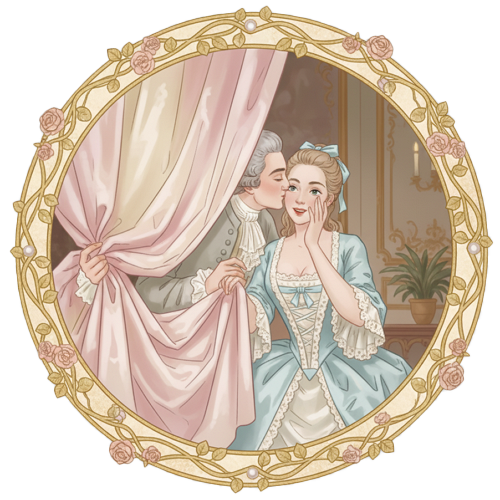
Then he leaned in and kissed me.
It started as a soft press of lips, a moment of pure, breathtaking tenderness that seemed to ask a question.
My breath hitched, and my hands, of their own accord, came up to rest on his chest, feeling the solid, steady beat of his heart beneath my palms.
I could smell the earthy scent of moss on his clothes, mixed with the sweet, heady perfume of the orchids.
The question was answered with a sigh that was half surrender, half longing.
I leaned into him, and the kiss deepened. It became intense, a slow burn of pent-up energy and unspoken words.
This wasn’t the frantic, messy passion I was used to. It was deliberate, consuming.
It wasn’t just a kiss; it was a conversation that had been happening between us for weeks, spoken in a language of shared glances, quiet compliments, and grudging respect.
It was the thrill of our shared victory, the exhaustion of the long day, the magic of the moonlit garden, all melting into a single, perfect point of contact.
It was chaos and control, intertwined.
When he finally pulled back, it was only by an inch. His forehead rested against mine, his breathing as uneven as my own.
His eyes were closed, but I could feel the intensity of his presence, a magnetic force that held me there. My fingers were still splayed on his chest, my silver rings cool against the warmth of his shirt.
In the sudden, ringing silence, the slow, rhythmic drip of water onto a leaf sounded as loud as a gunshot.
The spell was broken. Or perhaps, it had just been cast.
Julian slowly opened his eyes, and the look in them was one of profound shock, as if he’d just woken from a dream and was terrified to find it was real.
He dropped his hand from my face as if he’d been burned, and the cool air that rushed into the space between us felt like a chasm.