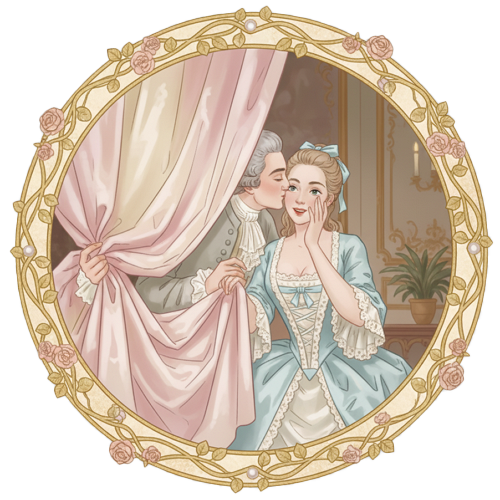
The coffee shop Alistair had chosen was as sterile as a laboratory. All white walls, blond wood, and brushed steel, it smelled more of disinfectant than espresso.
He was, of course, early. Seated at a small, square table, he had his leather briefcase open beside him, a bottle of mineral water precisely aligned with the edge of the table, and a thick, professionally bound document resting squarely in front of him.
He looked less like a man on a clandestine meeting and more like a PhD candidate about to defend his dissertation.
Chloe blew in five minutes later, a whirlwind of color and energy that seemed to instantly unbalance the room’s severe Feng Shui. She wore a bright floral scarf that defied the gray afternoon outside, and her smile, though professional, was warm enough to melt the frost on the window.
“Dr. Finch,” she said, sliding into the chair opposite him. “Or should I call you Alistair, now that we’re about to be madly in love?”
Alistair blinked, the jest sailing past him like a paper plane in a wind tunnel. “Dr. Finch is appropriate for this stage of the negotiation.
Alistair can be… phased in, as per the established timeline.”
He gestured to the document between them. Its cover page read: Memorandum of Understanding Concerning a Mutually Beneficial Socio-Romantic Partnership.
Chloe stared at the title, her eyebrows climbing toward her hairline.
“Wow. You weren’t kidding.
I was expecting a couple of pages of bullet points, maybe a standard NDA. This looks like a peace treaty.”
“Clarity is paramount in any venture,” Alistair said, his tone dry and factual. He slid the document across the table.
“I believe you will find the terms both comprehensive and equitable.”
Chloe picked it up. It was heavier than it looked.
She flipped through the pages, her initial amusement giving way to a sort of stunned reverence for his sheer, unadulterated meticulousness.
There were sections, sub-sections, and appendices. There were footnotes.
“Okay,” she began, flipping to a tabbed page. “Section 7: Protocols for Public Displays of Affection.”
She read aloud, her voice laced with disbelief. “Clause 7.2(a): Hand-holding.
Permissible in public family settings. Duration not to exceed five minutes per instance, with a minimum cooldown period of twenty minutes to avoid suggestion of… unseemly dependence?”
Alistair nodded gravely. “I felt that was a reasonable parameter.
It projects intimacy without sacrificing decorum.”
“Decorum,” Chloe repeated, her lips twitching. She continued reading.
“Clause 7.2(c): Kisses. Restricted to one (1) chaste peck on the cheek upon greeting and one (1) upon departure.
A singular kiss on the lips, closed-mouth, maximum duration three seconds, is permissible if initiated by a third party, for example, under mistletoe, which is seasonally irrelevant but included for thoroughness.”
She looked up, her expression a perfect cocktail of horror and fascination. “Alistair, are you trying to convince your grandmother you’re in a relationship or that you’ve joined a very formal, very unaffectionate cult?”
“It’s about establishing a baseline,” he insisted, a faint flush creeping up his neck. “Unpredictable variables are the enemy of a successful outcome. Emotion is the most unpredictable variable of all.
This contract seeks to mitigate that.”
“Emotion is the entire point,” Chloe countered, leaning forward and lowering her voice. “We’re not building a model airplane; we’re selling a love story.
A love story needs spontaneity. It needs to be messy.
People in love don’t time their hand-holding with a stopwatch.” She tapped a perfectly manicured nail on another clause.
“And this… Section 9: Conversational Parameters. Approved topics include eighteenth-century manuscript preservation, Impressionist art, and recent meteorological patterns?”
She met his eyes. “No one talks about the weather unless they’re trying to escape a conversation, Alistair. It’s a social SOS.”
“They are topics on which I can expound with confidence,” he defended himself. “Appendix B lists forbidden topics, which I believe is self-explanatory.
Past romantic entanglements, personal finances…”
“Existential dread,” Chloe finished, having already scanned the list. “My God, you’ve outlawed small talk and big talk.
What’s left?”
“The approved topics are more than sufficient.”
Chloe took a deep breath, shifting from amused spectator to seasoned professional. This was the part of her job she was actually good at: managing the unmanageable.
“Okay. Look.
I appreciate the effort. Sincerely.
No client has ever been this… thorough. But from a performance standpoint, this is a straitjacket.
I can’t build a believable character inside these constraints. Your grandmother, Matilda, you said she’s sharp.
She’ll spot a robot a mile away. We need room to improvise.”
“Improvisation leads to error,” he stated, the words as rigid as his posture.
“No, improvisation leads to authenticity,” she shot back. “You’re the historian
You know that history isn’t just a list of dates and facts. It’s the stories, the passions, the mistakes.
That’s what makes it feel real.” She picked up a pen from her purse.
The sight of it hovering over his pristine document made Alistair flinch. “Let’s compromise.”
He watched in silent agony as she drew a neat line through the five-minute hand-holding rule. “Let’s just say, ‘when it feels right,’” she said, writing in the margin.
“But how will I know when it ‘feels right’?” he asked, a note of genuine panic in his voice.
“You won’t. I will,” she said calmly.
“That’s what you’re paying me for. Trust me. I’ll lead.”
She moved on to the kissing clause, amending it to read: Affection to be deployed as believability dictates. See ‘Signal System’ in Appendix D.
“We’ll need a signal,” she explained. “If I squeeze your hand twice, it means play along.
If I adjust my scarf, it means change the subject immediately.”
He seemed to relax fractionally at the introduction of a systematic approach. “A signal system.
That is… an acceptable amendment.”
For the next half hour, they worked their way through the document. He was the architect, obsessed with blueprints and stress tolerances; she was the interior designer, insisting that the cold, functional space needed warmth and life to be habitable.
She crossed out his list of approved topics and replaced it with a simple directive: Follow my lead, but feel free to talk about books. It’s your ‘passion,’ it’ll seem authentic.
Finally, they reached the signature page. The document was now a mess of Chloe’s elegant cursive corrections and Alistair’s tight, slightly horrified annotations.
It was no longer a treaty; it was a collaboration.
“The fee,” Alistair said, clearing his throat as Chloe took out her own copy to sign. “Fifty thousand, as discussed.
Half upon signing, half upon the successful release of the inheritance funds.”
Chloe nodded, the number grounding her. This was why she was here.
This was for her business, for her future. It was worth enduring a man who footnoted his feelings.
They signed both copies and exchanged them. The deal was done.
“Now,” Alistair said, sliding the amended contract carefully back into his briefcase as if it were a fragile artifact.
“Phase two. Backstory integration.”
He produced a second, much slimmer folder. “I’ve prepared a list of key biographical data points for you to memorize.
My educational history, notable academic publications, allergies—I have a mild sensitivity to kiwi fruit—and a summary of my work regarding the Blackwood Library.”
He handed her a single sheet of paper that was, essentially, his life in bullet points. It was as dry and impersonal as a curriculum vitae.
- Born: Winchester, UK
- Education: BA, MA (Oxford); PhD (Cambridge) – History
- Notable Publication: ‘Vellum & Virtue: The Moral Implications of Medieval Bookbinding’
- Allergies: Actinidia deliciosa (Kiwi)
Chloe read it over, trying to find a flicker of the man behind the facts.
“Okay. Got it. No kiwi.
So, what’s my story?”
“I have left that largely to your professional discretion,” Alistair admitted. “I assumed you would prefer to construct your own persona.
However, it must be something… plausible. Perhaps an archivist?
Or a fellow academic from a different field?”
Chloe shook her head. “Too much jargon to learn.
Too easy to get tripped up by an expert. No, it’s better if I’m something completely different.
It makes our pairing more interesting. An opposites-attract narrative is very compelling.”
She thought for a moment. “I’m a freelance floral designer.
It’s creative, a little romantic, and no one knows enough about it to ask trick questions. My business is called ‘Petal & Post.’”
It wasn’t, but it sounded better than ‘Plus-One for Hire.’
Alistair considered this, his brow furrowed.
“Floristry. A botanical artist.
That… has a certain classical appeal. Acceptable.”
“Great,” Chloe said, scribbling a note on a napkin. “So, how did we meet?”
This, apparently, was a question Alistair had prepared for. “At a symposium on late-Renaissance cartography.
You were there providing the floral arrangements for the welcome dinner. I was presenting my paper.
I was captivated by your… symmetrical arrangement of the lilies.”
Chloe winced. “Symmetrical lilies.
Alistair, no. That sounds like something you’d write in a research paper, not how you’d fall in love.
Let’s try again.” Her mind, trained for this very task, began to spin a story.
“Okay, how about this: We met at the British Library. You were engrossed in a manuscript, looking for a specific reference you couldn’t find.
I was there researching historical floral patterns for a big wedding project. I was sitting at the next table and overheard you muttering to yourself in frustration.
I happened to know the reference because the flower in the manuscript’s margins—a wolfsbane—was a key symbol in the wedding theme I was designing. I leaned over and pointed it out to you.”
Alistair was quiet for a long moment, processing. She could almost see the gears turning in his head.
“That is… highly improbable,” he finally said.
“That’s why it’s perfect!” she exclaimed.
“It’s fate. It’s a meet-cute. It’s romantic.”
“It’s statistically unlikely.”
“Love is statistically unlikely,” she countered gently. “That’s the whole point.”
He conceded with a stiff nod, making a small note on his own pad. Origin Story: British Library, mutual interest in Aconitum variegatum.
They spent the next hour like that, studying for the most important exam of their lives.
They exchanged fabricated childhood anecdotes, decided on their first date (a walk along the South Bank, followed by him talking her ear off about the architectural history of the Globe Theatre), and picked out their favorite “couple” song (a piece by Vivaldi he’d chosen, which Chloe privately thought was the least romantic music imaginable).
When they finally stood to leave, the sterile coffee shop was nearly empty, the afternoon light fading outside. They were no longer Dr. Finch and Ms. Jones.
They were Alistair and Chloe, a historian and a floral designer who fell in love over a poisonous flower in a dusty library.
The construct felt both absurdly fragile and terrifyingly real.
“The car will pick you up at ten a.m. on Friday,” Alistair said, his voice formal once more. “We will arrive at the estate together.
From that moment, the agreement is active.”
“Showtime,” Chloe confirmed with a small, tight smile.
They stood on the pavement for a moment, two strangers bound by a contract full of crossed-out clauses and improbable stories. The gulf between his rigid, quantifiable world and her fluid, emotional one seemed as wide as the London street separating them.
And in three days, they were going to have to build a bridge across it strong enough to fool a family.