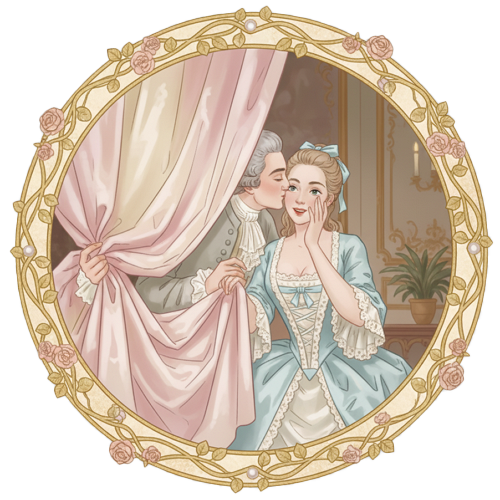
The air in the Marlowe family box was thick with the scent of beeswax, expensive perfume, and smug satisfaction. To Beatrice, it was the smell of suffocation.
She sat perfectly still, a marble statue in watered silk, the heavy emeralds at her throat feeling less like adornment and more like a collar.
Beside her, Lord Ashworth preened, his fingers tapping possessively on the velvet railing. On her other side, her brother, the Earl of Danbury, wore an expression of profound, proprietary pride.
“A triumph, is it not?” Danbury murmured, his voice a low rumble meant only for her and Ashworth.
“The ton is utterly captivated. You have chosen well, Ashworth. Shaw may be a commoner, but the fellow has a certain… flair.”
Ashworth inclined his head, a gesture of magnanimous ownership.
“He has his uses. But the true genius, of course, is the composer. A pity no one knows who he is. A ghost, they call him.”
A cruel, knowing smile played on his lips as he glanced at Beatrice.
“Fitting, I suppose. Some talents are best kept in the shadows.”
Beatrice offered no reply. Her spirit had retreated to a place so deep within her that their voices were merely a dull drone, like wasps trapped behind a windowpane.
The first two acts of The Echo of a Soul had passed in a blur of colour and sound. She had watched the actors move across the stage, had heard the orchestra swell with melodies that had been born in the secret, dusty rooms of her soul, and had felt nothing but a profound and hollow ache.
It was her music, but it was no longer hers. It was a beautiful corpse, exquisitely dressed and presented to the world, its heart ripped out.
Every note was a memory. The soaring romantic theme in the second act was the memory of Finnian’s hand brushing hers over a freshly inked page.
The melancholic cello solo was the sound of his grief for a childhood loss, a grief she had cradled and transformed into music.
The entire opera was a testament to their forbidden love, and she was forced to witness its public unveiling chained to the very men who had conspired to murder it.
The intermission bell chimed, and the house lights rose slightly. The hum of conversation grew louder, a wave of praise and speculation.
“My dear, you look pale,” Ashworth noted, his tone a perfect blend of concern and command.
“The excitement, I imagine. We shall have to ensure you are not so easily overwhelmed when you are Lady Ashworth.”
Her hands, gloved in white kid, clenched in her lap.
Overwhelmed? She was not overwhelmed. She was being erased.
The lights dimmed again for the final act. A hush fell over the theatre.
Beatrice closed her eyes, preparing to endure the last of it. This was the act that had remained unfinished, the one they had never perfected.
After she had sent her cold, clinical letter ending their collaboration, Finnian had been left to stitch together a finale on his own. She braced herself for the inevitable disappointment, for the sound of his work without her soul to guide it.
The music began, familiar yet… different. Fuller, somehow. More desperate.
Then the lead soprano, the fiery Signora Vettori, stepped into a single pool of light at the centre of the stage.
This was new. There was no grand aria for the soprano at this point in their original score. This was Finnian’s addition. His final word.
The orchestra softened to a tremulous whisper, and the soprano drew a breath. Her voice, clear and powerful, filled the cavernous theatre.
“They bid me live a shadow in the sun,
An echo of a soul, my music done.
They build a cage of gold and call it grace,
And bid me hide the truth behind my face.”
Beatrice’s breath caught in her throat. The words struck her not like music, but like stones. They were not for the audience; they were for her.
This was not a song for the character on the stage; it was a message, a plea, a final, desperate cry across the chasm that separated them.
Ashworth shifted beside her, a flicker of irritation crossing his face at the unexpected change in the score. Danbury leaned forward, intrigued by the raw power of the performance.
But Beatrice heard only Finnian’s voice, as clear as if he were whispering in her ear from the wings.
The soprano’s voice swelled, climbing with a fierce, defiant passion.
“But stone can break and iron bars can bend,
And silence is a lie I will not lend!
This ghost will not be bound, will not be tame,
This soul will rise and scream its own true name!”
A tremor ran through Beatrice’s entire body. Scream its own true name. It was what he had always urged her to do.
He had seen her, truly seen her, not as Lady Beatrice Marlowe, a jewel to be owned, but as a creator, a force equal to his own.
And now, from the darkness of his own heartbreak, he was reminding her of that person, the one she was about to let Ashworth bury alive.
In that moment, something within her fractured. The carefully constructed dam of resignation, of fear, of noble sacrifice, shattered into a thousand pieces.
It was not noble to let her spirit die to protect Finnian’s body. The greatest betrayal of their love would be to let their creation, their shared soul, be presented as a lie.
The greatest betrayal of herself would be to remain silent.
A white-hot clarity, pure and terrifying, surged through her. There was only one choice. There had only ever been one.
She rose.
The movement was so abrupt, so out of place, that it felt like a physical blow in the stillness of the box.
“Beatrice?” Danbury hissed, his face a mask of confusion and outrage.
“What in God’s name are you doing? Sit down!”
Ashworth’s hand shot out, grabbing her arm. “Control yourself,” he snarled, his mask of civility vanishing to reveal the cold fury beneath.
“You are making a scene.”
She looked down at his hand on her arm, then met his eyes. The fear was gone, replaced by a cold, glittering fire.
She pulled her arm away with a force that surprised them both. Without a word, she turned her back on them.
She reached up and unclasped the heavy velvet cloak from her shoulders, letting it fall to the floor in a dark pool at her feet. It felt like shedding a skin.
“Beatrice!” Her brother’s voice was a choked command, but it was distant now, unimportant.
She opened the door of the box and stepped out into the shadowed corridor. She did not run.
She walked with a deliberate, resolute pace down the curved staircase, her silk slippers making almost no sound on the carpeted steps.
Heads began to turn. A ripple of whispers followed her progress, a current of scandal and confusion. She ignored it all.
Her focus was singular, a burning point of light at the bottom of the theatre: the orchestra pit.
As she reached the main aisle, the music on stage faltered. Signora Vettori held her final note, her eyes wide with astonishment as she watched Beatrice’s steady advance.
The conductor’s baton wavered, and a few violins trailed off into discordant squeaks. A wave of murmurs swept through the audience.
Beatrice did not hesitate. She descended the small steps into the pit, her heart hammering against her ribs not with fear, but with a wild, exhilarating power.
She walked directly to the pianoforte, where a hired musician was staring up at her, his hands frozen above the keys, his mouth agape.
She looked at him, her expression calm and unyielding.
“Excuse me,” she said, her voice clear and steady in the sudden, ringing silence of the theatre. “This is my part.”
A collective gasp swept from the stalls to the rafters. The man, utterly bewildered, slid from the bench as if compelled by a force beyond his understanding.
In the Marlowe family box, Lord Ashworth stood rigid, his face pale with a rage so profound it was almost silent. Danbury had sunk into his chair, his head in his hands, the picture of public ruin.
And in the wings, Finnian stood frozen, his heart stopping as he understood.
Beatrice sat down on the bench. For a moment, she simply rested her bare fingers on the cool ivory keys.
She took a deep, shuddering breath, inhaling the scent of dust and rosin and freedom. This was her sanctuary. This was her truth.
She looked up, her gaze sweeping past the conductor, past the sea of shocked, upturned faces, and found him. Finnian.
Standing in the shadows of the wings, his face was a portrait of disbelief, terror, and a dawning, incandescent hope.
Their eyes locked, and in that single, silent exchange, everything was said. I am here. I will not be a ghost. This is for us.
Then, she began to play.
It was not the simple accompaniment the hired musician had been providing. This was the music as it was meant to be, as only she could play it.
A torrent of sound erupted from the pianoforte, a brilliant, complex, and breathtakingly passionate finale.
Her hands flew across the keys, weaving intricate counter-melodies, thundering through powerful chords, and whispering through delicate arpeggios.
This was the culmination of every secret meeting, every argument, every shared glance, every stolen touch. It was the sound of her gilded cage breaking apart.
It was her rage at Ashworth, her sorrow for her brother’s blindness, her boundless, terrifying love for Finnian. It was the declaration of her own soul, note by glorious note.
The orchestra, stunned into silence, slowly began to rejoin her. The conductor, tears streaming down his face, lowered his baton and simply listened, mouths agape as the musicians followed her lead, swept up in the raw, undeniable genius of the true composer.
The music swelled, grander and more emotionally resonant than it had been all night. It was no longer just an opera; it was a revelation.
Beatrice played on, lost to the world, lost in the music that was her very essence. She was not Lady Beatrice Marlowe. She was not the future Lady Ashworth.
She was the Ghost of Covent Garden, and she was finally, gloriously, haunting them all.
The final chord crashed through the theatre, a triumphant, resonant sound that vibrated in the very bones of the building. It hung in the air for a long, breathless moment.
Silence. A silence so absolute, so profound, it was louder than any applause.
Then, from the highest balcony, a single person began to clap. Another joined in, then a dozen, then a hundred, until the entire theatre erupted in a deafening roar.
It was not polite applause. It was a storm, a tidal wave of ecstatic, thunderous ovation. People were on their feet, shouting, weeping, throwing flowers not at the stage, but towards the orchestra pit.
Beatrice’s hands fell from the keys, trembling with exhaustion and adrenaline. She looked out at the blur of faces, the roaring, anonymous crowd that had just witnessed her birth.
And through it all, she saw only him. Finnian was now at the edge of the stage, looking down at her, his face alight with a love and awe so powerful it burned away every last trace of her fear.
She had lost her name, her family, her future. But in one triumphant, impossible act, she had claimed herself. And that, she knew, was everything.