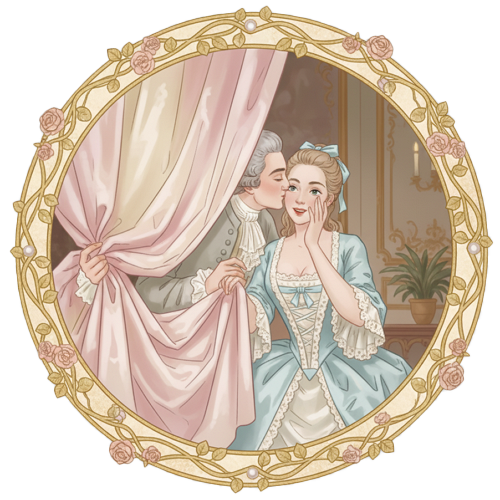
The world had shrunk to the dimensions of Beatrice’s bedchamber. The brocade wallpaper, with its pattern of climbing roses, seemed to writhe and tighten, a gilded cage constricting around her lungs.
Lord Ashworth’s voice echoed in her memory, not as a shout, but as a calm, venomous whisper that was infinitely more terrifying. He will be charged… imprisoned for corrupting a lady of quality… I will see him ruined.
The words were a physical weight, pressing down on her chest until she could barely draw a breath. Every beautiful thing in her room had become an instrument of torture.
The elegant harp in the corner stood mute, its strings accusing her of the silence she was about to impose. And the pianoforte… she could not even look at it.
The polished rosewood gleamed like a coffin. To touch the keys now would be a betrayal of the promise she was being forced to make. It would be like screaming in a church.
Finnian. His face swam before her eyes—the intensity of his gaze when they worked, the rough tenderness of his hands, the way his laughter seemed to coax the sun from behind the London smog.
She thought of their last night together, a stolen symphony of whispered confessions and breathless discovery. She had given him her body, her heart, her music.
And in return, he had shown her a world where she was not an ornament, but a creator.
Now, Ashworth was demanding she take a blade to the very tapestry of that world. To protect Finnian, she had to destroy him.
Or rather, she had to let him believe she was the one destroying him. It was the only way.
If he knew the truth, he would fight. He would rage against Ashworth, call him out, and in his defiant, beautiful pride, he would walk directly into the trap.
He would be ruined not for a crime he committed, but for the love she bore him.
She would not allow it.
With movements that felt stiff and foreign, as if she were a marionette being worked by a cruel puppeteer, Beatrice crossed to her writing desk. The inlaid mother-of-pearl shimmered, oblivious to the desolation in her soul.
She took out the thickest, creamiest sheet of parchment—Marlowe stationery, embossed with her family’s crest. The very paper was a weapon, a symbol of the world he despised and the one she would now use as a shield.
Her hand trembled as she dipped the nib of her pen into the ink. What could she possibly write?
My dearest Finnian, I am being blackmailed and must abandon you to save you? Impossible.
Ashworth would be watching. Any hint of collusion, any scent of a secret message, and he would spring his trap.
The letter had to be cold. It had to be cruel.
It had to be a clean, sharp cut that would cauterize the wound immediately, leaving no room for questions or hope.
It had to be the one thing he would believe: that the Lady had finally reasserted herself over the artist.
She took a steadying breath, the air smelling of beeswax and despair.
Mr. Shaw, she began, the formal address a dagger in her own heart.
Upon careful consideration, I have come to the conclusion that our association can no longer continue. The world in which I move and the world you inhabit are, as you have often noted, fundamentally incompatible. I have duties and obligations that I can no longer neglect in favour of this… enterprise.
The opera is nearly complete. I am confident you can see it to its conclusion without my further assistance. Please consider this letter my final correspondence on the matter. I wish you success in your endeavours.
Sincerely,
Lady Beatrice Marlowe.
She did not sign it with the familiar, looping ‘Beatrice’ he knew. She wrote her full, formal title, a name that felt like a shroud.
She read the words over, each one a fresh lash against her spirit. It was a masterpiece of cold dismissal, a calculated betrayal designed to push him away so completely that he would never think to look back.
She folded the note, her fingers numb, and sealed it with a drop of dark blue wax, pressing her family signet ring into it with a final, damning thud.
Summoning her maid, she handed her the letter with a quiet instruction to have it delivered by a footman. Not a messenger boy from the streets. A liveried servant from the House of Danbury. The final insult.
As the door closed, Beatrice sank to the floor, her fine silk dress pooling around her. She wrapped her arms around her knees, pressed her forehead against them, and for the first time, allowed a single, dry sob to escape.
The music inside her had gone quiet. All that was left was a hollow, ringing silence.
***
Finnian was alive with it. The music was a living creature in the dusty, rented room above the music shop.
He paced the floorboards, a half-eaten apple forgotten on the windowsill, humming the counter-melody for the soprano’s final lament. Beatrice had been right about the chord progression; it needed to resolve with more melancholy, a touch of unresolved longing.
He’d scribbled the change onto the sheet music, his notation messy and energetic next to her elegant, precise script.
Their two hands, their two souls, entwined on the page.
He hadn’t seen her in two days, not since her brother had nearly caught her returning home. The wait was agony, but it was an agony laced with the sweetest anticipation.
He lived for their sessions, for the moment she would walk through the door, a blush on her cheeks from the thrill of her escape, her eyes shining with the ideas that had been clamouring for release.
He lived for the scent of her lavender perfume mixing with the smell of old paper and rosin, a perfume that now clung to his own worn coat.
A sharp knock on the door made him start. He grinned, his heart leaping. She’d found a way.
He flung the door open, the words of greeting already on his lips, but they died when he saw not Beatrice, but a tall, impassive man in a coat of impossibly fine tailoring, holding a silver tray. Upon the tray sat a single, cream-coloured letter.
“A message for Mr. Finnian Shaw,” the footman said, his tone dripping with disdain as his eyes swept over the cramped, shabby room.
Finnian’s joy curdled into confusion and a familiar prickle of resentment. He took the letter.
The parchment was heavy, expensive. The seal was a coat of arms—a rampant lion he vaguely recognized.
He ripped it open, his thumb smudging the crisp wax.
His eyes scanned the words once, then twice. They made no sense.
It was as if they were written in a foreign language he almost understood. Incompatible… duties and obligations… enterprise.
The words were sterile, clinical. He could not hear her voice in them.
Then he saw the signature. Lady Beatrice Marlowe.
Not ‘Beatrice’. Not the name she’d whispered against his skin in the dark.
The letter fell from his fingers, fluttering to the floor. The footman, his duty done, had already turned and descended the stairs.
Finnian stared at the empty doorway, a roaring sound filling his ears.
He sank into the piano stool, the one she always used, and picked up the note again, forcing himself to read it a third time. This time, the meaning pierced through his disbelief with the force of a physical blow.
It was exactly what he had always feared. The fight after the masquerade ball—his bitter words about her world, her defence of it—it hadn’t been a moment of misunderstanding.
It had been a prophecy. She had been weighing her choices. And she had chosen.
She had chosen the gilded cage. The titles, the gowns, the security.
She had chosen Lord Ashworth and his smirking, possessive entitlement. This collaboration, their love, their music—to her, it had been a thrilling diversion, an ‘enterprise.’
A dalliance with the lower classes before settling back into the suffocating comfort of her birthright.
The pain was so sharp, so absolute, it stole the air from his lungs. He felt like a fool.
A gullible, love-struck fool who had actually believed a lady of the ton could see past his rough hands and common birth to the man he was.
He had let himself believe their connection was stronger than class, stronger than duty, stronger than London itself.
He looked at the sheets of music spread across the pianoforte, her handwriting a ghostly presence beside his own. Their masterpiece. The Echo of a Soul.
It felt like a mockery now. He slammed his fist down on the keys, producing a jarring, ugly chord of pure dissonance that shuddered through the small room.
The sound was a perfect reflection of the chaos in his own soul. He had been a ghost in her world, and now she had banished him.
***
Two days later, Beatrice sat in the morning drawing room of Marlowe House. She wore a dress of pale dove-grey, the colour of ash.
Her brother stood by the mantelpiece, his face a mask of satisfaction. Lord Ashworth sat opposite her, his posture relaxed, a triumphant gleam in his eyes that he did not bother to hide.
“Beatrice,” Danbury said, his voice brimming with paternal pride.
“Lord Ashworth has done us the great honour of requesting a private audience. He has something to ask of you.”
Beatrice looked at Ashworth. He was smiling, a predator’s smile that did not reach his cold eyes.
He had won. She had delivered everything he demanded.
The letter was sent. Finnian was gone. All that remained was the final sacrifice.
“Lady Beatrice,” Ashworth began, his voice smooth as poisoned honey.
“We have known each other for some time. I have long been an admirer of your grace, your beauty, and your impeccable breeding. It would be my greatest honour if you would consent to be my wife.”
He did not speak of love. He did not speak of affection.
He spoke of admiration and breeding, as if she were a prize mare he was acquiring for his stable.
The silence in the room stretched, thick and heavy. Beatrice felt her brother’s expectant gaze on her, felt Ashworth’s smug certainty.
She thought of Finnian, shattered and alone, cursing her name. She thought of him safe from a debtor’s prison, safe from ruin. This was the price.
She lifted her chin, her expression as blank and still as a frozen lake. She met Ashworth’s gaze and held it, letting him see the emptiness there. Let him see what he had purchased.
“Yes, my lord,” she said, her voice a quiet, toneless whisper. “I accept your proposal.”
Danbury beamed. Ashworth rose, took her hand, and lifted her cold, unresponsive fingers to his lips.
The touch was like ice against her skin.
As he straightened, still holding her hand in a possessive grip, Beatrice stared out the window at the grey London sky. The Ghost of Covent Garden was dead.
In her place sat Lady Ashworth, a woman made of silence.