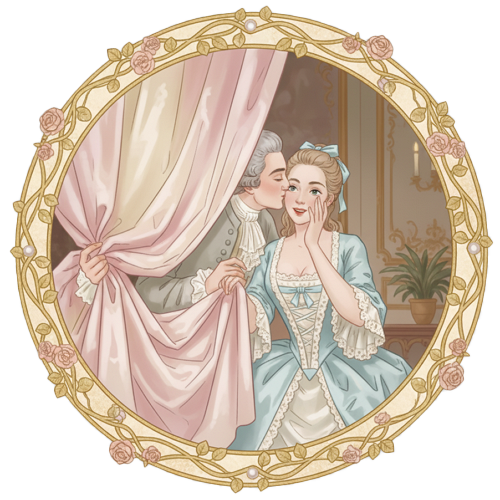
The days following her brother’s confrontation were a study in silent suffocation. Beatrice existed within the walls of the Marlowe townhouse not as its daughter, but as its prisoner.
Danbury’s anger had cooled into a vigilant, suffocating condescension. He was no longer shouting, which was somehow worse.
He now watched her with the weary disappointment of a man tending a flawed but valuable piece of property, ensuring it was not further damaged before its sale.
And the sale, it seemed, was imminent.
She had not seen or heard from Finnian. Every knock at the door sent a jolt of hope and terror through her—hope that it was a message, a sign; terror that it would be Danbury intercepting it.
The rented room above the music shop, their sanctuary of creation and whispered confessions, felt a world away, a dream she was no longer certain was real. Her pianoforte, too, was a torment.
It sat in the drawing room, a silent monument to the life she had briefly tasted. To touch its keys now would feel like a betrayal, a reckless indulgence when her every move was scrutinized.
The music was trapped inside her, a frantic, desperate symphony with no means of escape.
So when the footman announced that Lord Ashworth had called and requested a private audience, Beatrice felt no surprise, only a cold, leaden certainty. This was the next step in the tightening of the noose.
“Excellent,” Danbury had boomed, clapping her on the shoulder with a proprietary air.
“The man knows when to press his advantage. See that you are charming, Beatrice. Our family’s patience is not without its limits.”
She said nothing, merely inclining her head as her lady’s maid, eyes full of pity, led her to the morning room.
The room was bright, the morning sun streaming through the tall windows and illuminating the dust motes dancing in the air. It felt mocking, this cheerful light.
Lord Ashworth stood by the fireplace, one hand resting on the marble mantelpiece. He was dressed to perfection, his coat impeccably tailored, his cravat a pristine white waterfall of silk.
He looked as if he had been sculpted from polished, expensive ice.
He turned as she entered, a slow, deliberate smile spreading across his face. It was a smile of ownership, and it made the skin on her arms prickle.
“Lady Beatrice,” he said, his voice a smooth, cultured purr.
He bowed, taking her hand and brushing his lips against her knuckles. His touch was dry and cool, like old paper.
“Thank you for agreeing to see me. I trust you are well?”
“I am, my lord,” she replied, her voice a thin, brittle thing.
She withdrew her hand and sat on the edge of a brocade settee, her spine so straight it ached.
He did not take the seat opposite her, but instead began to pace slowly before the fireplace, his hands clasped behind his back.
It was a calculated performance, the movements of a barrister about to present his closing argument.
“I have come to speak on a matter of some… delicacy,” he began, his tone maddeningly pleasant.
“A matter that concerns your future. And, I daresay, mine.”
Beatrice remained silent, her hands clenched in her lap. She would not help him.
She would make him say every venomous word himself.
“We are, I believe, of a similar mind on many things,” he continued, pausing to admire a porcelain figurine on the mantel.
“We appreciate beauty. We understand the importance of station, of legacy. And we both have an appreciation for the finer arts. Music, for instance.”
He glanced at her, and his eyes, for the first time, held a glint of something sharp and cruel.
“You are an extraordinarily gifted musician, Lady Beatrice. Truly. A talent far beyond what is required for simple parlor entertainment.”
A cold knot formed in her stomach. “You are too kind, my lord.”
“Oh, I am not kind. I am merely observant,” he said, his smile tightening.
“I was particularly observant at Lady Wrexham’s musicale. You played that Chopin nocturne with such… passion. Such virtuosity. You even added a small embellishment, a little melodic turn of your own. It was quite unique.”
He paused, letting the words hang in the still air. Beatrice could hear the frantic drumming of her own heart.
“What was so remarkable,” he went on, turning to face her fully, “is that I had heard that very same flourish before. In a song. A rather popular, vulgar little piece performed in salons, I believe. From a new opera by that playwright… Shaw. The Echo of a Soul, is it not? A curious coincidence.”
The room seemed to shrink, the air thinning until she could barely draw a breath. She stared at him, her face a pale, frozen mask, but inside, a storm of panic was breaking.
He knew.
The thought was a physical blow, knocking the wind from her lungs.
“I confess, the coincidence intrigued me,” Ashworth said, taking a step closer. His voice dropped, becoming more intimate, more conspiratorial.
“It drove me to make certain inquiries. It is a common theatrical practice, I’m told, for a playwright to collaborate with a composer. Yet Mr. Shaw has been notoriously secretive about his partner. He claims the music simply… comes to him. A rather fanciful notion.”
He was circling her now, a sleek predator cornering its prey.
“One begins to construct a narrative. A composer of extraordinary skill. A melodic signature that mirrors that of a certain lady of the ton. A lady who has been seen, on occasion, in the less-than-reputable environs of Covent Garden. A lady whose behavior has, of late, become secretive. Distant.”
He stopped directly in front of her, forcing her to tilt her head back to meet his gaze.
“It is a fascinating puzzle, is it not? But the final piece clicks into place rather easily, I find.”
He leaned down, his face close to hers, the scent of his cologne cloying and sweet. His voice was barely a whisper, yet it boomed in the silent room like a cannon blast.
“You, Lady Beatrice, are the Ghost of Covent Garden.”
The accusation, spoken aloud, was devastating. It was no longer a secret terror but a cold, hard fact laid bare between them.
The blood drained from her face, and for a horrifying moment, she thought she might faint. She could not speak, could not deny it.
Her silence was his confirmation.
A slow, deeply satisfied smile spread across his lips. He had her.
He straightened up, his triumph radiating from him like heat.
“Do not look so stricken,” he said, his tone one of mock sympathy.
“Your secret is safe with me. For now. In fact, I am here to offer you a way to ensure it remains a secret forever.”
He resumed his place by the fireplace, the master of the room, of her fate
“I am, as your brother is well aware, prepared to make you a formal offer of marriage. A most advantageous match, I think you will agree. The union of the Ashworth and Marlowe estates will be the talk of the season.”
Beatrice finally found her voice, though it was a raw, shaking whisper.
“And what if I refuse?”
Ashworth’s smile vanished, replaced by a look of cold, passionless appraisal.
“Then I will be forced to conclude that you do not appreciate the… gravity of your situation. An unmarried lady of quality, consorting with a common playwright from the rookeries? Secretly composing for the public stage? The scandal would be unparalleled. Your name, your family’s name, dragged through the vilest filth imaginable. Your brother’s future in the Lords, your father’s legacy… all of it, utterly destroyed.”
Her heart hammered against her ribs, a wild bird trapped in a cage.
Ruin. He was threatening her with utter ruin.
But even as the fear for herself and her family washed over her, a more terrible thought followed close behind. Finnian.
“You would not dare,” she breathed.
“Oh, I would,” he replied calmly, with the unshakable confidence of a man who holds all the cards.
“But your ruin is only the beginning. The true consequences would fall upon your Mr. Shaw.”
He picked up the porcelain figurine again, turning it over in his hands as if it were a trifle.
“The law takes a very dim view of men who corrupt ladies of quality. A man of his station, luring you into his sordid world, taking advantage of your innocence… a magistrate would have no trouble believing such a story. There would be charges. Public indecency. Corruption of a minor, perhaps, for what is a gently-bred woman but a child in the eyes of the law? He would be imprisoned. Newgate, most likely. I doubt a man of his… artistic temperament… would survive it for long.”
The world tilted on its axis.
This was his true weapon. Not her reputation, not her family’s honor, but Finnian’s life.
The image of Finnian—vibrant, defiant, so fiercely alive—locked away in the squalor and disease of Newgate Prison flashed through her mind.
The thought was so monstrous, so unbearable, that it eclipsed everything else. Her own misery, her own shattered dreams, they were nothing compared to that.
Ashworth had seen the flicker of pure terror in her eyes.
He knew he had struck the fatal blow. He set the figurine down with a delicate click.
“So you see, you have a choice,” he said, his voice once again smooth and reasonable.
“A very simple one. On one hand, you accept my proposal. You become Lady Ashworth. Your secret is buried forever. You will cease all contact with Mr. Shaw and the theatre, of course. Your musical talents will be reserved for my drawing room, for my guests, for me. You will be safe, respected, and admired. Your family’s honor will be secure.”
He paused, letting the vision of the gilded cage settle around her.
“Or,” he continued, his tone hardening to steel, “you refuse. And I will burn down both of your worlds, starting with his. I will take everything from him, just as he tried to take you from me.”
She stared at him, seeing him for what he was: not a foppish suitor, but a monster cloaked in civility. He did not love her.
He did not even desire her, not in any way that mattered.
He wanted to possess her. He wanted to own her talent, to silence the music he could never create himself.
He wanted to win.
The trap was perfect. Its jaws were lined with her duty, her fear, and her love.
Every avenue of escape led to Finnian’s destruction.
To save him, she had to sacrifice herself. To protect the man she loved, she had to become the property of the man she loathed.
The fight drained out of her, replaced by an icy, desolate resignation. The sun still streamed through the windows, but for Beatrice, all the light in the world had just been extinguished.
“I will give you until the end of the week to provide me with your answer,” Ashworth said, moving toward the door.
“Though I believe you are intelligent enough to have already made your decision.”
He bowed once more, the very picture of a perfect gentleman, and then he was gone, leaving her alone in the suffocating silence of the sunlit room, the cruel echo of his ultimatum the only music left in her soul.