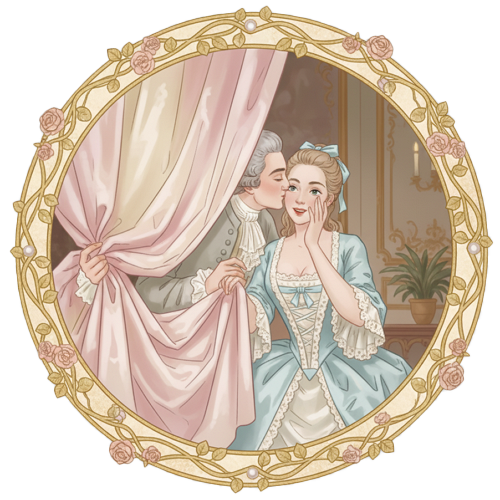
The world had shifted on its axis. For two days following their night together, Beatrice moved through her life as if in a waking dream, the memory of Finnian a constant, humming chord beneath the surface of her reality.
The stiff brocade of her morning gown felt coarse against skin that still remembered the warmth of his; the polite, vapid chatter at tea was a dull drone against the echo of his whispered confessions.
She found herself smiling at nothing, her gaze drifting to the middle distance, lost in the score of a love affair that was at once terrifying and more real than anything she had ever known.
Her secret joy made her careless. It wrapped her in a cocoon of invincibility, a foolish belief that the world she and Finnian had created in that dusty room was impervious to the one she was forced to inhabit.
She was a ghost in her own home, drifting through rooms and conversations, her true self alive only in her thoughts, with him.
This transformation did not go unnoticed. Her brother, the Earl of Danbury, observed her with the keen, predatory focus he usually reserved for a political rival or a faulty ledger.
He saw the new light in her eyes and mistook it for feverish distraction. He saw the faint, secret smiles and read them as a sign of some unseemly foolishness.
Beatrice had always been dutiful, if quiet. Now, she was withdrawn, secretive, and possessed of a restless energy that seemed to thrum just below her skin.
“You seem… preoccupied, Beatrice,” he remarked one afternoon, startling her from a reverie in the drawing-room.
She had been mentally replaying a particularly difficult transition in the opera’s second act, her fingers ghosting over an imaginary keyboard on her satin lap.
“Merely tired, Alistair,” she murmured, her heart thumping at the sudden intrusion. “The season is so draining.”
His eyes, a cool grey so unlike her own, narrowed.
“Is it? You have missed two engagements this week. Lady Albright was most put out. And at dinner last night, you barely spoke a word. Lord Ashworth made several attempts to engage you.”
Beatrice forced a polite smile, the mention of Ashworth a splash of icy water.
“My apologies. I have been suffering from headaches.”
It was a weak excuse, and they both knew it. Danbury set down his newspaper with a decisive rustle.
“See that you are recovered by this evening. We are to attend the opera.”
A pause.
“The proper opera, at His Majesty’s Theatre. None of that Covent Garden rabble.”
His disdain was a physical blow, a sharp reminder of the chasm between her two worlds. She nodded meekly, but inside, a familiar defiance stirred.
He could command her presence, but he could not command her soul. Her soul was at Covent Garden, with a playwright from the rookeries.
That evening, a fresh storm of inspiration struck her. She had been struggling with a celebratory finale for the first act, a piece that needed to be both grand and intimate.
Suddenly, the entire composition unfurled in her mind, a glorious, complex tapestry of sound. It was brilliant, it was perfect, and she knew, with a desperate certainty, that Finnian had to see it immediately.
The orchestra needed to begin rehearsals on it tomorrow.
Waiting was an impossibility. The music demanded to be heard.
She feigned the return of her headache after dinner, begging off the trip to the theatre. Her brother’s displeasure was a cold weight in the room, but he eventually relented, his parting words a thinly veiled warning.
“Rest, then. But know that this… mood of yours is wearing thin. Lord Ashworth intends to make a formal call upon you by the end of the week. I expect you to be ready to receive him with the grace befitting your station.”
The words were a death knell, but Beatrice pushed them aside. Ashworth was a problem for tomorrow.
Tonight, there was only the music.
She waited until the house fell into the deep, sonorous silence of the late hour. Donning her plainest grey cloak and bonnet, she became a shadow, slipping down the servants’ staircase and out a little-used side door into the mews.
The chill night air was a shock, but it invigorated her, sharpening the edges of her resolve.
With the rolled-up sheet music clutched in her hand like a holy relic, she hurried through the labyrinthine streets, her destination a pre-arranged drop point: the darkened doorway of a closed print shop not far from the theatre, a place they had used twice before.
She did not see the tall figure detach himself from the shadows of the grand townhome opposite her own. Danbury, his suspicion having curdled into certainty that something was amiss, had been watching her window.
He had not gone to the opera. He had waited. Seeing her slip out like a common thief, a cold, aristocratic fury settled over him.
He did not call out. He followed.
He kept a careful distance, his long strides eating up the cobblestones. He was a hunter, and his prey was his own sister.
He saw her destination was the theatre district—the very cesspit of vice and vulgarity he so despised. What shame was she bringing upon their name? Was she meeting some low-born actor? A degenerate artist?
His mind supplied a dozen sordid possibilities, each more damning than the last.
Beatrice reached the print shop, her heart a frantic drum against her ribs. She scanned the street, seeing only the flicker of a distant gas lamp and a few scurrying cats.
After a moment, a figure emerged from the alley across the way. It was Finnian.
The sight of him, solid and real, stole her breath. Even in the gloom, she could see the intensity in his eyes, the familiar set of his jaw.
He moved toward her quickly, his expression a mixture of relief and concern.
“Bea,” he murmured, his voice a low rumble. “It is too great a risk for you to come here.”
“The music wouldn’t wait,” she whispered, pressing the roll of parchment into his hands.
“The finale for the first act. I think… I think it is the best thing I have ever written.”
His fingers brushed hers, a spark of heat that shot straight through her. For a moment, they simply stood there, an island of shared creation in the sleeping city.
He wanted to pull her into the shadows, to kiss her, to feel the life and fire of her again. She wanted to lean into his strength, to forget the gilded cage waiting for her at home.
But the danger was a third person between them, cold and sharp.
“Go,” he urged, his voice tight.
“Do not linger. I will have this in front of the orchestra by dawn.” He gave her hand a final, desperate squeeze.
“Be safe.”
She nodded, pulling her cloak tighter, and melted back into the darkness. Finnian watched until she was gone, then he too disappeared, the precious music held tight against his chest.
The entire exchange had taken less than a minute.
Danbury rounded the corner just in time to see the man—a commoner, by the look of his rough coat—vanish down the alleyway. He had not seen the man’s face clearly, nor had he witnessed the exchange.
But he had seen his sister, alone in the dead of night, meeting a man in the shadows of Covent Garden. It was all the proof he needed.
He did not follow her back immediately. He let her get ahead, his rage a chilling, calculating thing.
He wanted her to think she had succeeded. He wanted to catch her in the very heart of her sanctuary, to shatter her illusion of safety.
Beatrice crept back into the house, her body trembling with a mixture of adrenaline and exhilaration. She had done it.
The music was safe, with Finnian. She closed the side door with a soft click, her shoulders slumping in relief.
She was home. She was undiscovered.
She turned from the door and froze.
A single oil lamp had been lit in the hall, casting long, distorted shadows. Leaning against the newel post of the grand staircase was her brother, his arms crossed over his chest.
He was utterly still, a statue of cold fury.
“Enjoying your evening stroll, Beatrice?” he asked. His voice was quiet, almost conversational, but it held a menace that turned her blood to ice.
Her mind raced, scrambling for a lie. “Alistair! You startled me. I… I couldn’t sleep. I needed some air.”
“Air,” he repeated, the word dripping with contempt.
He took a step toward her, out of the shadows. The lamplight carved his face into sharp, unforgiving angles.
“You seek air in the gutters of Covent Garden? At this hour? Dressed like a housemaid?”
Panic seized her. “I don’t know what you mean.”
“Do not lie to me!” The words were a whip-crack in the silent hall.
“I followed you. I saw you. Meeting a man in some filthy doorway like a common trollop.”
Her face drained of all colour.
He hadn’t seen Finnian clearly. He hadn’t seen the music. There was still a chance.
“It was not what you think,” she whispered, her voice trembling.
“Then tell me what it was!” he demanded, closing the distance between them until he loomed over her.
“Tell me who he is. What disreputable filth have you entangled yourself with? Has he compromised you? Have you brought utter ruin upon this family?”
Each question was a hammer blow. She could not tell him the truth—that she was the Ghost of Covent Garden, that the man was her artistic partner, the other half of her soul.
He would never believe it. He would see it as an even greater madness.
All she could do was deny the one thing he suspected.
“No one has compromised me,” she said, forcing a strength into her voice she did not feel.
“You are mistaken.”
“I am mistaken?” He let out a short, humourless laugh.
“I saw you with my own eyes. This recent… distraction, your secrecy, your lies. It is all clear now. You have been carrying on some sordid affair behind my back.”
He seized her arm, his grip bruising. “It ends. Now.”
“You are hurting me, Alistair.”
“Pain is a useful teacher,” he said, his voice dropping to a low, furious hiss.
“You will listen to me, Beatrice. You are forbidden from leaving this house without my express permission and a suitable chaperone. Your little midnight excursions are over. You will sever all contact with this… person. You will behave as a Marlowe should.”
He was imprisoning her. The walls of her gilded cage, which had seemed so permeable these last few weeks, were now solid stone.
He released her arm, pushing her back a step.
“Lord Ashworth will be calling on Friday to make his formal proposal. I have already given him my encouragement. You will accept him. You will be married within the month. His name will shield you from whatever scandal you have been courting, and his guidance will cure you of these reckless impulses.”
The world tilted, the floor seeming to fall away beneath her.
Ashworth. Marriage. A life sentence.
It was all happening, a trap sprung not by a villain’s cunning, but by her own brother’s suffocating sense of duty.
“You cannot do this,” she breathed, the words catching in her throat.
“I can, and I will,” he stated, his face a mask of cold resolution.
“I am the Earl. I am the head of this family, and I will protect its name, even from you.”
He turned without another word and ascended the staircase, leaving her alone in the dim, silent hall. The only light was the single lamp, and it felt like an interrogator’s glare.
She stood there for a long time, frozen, the echo of his words ringing in her ears. He had not discovered her secret, not the true one.
He had discovered something far more dangerous: her freedom. And he had extinguished it.