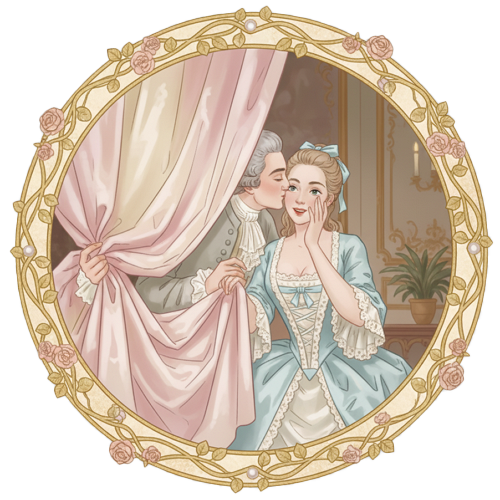
The air in Lady Wexhall’s salon was thick with the scent of beeswax, wilting roses, and the cloying sweetness of French perfume. To Beatrice, it was the smell of suffocation.
She sat beside her brother, her spine as rigid as the gilded legs of her chair, a polite and vacant smile pinned to her lips. It had been a week since the masquerade, a week since her shattering argument with Finnian.
A week of silence. Each day had stretched into an eternity of unspoken words and aching uncertainty, leaving a hollow space in her chest where their music used to reside.
Her mind was a tempest, replaying Finnian’s bitter words about her world, her privilege. Had he been right?
Was she nothing more than a symbol of the class he despised, a gilded bird in a cage so ornate she had forgotten the feel of the sky? The memory of his face, contorted with a pain that seemed to carve a chasm between them, was a fresh wound.
“Lady Beatrice, you seem a world away,” her brother, Danbury, murmured, his voice a low reproof.
“Lord Ashworth approaches. Do try to appear… present.”
Beatrice forced her attention back to the room, her gaze landing on Lord Ashworth as he navigated the sea of silk and satin. Something about him was different tonight.
The usual foppish indolence in his posture was gone, replaced by a straight-backed, predatory stillness. His eyes, usually clouded with bored amusement, were sharp and focused as they swept the room, not with the aimless gaze of a socialite, but with the specific intent of a hunter.
His humiliation at the ball, she realized with a jolt of unease, had not been forgotten; it had been honed into a weapon.
He had spent the better part of the evening in quiet observation. He’d complimented the timid Miss Albright on her rendition of a simple country air, his praise so faint it was nearly an insult.
He’d then engaged the far more accomplished Miss Sutton in a pedantic discussion of Haydn, coaxing her to the pianoforte only to watch with a discerning, almost critical eye as she stumbled through a moderately difficult passage. He was not merely passing the time.
He was testing the waters, charting the depths of musical talent within his own circle.
And now, his course was set for her.
“My lord,” Danbury said, rising slightly. “A pleasure to see you.”
“Danbury,” Ashworth replied, his nod crisp. His eyes, however, were fixed on Beatrice.
“Lady Beatrice. I trust you are enjoying Lady Wexhall’s musicale?”
“It is a charming evening, my lord,” she managed, her voice sounding thin to her own ears.
“Charming, yes,” Ashworth mused, tapping a finger against his lips.
“Though I confess, I find the selection of music somewhat… elementary. All parlor trifles and simple ballads. Our English ladies have grown shy of a true challenge, it seems.”
The bait was laid so precisely it was almost elegant. Beatrice felt a prickle of annoyance.
He was dismissing the efforts of every other woman in the room, framing his impending request as a search for true artistry.
Danbury, oblivious, puffed up with pride. “My sister has no such shyness, I assure you. Beatrice’s talent is well-known.”
“Is it?” Ashworth’s smile was a thin, bloodless line.
“Then perhaps she would do us the honour. I recently acquired the sheet music for a rather fiery sonata by Scarlatti. The K.141. They say it requires fingers of lightning and a devil’s own spirit to master. I cannot imagine a more perfect instrument for it than Lady Wexhall’s Broadwood.”
A collective intake of breath rippled through the guests nearby. The Scarlatti piece was notoriously difficult, a blistering cascade of repeated notes and frantic, cross-hand passages that was far beyond the scope of a drawing-room recital.
It was a professional’s piece. A test.
Danbury looked at her, his expression a command. This was an opportunity to shine, to secure Ashworth’s admiration, to prove her worth on the marriage market.
To refuse would be an admission of inadequacy, a public slight.
Beatrice’s heart hammered against her ribs. Every instinct screamed at her to decline, to feign a headache, to shrink back into the shadows.
To play a piece of such complexity with the passion it demanded would be to reveal a part of herself she kept fiercely hidden—the part that belonged to Finnian, to their dusty rented room, to the soul-baring act of creation.
But as she met Ashworth’s cool, challenging gaze, a different feeling rose within her: defiance.
He thought to trap her, to measure her against his petty suspicions. Let him.
In this gilded cage, the pianoforte was her only true voice. If she was to be judged, let it be for the one thing that was undeniably hers.
“I would be delighted to try, my lord,” she said, her voice steady.
A flicker of triumph sparked in Ashworth’s eyes as he produced a roll of sheet music and escorted her to the instrument. The room fell into a hush of anticipation.
As Beatrice settled onto the bench, the familiar scent of ivory and polished wood was a small comfort. She spread the music before her, the frantic black notes swarming on the page like a confession.
For a moment, she closed her eyes, shutting out the expectant faces, her brother’s pride, Ashworth’s scrutiny. She thought of Finnian.
She thought of their fight, of his accusations and her defensiveness. She poured all of it—the anger, the longing, the heartbreak—into the tips of her fingers.
Then she began to play.
The first notes erupted from the pianoforte, sharp and percussive, silencing the last rustle of silk. This was not the gentle, melodic music of the salon.
This was a torrent, a furious argument rendered in sound. Her hands flew across the keys, a blur of motion.
She played not just with technical precision, but with a raw, visceral energy that stunned the assembled guests. The music was a storm, and she was its master, her body swaying with the rhythm, her brow furrowed in concentration.
This was not the performance of a lady demonstrating a genteel accomplishment. This was the work of an artist.
She poured her frustration with Danbury into the relentless, driving tempo. Her aching for Finnian bled into the brief, melodic respites, making them sound less like pauses and more like gasps for air in a drowning lament.
The chasm between their worlds, the central, impossible conflict of her life, became the jarring dissonance of the cross-hand passages, where her left hand leapt over her right in a frantic, desperate dance.
She was so lost in the emotional crucible of the piece that she barely noticed when she reached the final section. And it was there, in the heat of her own creation, that she made her fatal error.
The music, as written, felt incomplete to her. It needed something more, a final, personal cry.
On instinct, driven by a week of suppressed artistry, she altered the final cadence. She wove in a small, intricate melodic flourish—a rising, questioning phrase that resolved in a minor key, full of longing and an echo of defiance.
It was a beautiful, haunting addition.
And it was the ghost of their opera.
The melodic turn was nearly identical to a signature phrase in “The Nightingale’s Cage,” the very song Finnian had leaked, the song that had been hummed in every salon in London for the past month.
It was her musical fingerprint, an unconscious signature she had just signed to a confession she hadn’t known she was writing.
The final note hung in the air, vibrating with a terrible resonance. A stunned silence held the room captive for a beat before it broke into a wave of astonished applause.
Ladies fanned themselves, and gentlemen murmured their admiration. Danbury beamed, his face glowing with vicarious triumph.
But Beatrice did not hear them. Her blood had turned to ice. As she lifted her head, her gaze met Lord Ashworth’s across the pianoforte.
He was not applauding.
He stood perfectly still, a slow, terrible smile spreading across his face. It was not a smile of admiration or pleasure.
It was a smile of absolute, chilling certainty. Of discovery.
He had asked a question, and she, in all her foolish, prideful passion, had given him the answer. In his eyes, she saw the glint of a closing trap, the final, satisfying click of a lock falling into place.
He moved toward her, his steps deliberate. He took her hand, his touch cool and proprietary, and raised it to his lips.
His voice, when he spoke, was a proprietary murmur meant only for her.
“A truly… inspired performance, Lady Beatrice,” he said, his eyes boring into hers. “Such fire. Such originality. One might say it had a soul all its own.”
The meaning was unmistakable. He knew.
A knot of pure, cold dread tightened in her stomach. She had not only revealed her talent; she had revealed her soul. And now, it belonged to him.