The silence in the rented room above the music shop was a leaden thing, thick and suffocating. It was a stark contrast to the usual crackle of creative energy that filled the space, a vibrant hum that had become as essential to Beatrice as breathing.
Now, the only sound was the listless patter of a London drizzle against the grimy windowpane, each drop a tiny, mournful beat counting down the moments of their discomfort.
Beatrice sat at the pianoforte, her gloved fingers resting on the keys without depressing them. The ivory was cold, lifeless.
She had been staring at the same bar of music for a quarter of an hour, a half-formed melody for a scene between the opera’s hero and a duplicitous courtier. The notes refused to come.
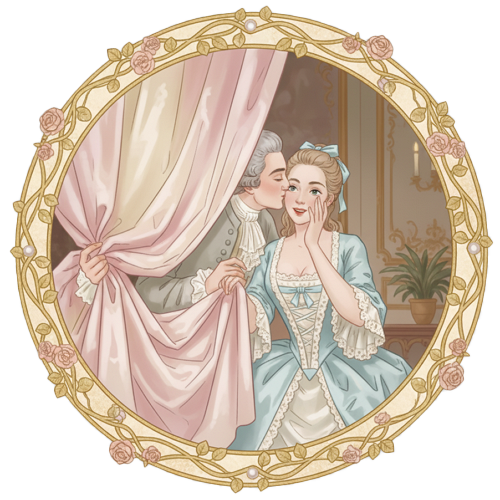
Her mind kept replaying the scene from the masquerade ball: the press of the crowd, the heat behind her mask, and the brief, stolen fantasy of a dance with Finnian. A fantasy shattered by Lord Ashworth’s proprietary hand on her arm.
Across the room, Finnian paced. He hadn’t looked at her directly since she’d arrived, his movements tight and agitated, like a caged wolf.
He ran a hand through his dark hair, leaving it in a state of disarray that mirrored the turmoil in his eyes.
“It’s no good,” he said finally, his voice rough.
He stopped before the window, staring down at the slick, grey cobbles below. “The words are hollow. This courtier… he sounds like a caricature.”
Beatrice flinched.
The criticism felt personal, a barb aimed not at the fictional character but at the world he represented. Her world.
“Perhaps,” she began, her tone carefully neutral, “if we focus on his ambition rather than his station—”
“His ambition is his station,” Finnian shot back, turning to face her. The bitterness that had been simmering beneath the surface all morning now boiled over.
“It’s all it ever is with your kind. Acquiring titles, securing land, parading women like prize fillies at a country fair. There is no soul in it. Just a ledger of assets.”
The accusation hung in the air, sharp and ugly. The image of her brother, Danbury, doing precisely that flashed in Beatrice’s mind, but hearing the condemnation from Finnian’s lips was a different kind of pain.
It was a branding iron, marking her as one of them.
“My kind?” she repeated, her voice trembling slightly. She forced it steady.
“You speak as if you know anything about it.”
“I know what I saw last night,” he snarled, taking a step closer.
The memory of the ball was a raw wound for him, and he was determined to pour salt in it.
“I saw Lord Ashworth, a man whose only talent is the accident of his birth, lay claim to you as if you were another one of his properties. And you let him.”
The injustice of his words stole her breath.
“I let him? What would you have had me do, Finnian? Create a scene? Rip off my mask and announce to the entire ton that my heart belongs to a playwright from the rookeries? You speak of my cage, but you have no concept of the strength of its bars.”
“They are bars of your own making! Gilded, perhaps, but you choose to remain behind them.” He gestured wildly around the small, dusty room.
“Here, in this world, you are a genius. You are a force. But out there…” He scoffed, a deep, contemptuous sound.
“Out there, you are Lady Beatrice Marlowe, an ornament to be polished and displayed. And it seems you are content with that role.”
A hot, furious despair rose in her chest. He wasn’t just angry; he was cruel.
He was taking every fear she harbored about herself and twisting it into a weapon against her.
“Content?” she cried, rising from the bench. Her gloves felt suddenly constricting, and she ripped them off, tossing them onto the pianoforte.
“Do you think I am content to live a lie every moment of every day? To hide the only part of myself that feels real in a dusty room above a shop? I risk my name, my family, my entire future every time I walk through that door. And for what? To be told I am a willing participant in a system I despise as much as you do?”
“Do you?” he challenged, his eyes blazing.
“Or do you simply despise its inconveniences? The boring suitors, the stifling balls. But you enjoy the silks, the security, the deference. You cannot have the fire of this world and the comfort of that one, Beatrice. A choice must be made.”
His words struck a chord of terror deep within her. It was the very conflict that warred within her soul daily, the impossible chasm between her duty and her heart.
But for him to frame it so coldly, as if it were a simple matter of preference, was an unbearable insult. He saw none of her struggle, only the label she wore.
“You see nothing,” she whispered, her voice cracking with the weight of her disillusionment.
“You look at me and you do not see me. You see an Earl’s sister. You see a silk dress and a title. You, who write of truth and seeing past the surface of things, are the blindest of all.”
Finnian’s face tightened, a flicker of something—guilt, perhaps, or his own fear—crossing his features before the anger masked it again.
He was afraid. She saw it then.
He wasn’t just angry at her world; he was terrified of his feelings for her, for the woman who was a symbol of everything he stood against.
He was pushing her away, trying to make her into a villain he could easily hate, because loving her was an act of treason against his own identity.
“And what am I supposed to see?” he demanded, his voice dropping lower, thick with a pain he couldn’t hide.
“I see a woman who can create a melody that breaks a man’s heart, and then hours later allows a peacock like Ashworth to lead her around on a leash. How can those two people be the same? Tell me. Because I am beginning to believe one of them is a phantom. A ghost.”
He had used their name for her, the secret, intimate name for her genius, and turned it into an accusation. It was the cruelest cut of all.
Beatrice felt the fight drain out of her, replaced by a profound and hollow ache. They were at an impasse, two people shouting at each other across a divide too wide to bridge.
He was right; she was two people. And she was beginning to fear that neither of them could survive.
“I cannot do this,” she said, her voice flat. She moved to gather her gloves, her movements stiff and deliberate.
“I cannot create music in a room filled with such bitterness. I cannot bare my soul to a man who refuses to see it.”
Finnian stood rooted to the spot, his fists clenched at his sides. The fury in his eyes had subsided, replaced by a look of bleak realization.
He had gone too far. He had taken his own self-loathing, his own resentment of the world, and used it to shatter the most precious thing in his life.
He wanted to call her back, to apologize, to erase the last hour, but the words caught in his throat, choked by pride and a lifetime of ingrained class hatred. She is one of them, a bitter voice whispered in his mind.
She will always choose them.
Beatrice pulled on her gloves, smoothing the kid leather over her trembling fingers. It was an act of armouring herself, of reassuming the role of the lady she had to be to walk out the door.
“When you can look at me and see Beatrice, not Lady Marlowe,” she said, her back still to him, “then perhaps we can write music again. But until then…”
She left the sentence unfinished. There was nothing more to say.
She walked to the door without looking back, each step an agony. She could feel his eyes on her, a silent, desperate plea he was too proud to voice.
Her hand closed around the cool metal of the doorknob. For a moment, she hesitated, her heart screaming at her to turn around, to fight for them.
But what was the use? He had already drawn the battle lines, and she was on the wrong side.
She opened the door and slipped out, closing it softly behind her. The click of the latch was a sound of absolute finality.
Alone in the room, Finnian finally moved. He walked to the pianoforte and stared down at the unsigned sheet music, at the few hesitant notes Beatrice had sketched out.
He reached out and gently touched the keys, the same keys her fingers had rested on moments before. They were still cold.
The vibrant, soul-stirring harmony they had created together was gone, replaced by a jarring, painful dissonance. He was in love with a symbol, and he had just destroyed the woman.