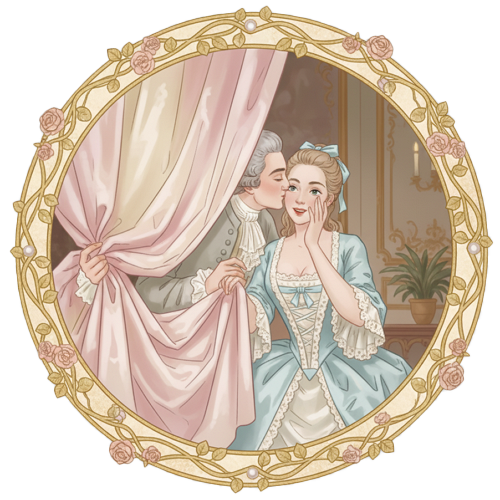
The news, when it came, was not a quiet stream but a deluge. Finnian burst into their rented room above the music shop, the door banging against the wall, his face flushed with a triumph so fierce it seemed to radiate heat.
He was clutching a sheaf of papers, a signed contract from Mr. Harris, the manager of the Covent Garden theatre.
“He said yes,” Finnian breathed, the words tumbling out, laced with disbelief and exhilaration.
“Beatrice, he said yes. They’re commissioning the full production. Scenery, costumes, the entire orchestra. The Echo of a Soul… it’s going to live.”
For a moment, Beatrice could only stare. All the clandestine meetings, the shared pots of ink, the melodies hummed in hushed tones—it had all been a desperate, whispered wish.
Now, that wish had been granted with the force of a thunderclap. A laugh, pure and unburdened, escaped her lips.
She sprang up from the pianoforte bench, closing the distance between them and placing her hands on the contract as if to feel the reality of it through the parchment.
“Finnian, this is… this is everything,” she whispered, her eyes shining.
He looked down at her, his gaze intense. In the dusty, moted sunlight of their secret world, they were not a common playwright and a lady of the ton.
They were simply two creators, joined in a victory that belonged to them alone. The air crackled with the energy of their shared success, pulling them closer until the unspoken tension of the past weeks—ever since that stolen kiss in the rehearsal hall—was a palpable hum between them.
He wanted to touch her, to pull her into his arms and share the victory properly, but the specter of their differences always stood sentinel.
“It is,” he said, his voice dropping to a low murmur.
“It is everything. And it means the real work begins. We are chained to this course now, for better or worse.”
“For better,” she insisted, her heart soaring.
She felt a reckless surge of confidence, a desire to celebrate this impossible moment in an equally impossible way. “There is to be a masquerade at Vauxhall Gardens in a fortnight. To celebrate the season’s end.”
Finnian’s smile faltered. “A masquerade? Beatrice, that is your world, not mine. I would be as welcome as a fox in a henhouse.”
“But that’s the beauty of it,” she pressed, her fingers tracing the sharp cursive of the theatre manager’s signature.
“No one would know you. Behind a mask, you are not a playwright from the rookeries. And I am not… well, I am not Lady Beatrice Marlowe. We are simply guests. We could have one dance. One moment, out in the open, where we are not hiding in the shadows.”
The idea was madness. A public ball, teeming with the very people who would see him hang for daring to associate with a woman like her.
It was a fool’s errand, a tempting of fate. And yet, the image she painted—of seeing her not in this dim, dusty room, but under lanterns, of holding her hand in a dance, of hearing her laugh without fear of being overheard—was a siren’s call he was powerless to resist.
“One dance,” he agreed, the words feeling like a vow and a surrender all at once. “And we must be ghosts.”
***
Two weeks later, Finnian stood beneath the glittering canopy of Vauxhall Gardens, feeling every bit the imposter he was. The air was thick with the scent of night-blooming jasmine and expensive perfume, a cloying combination that sat strangely in his lungs.
Laughter, as light and brittle as spun sugar, tinkled from behind ornate fans and feathered masks. He wore a simple suit of borrowed finery, the collar uncomfortably stiff, and a plain black domino mask that covered his eyes, fashioned to look like a raven.
In this sea of peacocks and lions, he was a crow, watching from the periphery.
This was her world. A world of practiced smiles and meaningless pleasantries, of men whose greatest labour was deciding which waistcoat to wear and women whose ambitions were suffocated by silk and lace.
He saw them everywhere, the Lord Ashworths of the world, preening and strutting, their arrogance a dazzling, repulsive armour. A familiar, bitter resentment coiled in his gut.
What was he doing here? This was a fool’s fantasy, a dangerous game that could cost them everything.
Then he saw her.
She stood near the grand rotunda, a vision in deep sapphire silk that shimmered like a twilight sky. Her mask was a delicate creation of silver filigree, shaped like a nightingale in mid-song, a single, perfect diamond glittering at its eye.
Even with her face half-hidden, he knew her. He knew the proud set of her shoulders, the elegant curve of her neck, the way she held her head as if listening to a distant melody.
And in that moment, all his resentment, all his fear, evaporated like morning mist. There was only her.
Beatrice’s heart hammered against her ribs. She had been scanning the crowd for an hour, enduring the tedious flattery of a dozen masked suitors, her nerves stretched taut.
Every tall man in a dark mask sent a jolt of anticipation through her.
When she finally saw him, leaning against a marble column, his raven mask stark and severe against the glittering frivolity of the ball, she felt a profound sense of relief, as if a ship had finally spotted its lighthouse.
He moved toward her, his steps measured and sure, cutting a path through the throng. He stopped before her, offering a formal bow that was both a perfect imitation of the aristocracy and a subtle mockery of it.
“Madam,” he said, his voice a low rumble that sent a shiver down her spine. “I believe I was promised a dance.”
She placed her gloved hand in his, the familiar warmth seeping through the thin layers of leather and silk. “I hoped you would remember, sir.”
He led her onto the dance floor just as the orchestra swelled into a waltz. He drew her into his arms, and the world fell away.
There were no gawking lords, no whispering ladies, no threat of discovery. There was only the music and the magnetic pull between them.
They moved as one, a seamless, breathtaking harmony of motion, just as they did when they composed.
“You are a surprisingly adept dancer for a creature of the shadows,” she murmured, her face tilted up toward his.
His eyes, dark and intense behind the mask, held hers. “I have a brilliant teacher. She communicates in rhythm and melody.”
They spun, the silk of her dress brushing against his legs. For these three minutes, the chasm between their worlds did not exist.
He was not a playwright; she was not a lady. They were a man and a woman, their bodies speaking a language of longing that their words could not.
“Our opera,” he said softly, his breath warm against her ear, “it feels real tonight.”
“It is real,” she whispered back, her hand tightening on his shoulder. “We made it real. When I am with you, Finnian, I feel as though I am no longer a ghost in my own life.”
His grip on her waist grew firmer, pulling her impossibly closer.
“And I,” he confessed, his voice thick with an emotion that stole her breath, “feel as though I have found the one person who can see my soul.”
The music softened, the final notes lingering in the air like a sigh. The fantasy was so perfect, so complete, that when it shattered, the sound was deafening.
A hand landed on Finnian’s shoulder, hard and insistent. “I believe, sir, you have had your turn.”
They broke apart. Lord Ashworth stood before them, resplendent in a waistcoat of gold brocade, his mask a snarling, gilded lion.
He did not recognize Finnian, seeing only an anonymous rival. His gaze swept over Finnian’s plain attire with disdain before settling on Beatrice, a look of smug possession in his eyes.
“My lady,” Ashworth said, his voice slick with ownership.
“You have been neglecting your friends.” He offered his arm to Beatrice, pointedly ignoring Finnian.
The spell was broken. Finnian was once again the commoner, the interloper.
Beatrice was once again the property of her class, to be claimed and paraded. The rage that had been dormant in Finnian’s gut roared to life, hot and acidic.
Beatrice stiffened, her hand still loosely in Finnian’s. “Lord Ashworth, this gentleman and I were just—”
“You were just finishing,” Ashworth cut in smoothly, his tone leaving no room for argument. He took her hand from Finnian’s, his touch possessive.
“Come, Danbury is expecting us to join him for cards. You cannot keep your brother waiting.”
Each word was a gilded brick, rebuilding the wall between them. Your friends. Your brother. Your world.
Ashworth pulled Beatrice away, and she had no choice but to go, casting one last, helpless look at Finnian over her shoulder. The apology and fear in her eyes were a knife in his chest.
Finnian stood frozen, his hands clenched into fists at his sides. He watched Ashworth lead her away, watched as she was swallowed back into the glittering, suffocating cage he had, for one beautiful waltz, helped her escape.
The laughter of the crowd suddenly sounded harsh and mocking. The music was a discordant clamor. He was a fool.
A naive fool who had believed, for one stolen dance, that their two worlds could ever truly meet.
He saw it now with brutal clarity: Ashworth wasn’t just a man. He was an institution.
He was the embodiment of the privilege, the entitlement, the unearned power that Finnian had spent his entire life fighting against with his words. And that institution owned Beatrice.
He turned and strode from the dance floor, pushing his way through the oblivious, laughing aristocrats. He didn’t stop until he was outside in the cool night air, the sounds of the masquerade a faint, galling echo.
He tore the raven mask from his face, the fantasy crumbling to dust in his hands. The victory of their opera, the joy of their stolen dance—it all tasted like ash in his mouth.
He wasn’t her partner. He was her secret. And a man like Ashworth was her fate.
The chasm between them had never felt so vast, so deep, or so utterly insurmountable.