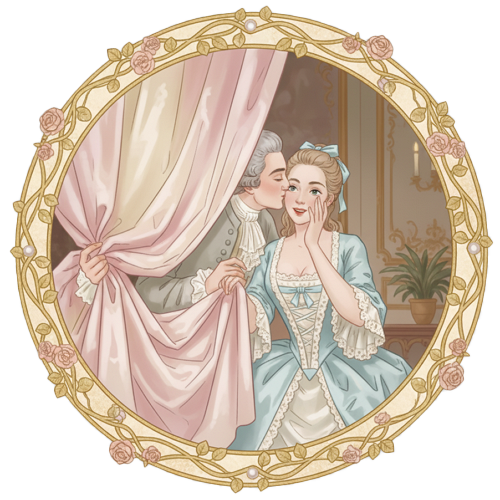
The rehearsal hall was a cavern of shadows, its vast emptiness amplifying every small sound. The scuff of Finnian’s boot on the dusty floorboards, the rustle of sheet music in Beatrice’s lap, the sigh of a draft through the ill-fitting window frames.
Outside, Covent Garden slept, but here, under the unsteady glow of a single gas lamp, a storm was brewing over a single page of music.
It was their latest session, and the most perilous. The rented room above the music shop had begun to feel too small, too confining for the scale of the opera they were creating.
Finnian, with a pilfered key and a devil-may-care grin, had led Beatrice through a side door into the theatre proper, into this ghost-haunted space where the air itself seemed to hum with the memory of a thousand performances.
Tonight, the humming was discordant. They were working on the opera’s heart: the love duet, where the heroine, Elara, and the commoner hero, Lysander, finally confess their feelings.
Finnian’s lyrics were a conflagration, a raw declaration of need and want that left no room for subtlety.
“It’s too much,” Beatrice said, her voice quiet but firm. She tapped a slender finger on a line of Lysander’s part.
“‘My soul is a pyre that burns for you alone.’ A pyre, Finnian? It’s an inferno. He sounds less like a lover and more like an arsonist.”
Finnian, who had been pacing the perimeter of the light like a caged wolf, stopped and turned to face her.
“It’s honest. It’s how a man like him would feel. He has nothing else but this love. It consumes him. It’s fire and truth, not some polite parlor poetry.”
“Passion isn’t a shout,” she countered, her gaze lifting from the page to meet his. The shadows carved his face into sharp angles, making his eyes seem darker, more intense.
“It’s the breath held before the note is sung. It’s the silence between chords. This… this is a declaration of war, not love. Elara would be terrified, not seduced.”
He let out a short, harsh laugh.
“And what would a lady in Mayfair know of terror? Or of anything that isn’t wrapped in silk and polite refusal? Your world is built on restraint, Beatrice. Mine is built on survival. Love, in my world, is a desperate, messy thing. It has guts.”
The barb struck home, as he’d intended. A flush of heat crept up her neck.
All their sessions were a careful dance around the chasm of their different worlds, but tonight, the chasm seemed to be cracking open beneath their feet.
“You mistake vulgarity for honesty,” she shot back, her composure a thin veil over her hurt.
“And you assume my life has been devoid of feeling simply because it has not been lived in a rookery. There is passion in restraint, Finnian. There is a world of emotion in a single, perfectly placed grace note that a hundred crashing chords could never convey.”
To prove her point, she turned to the battered pianoforte in the corner of the hall. Her fingers, sure and steady, found the keys.
She didn’t play the melody she had written for the scene, but a variation of it—haunting, questioning, full of a yearning so profound it made the air ache. It was Elara’s heart, not Lysander’s shouting, that filled the room.
The music spoke of longing, of fear, of a love that was a fragile, secret hope, not a raging fire.
The final notes hung in the dusty air, shimmering like moonlight.
Finnian stood motionless, his argument dying on his lips. The music had undone him.
It had bypassed his intellect, his prejudices, and struck him somewhere deeper, a place he kept guarded and raw.
He saw her then, not as Lady Beatrice Marlowe, an ornament of the ton, but as the architect of that sound, a woman who understood the very anatomy of the human heart.
He moved toward the pianoforte, his steps slow, deliberate. The spell of the music was still on him, drawing him in.
“How?” he whispered, his voice rough with an emotion he couldn’t name. “How do you know what that feels like?”
“Because I live it,” she answered, her hands still resting on the ivory keys, her knuckles white.
“I live in a world of unspoken things. Of feelings that must be hidden behind a fan or a polite smile. My music is the only place I do not have to lie.”
The admission was a crack in her flawless façade, and through it, he saw everything. The stifling balls, the empty-headed suitors, the gilded cage she inhabited.
He saw the kindred spirit he’d first recognized in her anonymous composition, a soul as trapped as his own.
He was standing beside the pianoforte now, so close she could feel the heat radiating from him. He braced a hand on the instrument’s lid, leaning over her, trapping her between his body and the music.
The scent of him—ink and winter air and something uniquely, dangerously Finnian—filled her senses.
“The words are wrong,” he said, his eyes fixed on hers. “But the feeling… the need… is not.”
He picked up the libretto from where she had set it. His voice dropped, losing its combative edge and taking on a low, resonant timbre that vibrated through her.
He wasn’t reciting Lysander’s lines; he was speaking them to her.
“‘I see you across a crowded room,’” he began, his gaze unwavering, “‘and the world falls silent. There is only the music of your name in my blood.’”
Beatrice’s breath caught in her throat. The lines between the characters and themselves were not blurring; they were dissolving entirely.
This wasn’t Elara and Lysander in a fictional opera. This was Finnian and Beatrice in a deserted rehearsal hall, suspended in a moment of terrifying, beautiful truth.
“Finnian, don’t,” she whispered, but the protest was weightless, a feather in a hurricane.
He ignored her, his thumb stroking the back of her hand where it rested on the keys, sending a jolt of lightning up her arm. “He doesn’t want to set her on fire,” he murmured, his earlier argument forgotten, replaced by this new, breathtaking reality.
“He wants to be the air she breathes. The silence where she can finally be heard.”
Her own words, her own philosophy of passion, turned back on her. He understood. In that moment, he understood her completely.
And that was her undoing.
She looked up at him, her carefully constructed world fracturing. The rules, the secrecy, the danger—it all faded into insignificance, eclipsed by the man before her, who saw not a lady, but the woman who wrote the music of his soul.
His eyes were dark with a desperate hunger that mirrored her own, a hunger she had been pouring into her compositions for years, never daring to feel it for herself.
The air grew thick, heavy with unspoken confessions. He lowered his head, slowly, giving her an eternity to turn away.
She didn’t move. She couldn’t.
She was pinned by the gravity of his presence, by the inevitability of what was about to happen. This was the crescendo she had been writing her entire life.
His lips met hers.
It was not a gentle kiss. It was a collision of two worlds, a desperate, hungry claiming.
It was everything his original lyrics had tried to say, and everything her music had answered. It was the crackle of fire and the soul-deep quiet all at once.
His hand left the pianoforte to cup her jaw, his calloused thumb a rough, shocking delight against the soft skin of her cheek. Her own hands rose from the keys to clutch at the lapels of his coat, holding on as if the world were tilting on its axis.
It was a surrender. He was surrendering his pride, his resentment of her class, his fierce independence.
She was surrendering her caution, her duty, her fear of ruin.
And it was a revelation. The artistic connection that had bound them, that intense, almost spiritual harmony, had been a pale shadow of this.
This was the source of the music, the raw, untamed force they had been trying to capture on paper. It wasn’t on the page. It was between them.
He deepened the kiss, a groan of long-suppressed longing rumbling in his chest. She met his passion with her own, a lifetime of muted feelings breaking free in a silent, desperate answer.
This was more terrifying than any public unmasking, more dangerous than any secret meeting. This was an irrevocable act, a note that, once played, could never be un-sung.
When they finally broke apart, they were both breathless, their chests heaving. The silence that rushed back into the room was heavier, more charged than before.
They stared at each other, their faces inches apart in the flickering gaslight, the shock of what they had done reflected in each other’s eyes.
“Beatrice,” he breathed, her name a prayer and a curse on his lips.
The sound of her name, spoken with such raw intimacy, shattered the last of the spell. The world came rushing back—her brother, Lord Ashworth, society, the impossible chasm between them.
Terror, cold and sharp, pierced through the warm haze of passion.
She pulled back, her hands dropping from his coat as if it had burned her.
“We cannot,” she whispered, the words tasting of ash. “We must not.”
“I know,” he said, but his voice was thick with regret, and his eyes said he didn’t care.
He took a half-step back, creating a space between them that felt both like a mile and no distance at all.
They stood in the echoing silence of the rehearsal hall, the ghost-light a solitary, silent witness. They had unleashed something elemental and wild, a force far more powerful than libretto or melody.
And as they stared at each other across the sudden, terrifying divide, they both knew, with a certainty that chilled them to the bone, that they could never go back to the way things were. The ghost of Covent Garden now had a heartbeat, and it was beating in time with his.