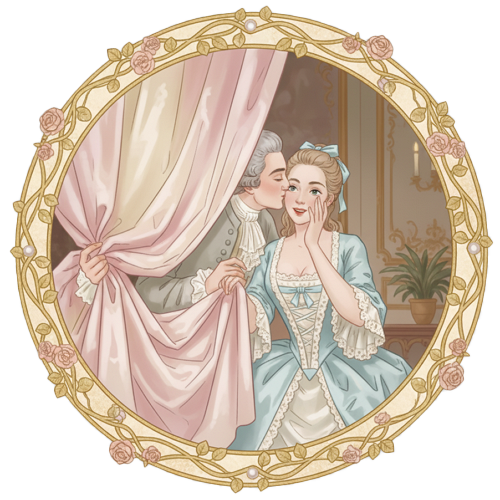
The drawing room of Harrington House was a masterpiece of suffocating elegance. Gilt-framed mirrors reflected a sea of silk and jewels, the candlelight glinting off diamond tiaras and polished silver until the very air seemed to shimmer.
The low murmur of conversation was a familiar symphony of gossip and pleasantries, a sound that usually set Beatrice’s teeth on edge. Tonight, however, an unfamiliar hum of anticipation thrummed beneath her skin, a counter-melody to the polite drone of the ton.
She stood near a towering fern, her gloved fingers clutching a delicate fan, using it as a shield. Her brother, Danbury, was at her side, his posture as rigid and unforgiving as his opinions.
“You look pale, Beatrice,” he observed, his gaze sweeping over her with the critical eye of a livestock judge.
“I trust you are not succumbing to some feminine malady. Lord Ashworth will be expecting you to be in fine form this evening.”
“I am perfectly well, Brother,” she replied, her voice a placid stream over a riverbed of churning nerves.
“Perhaps it is merely the heat of the room.”
“Nonsense. The windows are open.” He gestured dismissively toward Lord Ashworth, who was holding court by the fireplace, pontificating on the lamentable state of modern poetry.
“A match with Ashworth will secure our family’s position for a generation. Do not forget what is at stake.”
Beatrice offered a tight, meaningless smile. What was at stake was her soul, but that was a currency Danbury had never learned to value.
Her mind was not on Ashworth, but on Covent Garden. On Finnian.
Two nights ago, he had told her of his plan, his eyes gleaming with a dangerous, brilliant light in their rented room above the music shop.
“We need to create a hunger for it, Bea,” he had said, pacing the dusty floorboards.
“Not just amongst the rabble, but here. In your world. We’ll give them a taste, just one perfect bite, and they’ll clamor for the feast.”
He had arranged for Signor Vettori, a celebrated Italian tenor whose voice could make angels weep and duchesses swoon, to perform a piece from their opera. He called it a “leak,” a thrillingly illicit word that made her feel like a co-conspirator in a grand and glorious crime.
He had chosen the aria she had composed from the depths of his own grief, the one born from the story of his lost sister. It was their most honest, most vulnerable creation.
And tonight, it would be sung aloud in this gilded cage, and she would have to pretend she had never heard it before.
“Ah, Lady Beatrice, a vision as always.” Lord Ashworth had detached himself from his circle of admirers and now bowed before her, his powdered wig leaving a faint cloud of scented dust in the air.
“Your brother and I were just discussing the theatre. A rather brutish pastime, though one must occasionally endure it. I hear that upstart Shaw is attempting an opera. An act of supreme arrogance, wouldn’t you agree? A common playwright aspiring to the heights of Mozart.”
Beatrice’s grip on her fan tightened. “Perhaps ambition is a virtue, my lord, regardless of one’s station.”
Ashworth chuckled, a dry, rustling sound.
“A charmingly democratic sentiment, my lady. But genius requires breeding, as with a fine racehorse. You cannot expect a cart horse to win at Ascot.”
Before she could form a reply sharp enough to pierce his smugness, their hostess, Lady Harrington, clapped her hands for attention.
The room quieted, the sea of faces turning toward her.
“My dear friends,” she announced, her voice ringing with excitement.
“We are in for a most unusual treat tonight. The divine Signor Vettori has consented to perform a new piece for us—a song from an as-yet-unseen English opera. He tells me it is a composition of rare and profound beauty.”
A wave of intrigued whispers rippled through the crowd. Beatrice felt her heart begin to hammer against her ribs, a frantic drumbeat against the impending music.
She dared a glance at Ashworth, who looked mildly interested, and at Danbury, who looked profoundly bored. None of them knew.
In this room full of people who saw her as nothing more than a name, an asset, a pretty face, she was the only one who held the secret. The power of it was a heady, terrifying wine.
Signor Vettori, a man whose dramatic presence filled the room before he had sung a single note, took his place by the pianoforte. The accompanist settled himself on the bench, his fingers hovering over the keys.
Beatrice knew the introduction by heart; she had written it, bled it onto the page from her own fingertips. It began with a simple, searching melody, a cascade of melancholic notes that seemed to ask a question for which there was no answer.
Then, Vettori began to sing.
The voice that filled the room was magnificent, a rich and resonant tenor that soared with practiced ease. But it was the music itself, her music, that silenced the room.
The aria, titled “The Unremembered,” was not a lament of polite, drawing-room sorrow. It was a raw, aching cry of loss.
It was the echo of Finnian’s voice as he spoke of his sister, the cold desolation of the rookery in winter, the ghost of a child’s laughter. It was every lonely hour Beatrice had ever spent at her own pianoforte, pouring her silent screams into the ivory keys.
The melody swelled, building from quiet grief to a crescendo of breathtaking anguish, a demand hurled at an uncaring heaven. The harmonies were complex, shifting from major to minor in ways that were both unsettling and deeply, primally satisfying.
She had woven a thread of hope into the final bars—a fragile, flickering thing, but it was there. It was everything she and Finnian were.
A reverent hush had fallen over the salon. The clinking of glasses had ceased, the whispers had died.
Ladies fanned themselves slowly, their eyes glistening. Gentlemen stood straighter, their expressions serious, caught off guard by the profound emotion invading their carefully curated world.
Beatrice kept her own expression neutral, a mask of pleasant interest she had perfected over a lifetime. But inside, a fire was raging.
Pride, hot and fierce, surged through her. I made this. I took his pain and my longing and I shaped it into this thing that can stop a hundred hearts at once.
It was the most exhilarating feeling of her life.
When the final note faded, a stunned silence held for three long heartbeats before the room erupted.
It wasn’t polite applause; it was a storm of it, punctuated by cries of “Bravo!” and “Magnificent!”
Signor Vettori, beaming, took a deep bow, gesturing to the sheet music as if to give credit to the unseen composer.
“Astonishing!” Lady Harrington declared, dabbing a handkerchief at the corner of her eye.
“Who is this composer? I must know!”
“He remains, for the moment, anonymous, my lady,” Vettori announced with a theatrical flourish.
“A ghost, one might say, who haunts Covent Garden with his genius.”
The Ghost of Covent Garden.
Beatrice felt a dizzying thrill at the name. It was her name.
“Quite something,” Lord Ashworth conceded, his critic’s mind already dissecting the piece. He turned to Beatrice, his eyes narrowed thoughtfully.
“The structure is surprisingly sophisticated for the theatre. The counterpoint is almost… classical. It has a finesse one does not associate with the likes of Mr. Shaw. He must have found himself a proper musician.”
“Perhaps he is a more capable man than you imagine,” Beatrice said, her voice betraying nothing.
“Perhaps,” Ashworth mused, though his eyes lingered on her, a flicker of something she could not quite name in their depths.
Danbury, however, was unimpressed. He sniffed, his lip curling in disdain.
“It is overwrought. All that… feeling. It is vulgar. Theatre music is designed to appeal to the base emotions of the masses. It has no place in a setting such as this.” He leaned closer to Beatrice, his voice a low command.
“This is precisely the sort of grubby world I wish you to avoid. Stick to your Mozart. And for God’s sake, smile at Lord Ashworth. He is watching you.”
His words were a splash of icy water, dousing the triumphant fire within her. In a single breath, he had dismissed her creation as vulgar and reminded her of her duty as a commodity.
The chasm between her two worlds had never felt so vast, or so impossible to bridge.
But something had shifted within her. Hearing her music, seeing its effect, feeling the undeniable power of her own talent—it had changed the composition of her soul.
The fear was still there, a cold and constant companion. But now, it was accompanied by a bold new confidence.
She had created a sensation. She, Lady Beatrice Marlowe, the silent, obedient daughter of the aristocracy, was the Ghost of Covent Garden.
The success was not just Finnian’s; it was hers. And it was intoxicating.
She met her brother’s gaze, offering him the serene, empty smile he demanded. But behind her eyes, the notes of her aria were still playing, a defiant anthem of her own creation.
The success felt wonderful, but Danbury’s warning and Ashworth’s probing stare were a discordant harmony. She had lit a torch in the dark, and while it felt glorious to finally see, she knew, with a certainty that chilled her to the bone, that the light was attracting attention.
And some things were far more dangerous when brought out of the shadows.