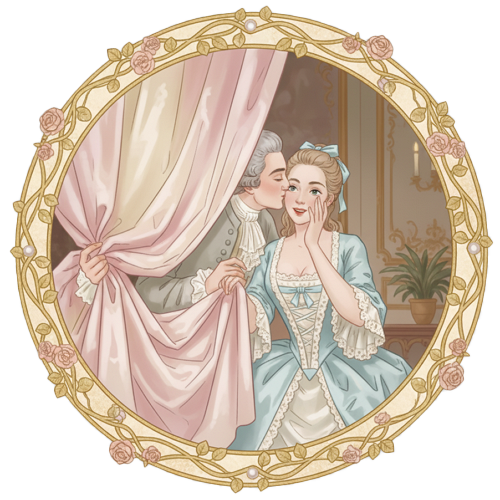
The heat was the first assault. It rose in waves from the press of a hundred bodies, thick with the scent of beeswax, cloying perfume, and the faint, funereal sweetness of wilting hothouse flowers.
Lady Beatrice Marlowe felt it clinging to her skin beneath layers of silk and whalebone, a physical manifestation of the gilded cage that was her life.
“You see, Lady Beatrice,” Lord Ashworth droned on, his voice a reedy instrument playing a dreadfully dull tune, “the true artistry of a cravat is not in the complexity of the knot, but in the nonchalance of its execution. It must appear as if it simply… happened.”
He gestured to the starched monstrosity at his own throat, a confection of white linen so stiff it seemed to hold his chin at a perpetual angle of disdain. Beatrice forced her lips into the shape of a smile, a carefully practiced sculpture of polite interest.
In her mind, she was snapping the strings of his cravat like a hangman’s noose.
“Fascinating, my lord,” she murmured, the words tasting of ash. Her gaze drifted over his shoulder, across the shimmering, suffocating sea of the Duchess of Abernathy’s ballroom.
Diamonds glittered like captive stars, laughter pealed with the brittle sound of breaking glass, and everywhere, the ton performed its tedious, intricate dance of courtship and commerce.
“Indeed.” Ashworth preened, utterly oblivious to the storm brewing behind her placid grey eyes.
“My man, Higgins, has the touch of a poet, truly. A poet of the necktie.”
From the corner of her eye, Beatrice saw her brother, Alistair, the Earl of Danbury, observing them. He gave a slight, almost imperceptible nod of approval, the gesture of a merchant pleased with the quality of his goods on display.
At twenty-six, Alistair wore his title like a suit of armor, his expression perpetually set in a mask of grim responsibility. And tonight, her successful match to Ashworth—a man with a respectable title and an intellect as shallow as a puddle—was his most pressing duty.
She was not his sister; she was a strategic alliance, a closing of accounts. She felt utterly, terrifyingly invisible.
“If you will excuse me, Lord Ashworth,” she said, her voice a model of decorum. “The heat is a trifle… overwhelming.”
Before he could launch into a lecture on the proper ventilation of a ballroom, she executed a neat turn and slipped into the crowd, the rustle of her gown the only sound of her escape. She moved with practiced grace, a ghost in powder-blue silk, navigating the currents of society until she found a small alcove partially concealed by a monstrous fern.
Leaning against the cool marble wall, she closed her eyes for a blessed moment, letting the cacophony wash over her.
It was then that she heard it. Not the music from the orchestra, a bland and forgettable waltz, but the low, rumbling tones of a conversation between two older gentlemen hiding from their wives.
“—utterly savage, I tell you,” one of them, Sir Winston Croft, was saying.
His voice was laced with a mixture of shock and grudging admiration. “No sentiment, no powdered-wig poetry. Just… blood and thunder. The man writes with a cudgel, not a quill.”
“You mean the new play at Covent Garden?” the other, Lord Hemlock, replied, his tone dismissive.
“The Beggar’s Throne? Heard it was penned by some guttersnipe from the rookeries. Shaw, is it?”
“Finnian Shaw,” Sir Winston corrected.
“And yes, they say he clawed his way out of the Seven Dials. But my God, Hemlock, the power of it. The audience was silent. Not bored silent, but held silent. He put the raw, brutal truth of this city on that stage, and for two hours, he made us all look at it.”
Beatrice’s eyes snapped open. Finnian Shaw.
She had seen the name on playbills, heard it whispered with a sneer by the more delicate members of the ton. They called his work vulgar, common, and dangerous.
But here, in Sir Winston’s hushed, electric tone, she heard something else: genius. A talent so raw and brilliant it cut through the noise, a voice that refused to be ignored.
“It’s a disgrace to the art form,” Lord Hemlock sniffed. “Theatre should elevate the spirit, not drag it through the muck.”
“Perhaps,” Sir Winston conceded, “but I haven’t been able to think of anything else for a week. It was… alive. Not like this.”
He gestured vaguely at the glittering ballroom. “This is a mausoleum with better champagne.”
A mausoleum. The word struck Beatrice with the force of a physical blow.
Yes. That was it exactly. She was a beautiful relic, immaculately preserved and utterly lifeless, displayed for the admiration of other relics.
The idea of Finnian Shaw—this man who wrote with a cudgel, who held audiences captive with truth—lodged itself in her mind like a splinter of glass, sharp and unsettlingly fascinating. He created worlds with words. He commanded stages. He was heard.
The pressure in her chest became unbearable. She could no longer breathe the stale, perfumed air.
With a final, desperate glance toward her brother, who was now deep in conversation with Ashworth’s father, she slipped from the alcove and fled.
She did not stop until she reached the sanctuary of her own chambers. Her lady’s maid, Agnes, was waiting up, dozing in a chair.
“My lady! You’ve returned early.”
“Help me out of this, Agnes,” Beatrice said, her voice tight. “All of it. Now.”
Agnes, sensing the urgency, moved with swift, practiced fingers, unlacing the corset that had been digging into Beatrice’s ribs for hours. With a final, gasping pull, the stays were released, and Beatrice could finally take a full, deep breath.
The relief was so profound it was almost painful. She tore the pins from her hair, letting the heavy coils tumble down her back, and ripped the suffocating gloves from her hands finger by finger.
The gown, a confection of silk and lace worth more than a common family’s yearly earnings, lay in a shimmering blue puddle on the floor.
Clad only in her thin chemise, she felt raw, exposed, and blessedly, wonderfully free. She dismissed Agnes with a wave of her hand and crossed the room not to her bed, but to the pianoforte that stood in the corner, its polished mahogany gleaming in the soft moonlight.
This was her only true confidante. This was her secret world.
Her brother permitted it as a “ladylike accomplishment,” a tool for her to entertain future husbands with gentle sonatas and polite nocturnes. He had no idea what she did here, in the dead of night, when the house was silent.
He had no idea of the storms she could unleash.
She sat on the bench, the wood cool against her bare legs. For a moment, she simply rested her fingers on the ivory keys, the silence of the room a stark contrast to the cacophony of the ball.
Then, she thought of Lord Ashworth’s insipid face, of her brother’s cold, calculating eyes, of the crushing weight of a future she had not chosen. She thought of the word mausoleum.
And then, she thought of a man who wrote with a cudgel.
Her hands came down on the keys.
It was not a polite nocturne. It was a declaration of war.
A crashing, dissonant chord shattered the silence, a cry of rage and despair that she could never voice aloud. The music poured from her, a torrent of sound that was all sharp edges and dark, swirling currents.
Her left hand hammered out a relentless, driving rhythm—the frantic, trapped beat of her own heart—while her right hand flew across the keys in a melody that was pure, untamed rebellion.
This was not music for a drawing room. This was music for a storm-lashed cliffside, for a battlefield, for a revolution.
It was complex and brutal, a story of a gilded bird beating its wings bloody against the bars of its cage. She poured every ounce of her frustration, her intelligence, her stifled passion into the composition.
The melodies fought one another, clashed, and then resolved into moments of agonizing, heartbreaking beauty before descending back into chaos. Her fingers ached, her hair fell across her face, and a fine sheen of sweat broke out on her brow, but she did not stop.
She was no longer Lady Beatrice Marlowe, the Earl of Danbury’s sister, the prize to be won by a foppish lord. She was a composer. She was a force.
Here, in the dark, with only the moon as her witness, she was truly, incandescently alive.
The final notes hung in the air, a trembling, unresolved chord that spoke of a question without an answer. Her hands fell from the keys, her chest heaving.
The silence that rushed back in was profound, broken only by her own ragged breaths.
She stared down at her fingers, then at the ivory keys, as if seeing them for the first time. For years, this had been her escape, her secret release.
She would play her fury into the night, and in the morning, she would put her mask back on, the music a forgotten dream.
But tonight was different. Hearing of Finnian Shaw, of a man who took the truth of his world and made it into art that shook the city, had changed something fundamental within her.
Her music, this secret, powerful thing she had hidden away like a shameful vice—what if it wasn’t just a release?
Her gaze fell upon the blank sheet music and the pot of ink on the stand beside the pianoforte. A new feeling began to stir beneath the exhaustion and the lingering rage.
It was a slow, dangerous current, an idea so audacious, so utterly ruinous, that it made her heart thunder in her chest all over again.
She looked at the music she had created, the ink-black notes that screamed what she could not. It was more than a composition. It was a voice. A soul.
And it deserved to be heard.
A slow smile, the first genuine one of the night, touched her lips. This music, this storm she had just unleashed—it was not a lament.
It was an overture.