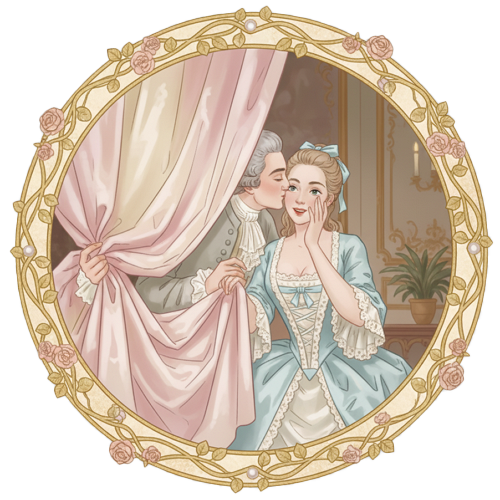
The stone wall was an affront to both propriety and her hemline. A lady did not scramble over moss-slicked stone walls, a voice that sounded suspiciously like her mother’s chided in her mind.
A lady most certainly did not do so with a leather satchel slung across her body, filled with pencils, charcoal sticks, and a well-worn sketchbook that was her most prized possession.
But Miss Beatrice Holloway, at that moment, was less a lady of leisure and more a soldier on a desperate campaign.
And the territory beyond this wall—the forbidden, reclusive Blackwood estate—was her last battlefield.
She hitched her skirts, ignoring the damp chill of the stone seeping through her woollen dress, and swung a leg over.
A bramble snagged at her shawl, a parting shot from the civilized world she was leaving behind. With a soft grunt, she landed on the other side, the ground yielding beneath her worn boots.
The air here was different—thicker, smelling of damp earth, decaying leaves, and the secret, sweet perfume of life left to its own devices.
This was a trespass, and she knew it.
The Earl of Blackwood was a notorious recluse, a man who guarded his lands as fiercely as a dragon guarded its hoard.
But her father’s letters, penned in the last lucid years of his life, had spoken of Blackwood’s unique topography with a botanist’s reverence.
Its sheltered valleys and ancient woods were a crucible for nature’s eccentricities, a place, he had written, where new worlds might be found under a single leaf.
New worlds were precisely what Beatrice needed. Her father’s passion had not, unfortunately, been accompanied by financial acumen.
Since his passing, the ledgers in his study had revealed a truth more devastating than grief: they were ruined.
The polite but firm letters from creditors were piling up, each one a fresh twist of the knot of fear in her stomach.
Her only inheritance was his encyclopedic knowledge, his keen eye, and a burning, desperate need to make a discovery so significant that the Royal Society could not ignore it.
A discovery that came with a prize, a pension, a future.
She adjusted the satchel on her shoulder and pushed deeper into the woods, her senses on high alert. This was not a park; it was a living laboratory.
Her gaze swept the forest floor, cataloging the familiar—the delicate fronds of Athyrium filix-femina, the creeping ivy strangling an old oak, the dappled pattern of sunlight on a patch of bluebells already past their prime.
Her mind was a flurry of Latin names and classifications, a defense against the rising tide of panic.
For weeks she had searched the common lands, returning home each evening with mud on her boots and failure heavy on her heart.
Blackwood was her final, reckless gamble.
She followed the whisper of a stream, its path carving a humid channel through the dense woods.
The air grew warmer, more still. She felt a prickle of anticipation, the instinct that had guided her father on his own expeditions.
The trees thinned, the oppressive canopy giving way to a soft, filtered light that seemed to hold its breath.
She pushed aside a heavy fern, its spores dusting her sleeve like gold powder, and stepped into a place that felt entirely separate from the world.
It was a small, secluded glade, cupped in the land’s gentle palm. A sliver of waterfall cascaded down a rock face covered in iridescent moss, feeding a small pool whose surface was as still as glass.
Sunlight, ancient and yellow, poured into the space, illuminating every leaf and petal in sharp relief. It was a natural glasshouse, a pocket of impossible warmth and light.
And there, in the center of it all, growing from the crevice of a fallen, nurse log, was the reason she had risked everything.
Beatrice’s breath caught in her throat.
The world narrowed to a single point of focus. It was an orchid, but like none she had ever seen or read about.
She took a step closer, her boots sinking into the soft loam, her heart a frantic drum against her ribs.
It was breathtaking. Two slender, arching stems rose from a cluster of waxy, emerald leaves, each bearing a cascade of blooms.
The petals were the colour of twilight, a deep, velvety indigo that seemed to absorb the very light around them. But it was the labellum—the flower’s pronounced lip—that was its true marvel.
It was a brilliant, shocking splash of gold, streaked with veins of the same indigo, and shaped with an intricacy that defied simple description.
It was a painter’s flourish, a defiant stroke of impossible beauty against a somber canvas.
Her scientific mind, usually so ordered, was a chaotic jumble of awe and adrenaline. Family Orchidaceae, that was certain.
The terrestrial growth, the bilateral symmetry, the fused column… but the species? It belonged to no genus she knew.
The specific combination of colour, the structure of the pollinia, the precise curvature of the petals—it was entirely new.
Undiscovered. Unclassified.
Hers.
A giddy, dizzying wave of relief washed over her, so potent it made her knees weak. She pressed a hand to her mouth, stifling a sound that was half-sob, half-laugh.
This was it. This was her lifeline.
The answer to the mounting debts, the salvation of her mother’s future, the validation of her own life’s work. This delicate, impossible flower was everything.
For a long moment, she simply stared, memorizing every detail, etching the image onto her soul before daring to commit it to paper.
It was more than a specimen; it was a masterpiece.
To discover it was a privilege. To document it would be an honour.
The shock began to recede, replaced by the familiar, comforting hum of professional focus.
She knelt carefully on the damp ground, shrugging the heavy satchel from her shoulder and opening it with trembling fingers.
The scent of paper and charcoal filled the air. She selected a fine-grained pencil, her movements economical and precise.
First, the habitat. She sketched the glade, the specific angle of the sunlight, the mossy log from which the orchid sprang.
She noted the humidity in the air, the composition of the soil clinging to the roots, the proximity to the waterfall.
Every detail was a piece of the puzzle, a clue to the unique circumstances that had allowed this marvel to exist.
Then, she turned to the plant itself. She worked with a focused intensity that blocked out the world, her hand moving across the page with practiced confidence.
She measured the height of the stems, the length and width of the leaves, counting the blooms on each spray.
Her illustrations were not mere art; they were scientific records, capturing the precise venation on a petal, the delicate, hair-like structures within the flower’s throat.
With each line, she was claiming it, making it real, proving its existence.
“Phalaenopsis astra,” she murmured, the name coming to her unbidden.
Star of the night. No, that wasn’t right.
The genus was wrong. Cymbidium, perhaps? The boat-like shape of the labellum suggested it.
Cymbidium nocturnum.
It had a pleasing ring to it. Her name would follow, of course.
Cymbidium nocturnum Holloway. Miss Beatrice Holloway, discoverer.
A smile touched her lips, the first genuine, untroubled smile in months. In this sun-dappled, secret world, she was not a debtor’s daughter in a shabby dress.
She was a scientist at the precipice of greatness. She was her father’s heir.
Here, she was powerful.
Blissfully absorbed, she switched from pencil to charcoal to capture the deep, dramatic shadows of the indigo petals.
The only sounds were the gentle splash of the waterfall and the whisper of her charcoal against the textured paper.
The world outside this glade—the Earl, the creditors, the disapproving gaze of society—ceased to exist.
There was only her, her discovery, and the silent, triumphant work of documentation.
She was so lost in the microcosm of the flower that she did not hear the nearly silent snap of a twig some twenty yards behind her.
She did not see the shadow that detached itself from the deeper shade of an ancient yew.
She remained entirely, blissfully unaware that her moment of private salvation was, in fact, being observed by a pair of cold, narrowed eyes.