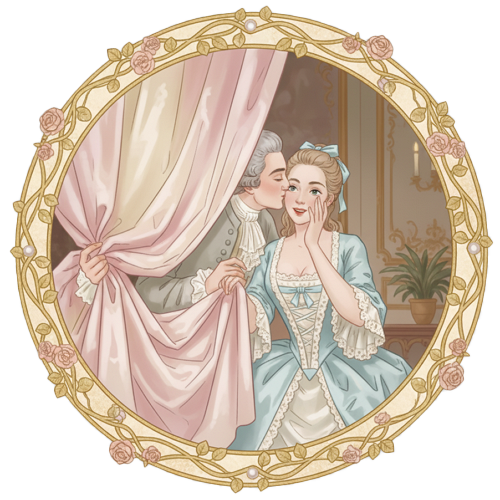
The ghost of the kiss lingered on Alistair’s lips, a phantom warmth that defied the cool mountain morning. It was a memory less than a day old, yet it had already branded itself onto him, a single, confounding data point that threw all his previous conclusions into disarray.
He sat on the edge of his narrow cot in the small room he’d rented, the scent of woodsmoke still clinging to his clothes from the barn fire. Before him, on the small crate he used as a desk, lay his leather-bound notebook, filled with the architecture of his exposé.
Item: Woman uses common yarrow for wound, calls it a miracle.
Item: Herbal steam for croup, a known folk remedy.
Item: Community relies on shared labor, not divine intervention.
The words were his own, written in his precise, confident hand, yet they read like the work of a stranger. Each sentence, once a sharp, irrefutable brick in the wall of his argument, now felt hollow, disingenuous.
He had come to Whisper Creek to dissect a faith he believed to be a lie, and in the process, he had found something infuriatingly, undeniably true. Not in the healings, perhaps, but in the heart of the healer. In the fierce, quiet strength of the community.
In the shared terror of a fire and the simple, human act of reaching for another in the aftermath.
He snapped the notebook shut. The article he had pitched to his editor—”The Mountain charlatan and Her Flock of Fools,” or some equally condescending title—was dead.
He could no more write it than he could un-feel the coarse fabric of Sera’s sleeve against his hand or the vulnerable trust in her eyes when she had shared her own grief. He had pried open her soul expecting to find deception and had instead seen a reflection of his own pain, purified by a faith he still couldn’t comprehend.
Alistair stood and paced the small room, his city shoes scuffing against the rough-hewn floorboards. Turmoil was an inadequate word for the storm raging within him.
It was a complete inversion of his world. He, Alistair Finch, the celebrated debunker, the champion of cold, hard fact, had been compromised.
Not by trickery, but by sincerity. Not by a grand miracle, but by the quiet accumulation of small truths.
And by a kiss. That kiss was the most illogical variable of all, a catalyst that had dissolved the foundation of his professional and personal identity.
He stopped at the window, looking out at the haze-softened peaks. They no longer seemed menacing or primitive, but ancient and watchful.
This place, these people, were under siege. The real story wasn’t Seraphina Mayhew’s supposed miracles.
The real story was the methodical, cruel avarice of Silas Blackwood and the Appalachian Coal & Timber Company. Blackwood wasn’t just a piece of local color for his article; he was the villain of a narrative far more urgent and important.
A new purpose began to crystallize in Alistair’s mind, sharp and clear. He was a journalist. His tools were not a plow or an herbal tincture; they were facts, questions, and the relentless pursuit of hidden truths.
He had come here to hunt a lie and had stumbled upon a conspiracy. Very well. If he could not write the story his editor wanted, he would write the one that needed to be written.
The decision was like a key turning in a long-rusted lock. The nervous energy coiling in his gut transformed into focused intent.
He would shift his investigation. He would turn his cynical, probing gaze from the healer to the predator stalking her home.
He would use the very skills he’d honed to expose charlatans to defend this community.
It was a dangerous path, one that cast him not as an observer but as a combatant. But after the fire, after that moment of shared honesty with Sera, neutrality was no longer an option.
It was a moral cowardice he could not stomach.
An hour later, Alistair was on the move. He told no one of his plans, least of all Sera.
He didn’t want to offer promises he might not be able to keep, and he certainly wasn’t ready to explain the complete reversal of his mission. For now, secrecy was his shield.
He retrieved his valise, ensuring his supply of fresh notebooks and pencils was intact, and set off on the dusty road toward the county seat, a town called Harmony Gap some ten miles distant.
The walk was arduous, the road little more than a wide wagon track that wound through the dense forest. But the physical effort helped clear his head.
For the first time in weeks, he felt a sense of clarity. He was no longer a man torn between his beliefs and his experiences.
He was a reporter with a lead.
Harmony Gap was a bustling hub compared to the quietude of Whisper Creek. It boasted a brick courthouse with a white-columned portico, a general store with glass windows, and the clatter of several smithies.
Alistair, in his city suit, blended in here far better than he did in the mountains. He went directly to the courthouse, a place whose language he understood far better than that of prayer or poultice.
Inside the County Clerk’s office, the air was thick with the scent of aging paper and stale pipe smoke. A harried-looking man with a green eyeshade sat behind a tall wooden counter.
“Help you?” the clerk asked without looking up from his ledger.
“I’m a writer,” Alistair said smoothly, deploying the easy, professional charm that had opened so many doors for him in Philadelphia.
“Researching a historical piece on land settlement in this region. I was hoping to review some of the property deeds and transfer records for the last few years. Specifically, any large acquisitions by timber or mining interests.”
The clerk finally glanced up, his gaze lingering for a moment on Alistair’s expensive suit. “Big city paper?”
“Just a humble historian,” Alistair lied. “Fascinated by the march of progress into these beautiful mountains.”
The clerk grunted, apparently satisfied. He gestured toward a towering wall of heavy, bound volumes.
“Records are public. Knock yourself out. Just put ’em back where you found ’em.”
For the next four hours, Alistair worked with a monk-like focus. He pulled down the heavy land registers, the thick pages crackling as he turned them.
He was a predator in his natural environment now, hunting for names, dates, and signatures. He started with the families he knew had been threatened by Blackwood.
The Millers. The Sullivans. The Abernathys.
One by one, he found their land transfers. And as he did, a pattern began to emerge.
Many of the original deeds were homestead grants from decades past, signed with a simple ‘X’ and witnessed by a circuit judge. But the recent sales, the ones transferring the land to the Appalachian Coal & Timber Company, were different.
They were all cash sales, for suspiciously low amounts. And nearly all of them, filed within the last eighteen months, were notarized by the same man: a J.D. Prentiss.
Alistair’s pulse quickened. This was it.
This was the thread. In his experience, low-level corruption was always funneled through a single, overworked functionary.
He meticulously copied the names, dates, and parcel numbers into his new notebook, the one dedicated to this new investigation. His handwriting was tight, urgent.
The work was tedious, but it fueled him. He was no longer just a man in turmoil over a woman; he was an investigator closing in on his quarry.
He returned to Whisper Creek as dusk was painting the sky in shades of bruised purple and soft rose. He was mentally exhausted but invigorated.
He walked with a new sense of purpose, his mind already piecing together the next steps of his plan.
As he approached the cluster of cabins, he saw a familiar, stooped figure sitting on the porch of the Mayhew home. Granny Mae was rocking slowly in her chair, a bowl of beans in her lap, which she was snapping with methodical precision.
Her eyes, sharp as a hawk’s, followed him as he approached.
For weeks, her gaze had been one of open suspicion, a constant, silent accusation. He had always met it with a defiant arrogance, a city man’s dismissal of a backwoods crone.
Tonight was different. He was too tired for arrogance and too committed to his new cause to feel defiant.
He simply gave her a weary nod.
“Evenin’, Mrs. Mayhew.”
She stopped rocking. The rhythmic snap of the beans ceased.
The silence stretched, filled only by the chirping of crickets.
“You were gone all day,” she stated. It wasn’t a question.
“Business at the county seat,” he said, offering no more.
He expected a sharp retort, a prying question, another layer of her impenetrable suspicion. Instead, she just watched him.
Her eyes traveled from his dusty shoes up to his face. He knew he must look different.
The frantic, haunted look of the morning had been replaced by a grim determination. The sneer of the cynical journalist was gone, replaced by the exhaustion of a man who had spent a day fighting a battle no one else knew had begun.
Granny Mae’s gaze seemed to peel back the layers of his façade, seeing not the city suit or the fancy words, but the man underneath. She saw the change.
The shift in his posture, the focus in his eyes. He was no longer circling them like a vulture.
He was standing his ground, and for the first time, he seemed to be facing the same direction they were.
After a long moment, she gave a slow, almost imperceptible nod. She picked up another bean and snapped it in two.
“Supper’ll be ready soon,” she said, her voice rough as river stone, but lacking its usual cutting edge.
“Sera’s down at the creek, checking the water levels. Don’t you be tracking that road dust into her clean kitchen.”
It was not an invitation, precisely. It was a command, wrapped in a simple statement of fact.
But for Alistair, it was a profound shift. It was the first crack in the wall of her distrust, a sign that his transformation had not gone unnoticed.
He was still an outsider, but perhaps, just perhaps, he was no longer the enemy. He nodded again, a strange sense of relief washing over him.
“I’ll be sure to wipe my feet.”
He walked toward his room, the quiet snap-snap-snap of the beans resuming behind him, a sound that now felt less like a judgment and more like the steady, enduring rhythm of a world he had decided to fight for.